

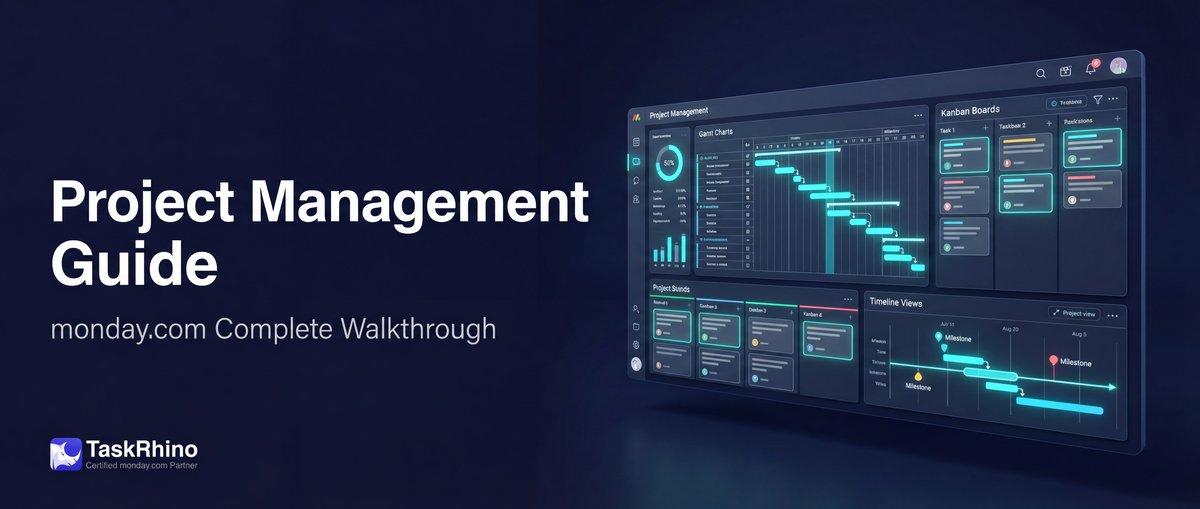
Master monday.com: A Guide to Boost Your Project Management Skills
Monday.com has become one of the most popular project management platforms for teams who want visual workflows, powerful automations, and flexibility that actually scales. Whether you’re managing software sprints, marketing campaigns, or client deliveries, monday.com gives you the building blocks to track work your way.
This guide walks you through everything you need to know to run effective project management on monday.com in 2026 — from initial setup to advanced automations, with real examples from teams who’ve made it work.
What Makes monday.com Different for Project Management
Monday.com isn’t a traditional project management tool with rigid workflows and prescribed methodologies. It’s a flexible Work OS that lets you build the exact system your team needs.
Core Capabilities
| Capability | What It Does | Best For |
|---|---|---|
| Visual Boards | Color-coded status tracking with customizable columns | Teams who need instant visibility |
| Multiple Views | Kanban, Gantt, Calendar, Timeline in one board | Different working styles on same project |
| Automations | Trigger-based rules that eliminate manual work | Reducing repetitive coordination tasks |
| Dashboards | Cross-board reporting and analytics | Portfolio-level visibility |
The platform’s strength is its adaptability — you’re not locked into someone else’s idea of how project management should work.
Who Uses monday.com for Project Management
monday.com serves teams across every industry, but it’s particularly popular with:
- Marketing teams running campaigns with multiple deliverables, approvals, and deadlines
- Software development teams tracking sprints, bugs, and releases
- Professional services firms managing client projects and billable hours
- Operations teams coordinating cross-functional initiatives
- Creative agencies handling client requests, design iterations, and production schedules
The common thread? Teams that need visibility, flexibility, and collaboration without drowning in spreadsheets or rigid software.
Setting Up Your First Project Board
Your project board is where all the work happens. Getting the structure right from the start saves hours of rework later.
Board Structure Basics
Every monday.com board has the same fundamental components:
| Component | Purpose | Example |
|---|---|---|
| Items | Individual tasks or work units | “Design homepage mockup” |
| Groups | Sections that organize related items | “Sprint 1”, “In Progress”, “Backlog” |
| Columns | Fields that track information about items | Status, Owner, Due Date, Priority |
Choosing the Right Column Types
Monday.com offers over 30 column types. Here are the ones that matter most for project management:
| Column Type | Use It For | Pro Tip |
|---|---|---|
| Status | Workflow stages (To Do → Done) | Use color coding for visual scanning |
| People | Task assignments | One owner per task prevents confusion |
| Timeline | Start and end dates with visual bars | Reveals overlaps and dependencies |
| Dropdown | Fixed choices (Priority, Category) | Keep options under 10 for usability |
TaskRhino Story #1: A healthcare client came to us with a sprawling project board containing 47 columns. Team members couldn’t find information, and the board took 10 seconds to load. We consolidated it to 12 essential columns using better column types (switching 5 text columns to dropdowns, merging 3 date columns into timelines). Board load time dropped to under 2 seconds, and the team actually started using it consistently.
Start minimal — you can always add columns later. Most effective project boards use 8-12 columns max.
Essential Views for Project Management
Views let you see the same data in different formats without duplicating information. Every project board should have these views configured:
| View Type | When to Use | Setup Time |
|---|---|---|
| Main Table | Daily task updates and details | Built-in (default) |
| Kanban | Sprint planning and workflow visualization | 2 minutes |
| Gantt/Timeline | Dependency mapping and schedule planning | 5 minutes |
| Calendar | Deadline tracking across the month | 2 minutes |
You can create multiple Kanban views grouped differently (by assignee, by priority, by sprint) — they all reference the same underlying data.
Project Planning: From Kickoff to Delivery
A solid project plan in monday.com answers five questions: What are we building? Who’s doing what? When is it due? What depends on what? How will we know we’re on track?
Creating Your Project Structure
Most project managers use one of two approaches:
Approach 1: Group by Phase “ Group: Discovery & Planning Group: Design Group: Development Group: Testing & QA Group: Launch “
Works well for waterfall projects with sequential phases.
Approach 2: Group by Sprint/Iteration “ Group: Sprint 1 (Jan 15-28) Group: Sprint 2 (Jan 29-Feb 11) Group: Sprint 3 (Feb 12-25) Group: Backlog “
Works well for agile teams running iterative cycles.
Task Breakdown: Getting Granular Without Going Crazy
Good task granularity means each item is:
- Completable in one sprint or less (ideally 2-5 days)
- Assignable to one person as the primary owner
- Independently trackable with its own status
Too granular? “Send follow-up email to John” (takes 10 minutes — not worth tracking). Too broad? “Build entire user authentication system” (weeks of work with multiple sub-components).
Timeline and Dependency Setup
Timeline columns show your project schedule visually. Here’s how to set them up effectively:
| Step | Action | Why It Matters |
|---|---|---|
| 1. Add Timeline column | Insert → Timeline | Shows task duration as horizontal bars |
| 2. Set dependencies | Click timeline bar → add dependency | Automatically adjusts dates when predecessors change |
| 3. Identify critical path | Look for longest chain of dependencies | Delays here affect entire project delivery |
Dependencies prevent your developer from starting before design is done, and prevent your QA team from testing before development finishes.
Pro tip: Use monday.com’s Timeline view (not just the Timeline column) for the best dependency management experience. You can drag timeline bars to adjust dates and click endpoints to create dependencies between tasks.
Managing Work: Daily Operations
Project plans are great — until reality hits and you need to actually manage the work. Here’s how to keep things moving without micromanaging.
Status Updates That Actually Get Done
Status updates fail when they require too much effort. Make them effortless:
| Update Type | How to Do It | Frequency |
|---|---|---|
| Task status | Click status label, select new stage | As work progresses (several times/day) |
| Item updates | Comment with @mentions | When something changes or questions arise |
| Progress photos | Drag image into Updates section | For visual/creative work |
Set up status automations to notify stakeholders when key milestones hit “Complete” — they get updates without asking for them.
Using Subitems for Task Breakdown
When a task has multiple distinct steps, use subitems instead of cluttering your main board:
Main Item: “Redesign checkout flow”
- Subitem: Create user flow diagram
- Subitem: Design mobile mockups
- Subitem: Design desktop mockups
- Subitem: Conduct usability testing
Subitems inherit the parent’s context but track independently. Roll up their status to the parent item so you see at a glance when all pieces are complete.
File Management Without Chaos
Every item can have files attached. Here’s the structure that works:
| File Type | Where to Attach | Naming Convention |
|---|---|---|
| Source files | Directly to item | descriptive-name-v1.fig |
| Deliverables | Item Files column | FINAL-homepage-design.png |
| Reference docs | Item Updates section | As links, not duplicates |
Never attach the same file to multiple items — use a Files column with links instead. One source of truth prevents version confusion.
Automations That Save Hours Every Week
Automations are where monday.com goes from “helpful” to “indispensable.” Every automation follows the same pattern: When [trigger] happens, then [action] occurs.
High-Impact Automations for Project Management
Here are the automations that deliver the most time savings:
| Automation | Trigger | Action | Time Saved |
|---|---|---|---|
| Status notifications | Status changes to “Complete” | Notify project manager | 30 min/week (eliminates check-ins) |
| Deadline reminders | Due date arrives in 2 days | Notify assignee | 45 min/week (prevents missed deadlines) |
| Cross-board sync | Item created in Requests board | Create linked item in Projects board | 1 hour/week (eliminates manual transfers) |
| Approval workflows | Status changes to “Ready for Review” | Notify reviewer + set due date | 1.5 hours/week (eliminates approval bottlenecks) |
Building Your First Automation
Click the “Integrate” button (top right of any board) → “Automations” → “Create Custom Automation”.
Example: Auto-assign when status changes “ When status changes to "In Progress" → Assign to Person column → And notify that person via email “
This prevents tasks from sitting in “In Progress” with no owner.
Advanced Automation Patterns
Once you master basic automations, these patterns unlock serious efficiency:
Pattern 1: Multi-step approvals “` When status changes to “Ready for Review” → Assign to Manager → Set Status to “Under Review” → Notify Manager via email
When status changes to “Approved” → Move item to Production board → Create item on Launch Checklist board → Notify Marketing team “`
Pattern 2: Time-based escalation “ When status is "Blocked" → And 2 days passed → Notify project manager → Set priority to "High" “
TaskRhino Story #2: We worked with a manufacturing client whose project delays were invisible until weekly status meetings. By implementing time-based escalation automations (any task in “Waiting” status for 48+ hours triggered a notification to both the assignee and their manager), they caught bottlenecks within days instead of weeks. On-time project delivery improved from 63% to 87% over three months.
Automation Quotas: Planning for Scale
Monday.com plans include monthly automation quotas:
| Plan | Actions/Month | What Happens When You Hit Limit |
|---|---|---|
| Basic | 250 | Automations pause until next month |
| Standard | 25,000 | Sufficient for most teams |
| Pro | 250,000 | Enterprise-level usage |
Each time an automation fires, it consumes one action. A notification automation on a board with 100 items updated daily consumes 3,000 actions per month (100 items × 30 days).
Monitor your automation usage in Settings → Billing → Usage to avoid surprises.
See How BoardBridge Handles This Workflow
Book a free demo to see BoardBridge solve this exact problem — live, with your data.
Resource Management and Workload Balancing
The best project plan fails if your team is overloaded or key people are double-booked. Monday.com gives you tools to see capacity before problems arise.
Workload View: Capacity Planning That Actually Works
The Workload view shows how many hours each team member has assigned across all their tasks.
| Setup Step | How To | What It Shows |
|---|---|---|
| 1. Add Numbers column | Name it “Estimated Hours” | Task-level effort estimates |
| 2. Enable Workload view | Add view → Workload | Visual bars showing capacity per person |
| 3. Set capacity limits | Click person → set weekly capacity | Red bars indicate overallocation |
A developer with 40-hour capacity who has 55 hours of tasks assigned shows up red — you can rebalance before they burn out.
Resource Allocation Strategies
When someone is overallocated:
- Defer non-critical tasks — Move lower-priority items to next sprint
- Redistribute — Reassign tasks to team members with capacity
- Extend timeline — Adjust due dates to realistic completion dates
- Add resources — Bring in additional team members (last resort — onboarding has costs)
Check the Workload view during sprint planning, not mid-sprint when it’s too late.
Cross-Project Resource Visibility
Use a dedicated Resource Management board to track allocation across multiple projects:
| Column | Purpose | Formula (if applicable) |
|---|---|---|
| Person | Team member name | — |
| Project A Hours | Hours allocated to Project A | Linked from Project A board |
| Project B Hours | Hours allocated to Project B | Linked from Project B board |
| Total Hours | Sum of all allocations | {Project A Hours} + {Project B Hours} |
This bird’s-eye view reveals when the same person is critical to three projects at once.
Dashboard and Reporting: Making Data Visible
Dashboards aggregate data from multiple boards into one view. Your project stakeholders shouldn’t need to hunt through 5 boards to understand status.
Building an Effective Project Dashboard
| Widget Type | What It Shows | Best Use |
|---|---|---|
| Chart widget | Progress over time, status distribution | Tracking sprint velocity, showing completion rates |
| Numbers widget | Key metrics (tasks complete, days remaining) | At-a-glance project health |
| Timeline widget | Gantt view across multiple boards | Portfolio-level schedule visibility |
| Workload widget | Team capacity and allocation | Resource management |
Dashboard best practice: Organize widgets by audience. Executives care about delivery dates and budget. Team leads care about blockers and workload. Design separate dashboard tabs for each audience.
Metrics That Matter for Project Success
Don’t track everything — track what drives decisions.
| Metric | Formula/Source | What It Tells You |
|---|---|---|
| Tasks completed this sprint | Count of items with status “Done” | Velocity (is team on pace?) |
| Overdue tasks | Count of items where Due Date < Today and Status ≠ "Done" | Risk indicator |
| Average task completion time | Timeline column data analysis | Process efficiency |
| Blocked items | Count of items with status “Blocked” | Bottleneck visibility |
Set up automated weekly reports that email these metrics to stakeholders. They stay informed without constant meetings.
Using Dashboards for Stakeholder Updates
Create a “Project Overview” dashboard with:
- Top section: Current sprint progress (chart + numbers)
- Middle section: Upcoming milestones (timeline widget filtered to next 30 days)
- Bottom section: Risks and blockers (board widget filtered to “Blocked” or “High Priority” items)
Share the dashboard link with stakeholders. They get real-time visibility without interrupting your team.
Advanced Project Management Techniques
Once your basic project workflow is humming, these advanced techniques take you to the next level.
Cross-Board Workflows and Integrations
Most projects span multiple boards. monday.com offers several ways to connect them:
| Connection Method | Use Case | Limitation |
|---|---|---|
| Mirror columns | Display data from connected items | Read-only (can’t edit mirrored data) |
| Cross-board automations | Create/update items on another board | Limited to same workspace |
| Integrations | Connect to external tools (Slack, Jira, etc.) | May consume integration quotas |
Example workflow: Client requests come into an “Intake” board. When approved, a cross-board automation creates a project item on your “Active Projects” board with all the request details pre-filled.
Managing Dependencies Across Boards
Dependencies usually live within a single board, but complex projects need cross-board dependencies.
Workaround: Use a Mirror column to display the linked item’s status:
- Connect boards via Connect Boards column
- Add Mirror column to show the linked item’s status
- Team members see when their dependency is complete
Not as elegant as true cross-board dependencies, but it works.
Template Boards for Repeatable Projects
If you run similar projects repeatedly (client onboarding, product launches, event planning), template boards are game-changers.
| Step | Action | Result |
|---|---|---|
| 1. Build master template | Create board with standard structure, columns, automations | Reusable project foundation |
| 2. Duplicate for each project | Board menu → Duplicate → Include structure + automations | New project ready in 2 minutes |
| 3. Update names/dates | Customize for this project’s specifics | Consistent process, unique details |
Your template should include group structure, essential columns, common automations, and default items (recurring tasks every project needs).
TaskRhino Story #3: A legal services firm was spending 2-3 hours setting up each new client matter board — copying columns, recreating automations, defining workflows. We built them a master template board with 17 standard columns, 12 automations, and 43 recurring checklist items. Now new matters launch in under 10 minutes with zero setup errors. Over a year, this saved their operations team approximately 180 hours.
Managing Multiple Projects: Portfolio View
When you’re juggling 5+ projects, the Portfolio view (available on Pro and Enterprise plans) gives you the bird’s-eye view.
Portfolio view aggregates multiple project boards into one consolidated timeline, showing:
- Which projects overlap
- Where resource conflicts exist
- Overall portfolio delivery schedule
This is essential for resource-constrained teams where the same people work across projects.
Common Project Management Challenges (and Solutions)
Every team hits these obstacles. Here’s how to work through them.
Challenge 1: Team Members Don’t Update Status
Symptoms: You’re constantly asking “What’s the status on X?” Tasks stuck in outdated states.
Solutions:
- Make it easier: Ensure status columns are visible and one-click to update
- Create accountability: Show each person a Kanban view filtered to “My Tasks” so they see their board daily
- Automate reminders: Set up “When Status hasn’t changed in 3 days, notify assignee”
- Lead by example: If leadership doesn’t update statuses, neither will the team
Challenge 2: Too Many Boards, Can’t Find Anything
Symptoms: Team creates new boards for everything. 50+ boards in the workspace. No one knows which board contains what.
Solutions:
- Naming convention: Use prefix structure (PROJECT-ClientName, TEMPLATE-ProcessName, ARCHIVE-OldProject)
- Workspace organization: Use folders to group related boards
- Sunset old boards: Archive boards older than 6 months that no one accesses
- Consolidate: If 3 boards track similar work, combine them into one board with Groups
Challenge 3: Notification Overload
Symptoms: Team members ignore notifications because they get 50 per day.
Solutions:
- Tune notification preferences: Settings → Notifications → customize what triggers notifications
- Use @mentions strategically: Don’t @mention someone unless they need to take action
- Batch updates: Use Updates section for multiple comments instead of separate notifications per item
- Disable low-value automations: If an automation’s notification isn’t driving action, turn it off
Challenge 4: Gantt Charts Don’t Reflect Reality
Symptoms: Timeline view shows green, but the project is actually behind.
Solutions:
- Update timelines weekly: Drag bars to reflect actual progress and revised estimates
- Use dependencies correctly: Ensure dependent tasks auto-adjust when predecessors slip
- Track actual vs. planned: Add a second Timeline column for “Actual Timeline” to compare
- Review in stand-ups: Make timeline updates part of daily or weekly team syncs
Need Help With Your monday.com Setup?
TaskRhino has implemented monday.com for 110+ teams. Get a free consultation.
Collaboration and Communication
Projects succeed or fail based on how well teams communicate. monday.com gives you tools to keep everyone on the same page.
Updates Section: Context Where You Need It
Every item has an Updates section — think of it as a comment thread attached to that task.
| Update Type | When to Use | Example |
|---|---|---|
| Status update | Communicate progress or completion | “Design review complete. Making final adjustments based on feedback.” |
| Question/blocker | Ask for help or flag an issue | “@Sarah — the API endpoint isn’t returning the user data we need. Can you check?” |
| Decision documentation | Record why you chose an approach | “Going with Option B because it’s faster to implement and meets 80% of requirements.” |
Use @mentions to notify specific people. Attachments, links, and even GIFs work in Updates.
Integration with Communication Tools
monday.com integrates with Slack, Microsoft Teams, and email to meet teams where they already work.
| Integration | Capability | Setup Difficulty |
|---|---|---|
| Slack | Get board notifications in Slack channels, create items from Slack | Easy (5 min) |
| Microsoft Teams | Embed boards in Teams tabs, notifications to channels | Easy (5 min) |
| Create items by emailing the board, get notifications via email | Built-in |
Pro tip: Create a dedicated Slack channel per project and connect that project’s board. Team conversations and status updates happen in one place.
Guest Access for External Collaborators
Need to involve clients, vendors, or contractors? monday.com supports guest users:
- Viewer guests: See boards but can’t edit (free)
- Member guests: Can edit assigned items (paid seat)
Use guest access to give clients visibility into their project without full workspace access.
Project Retrospectives: Learning from Each Project
The best teams don’t just finish projects — they learn from them. Build retrospectives into your monday.com workflow.
Creating a Retrospective Board
Set up a dedicated “Retrospectives” board with these columns:
| Column | Type | Purpose |
|---|---|---|
| Project Name | Text | Which project is this retro for? |
| What Went Well | Long Text | Successes to repeat |
| What Didn’t Work | Long Text | Problems to avoid next time |
| Action Items | Connect Boards | Link to improvement tasks |
After each project closes, create a retrospective item. Bring the team together for 30-60 minutes to fill it out.
Turning Insights into Action
Retrospectives are worthless if insights sit unused. Connect your retrospective items to actionable tasks:
- Identify top 3 improvement areas from “What Didn’t Work”
- Create improvement tasks on a “Process Improvements” board
- Assign owners and due dates — someone needs to implement the change
- Track completion — don’t let improvements linger forever
Great retrospectives change how you work. Bad retrospectives vent frustration without action.
Building a Knowledge Base
Over time, your retrospective board becomes an organizational knowledge base:
- “We tried weekly sprints with this client type — it didn’t work. Two-week sprints were better.”
- “External design reviews always add 3-5 days. Build that buffer into timelines.”
- “This developer is great at backend APIs but struggles with frontend work. Staff projects accordingly.”
Search past retrospectives before planning similar projects. You’ve already learned these lessons — use them.
Scaling monday.com for Enterprise Project Management
As your organization grows, project management gets more complex. monday.com scales, but you need to plan for it.
Governance and Standardization
Larger organizations need standards to prevent chaos:
| Governance Area | Standard to Set | Enforcement Method |
|---|---|---|
| Board naming | PREFIX-ProjectName-YYYYMM | Documented convention + training |
| Column types | Standard set of columns for all project boards | Template boards with locked structure |
| Status labels | Consistent workflow stages | Shared status templates |
| Automation patterns | Pre-approved automation recipes | Centralized automation library |
Without standards, you end up with 100 boards that all work slightly differently.
Role-Based Permissions
Control who can see and edit what using board permissions:
| Permission Level | Can Do | Use For |
|---|---|---|
| Viewer | See all, edit nothing | Executives, stakeholders |
| Member | Edit assigned items | Team members |
| Owner | Full control including board settings | Project managers |
Set permissions at the board level via Board menu → Settings → Permissions.
Multi-Workspace Strategy
Enterprise plans support multiple workspaces. Use them to separate:
- By department (Marketing workspace, Engineering workspace, Operations workspace)
- By security level (Public workspace, Confidential workspace)
- By business unit (Division A workspace, Division B workspace)
Workspaces are completely separate — no data sharing between them unless explicitly connected via integrations.
Audit Trails and Compliance
monday.com Enterprise includes activity logs that track:
- Who changed what, and when
- What was the old value vs. new value
- Which automations fired and why
Essential for regulated industries (finance, healthcare) where you need to prove compliance.
Integration Ecosystem: Connecting monday.com to Your Stack
monday.com doesn’t exist in isolation. Connect it to the tools your team already uses.
Native Integrations
Monday.com offers 200+ native integrations. Most popular for project management:
| Tool | Integration Capability | Use Case |
|---|---|---|
| Slack | Notifications, item creation | Team communication |
| Google Calendar | Two-way sync with Timeline columns | Schedule management |
| Jira | Bi-directional sync | Engineering teams using both tools |
| Zoom | Create meetings from items | Client calls and team syncs |
Install integrations from the Integrations Center (accessible via any board’s Integrate button).
Zapier and Make Integrations
For tools without native integrations, use Zapier or Make (formerly Integracly):
Example: Connect monday.com to your CRM
- Trigger: New deal closes in CRM
- Action: Create project board in monday.com with client details pre-filled
This eliminates manual data entry between systems.
API and Custom Development
monday.com provides a GraphQL API for custom integrations. Development teams can:
- Build internal tools that read/write monday.com data
- Create custom dashboards outside monday.com
- Automate complex workflows the UI doesn’t support
API documentation lives at developer.monday.com.
monday.com Pricing and Plan Selection for Project Management
Choosing the right plan affects what features you have access to — and what limitations you’ll hit.
Plan Comparison
| Feature | Basic | Standard | Enterprise |
|---|---|---|---|
| Boards | Unlimited | Unlimited | Unlimited |
| Timeline view | ✓ | ✓ | ✓ |
| Automations/month | 250 | 25,000 | 250,000 |
| Integrations/month | 250 | 25,000 | 250,000 |
Note: Table simplified for clarity. See monday.com pricing page for complete details.
Choosing Your Plan
Basic works for small teams (under 10 people) with simple workflows and light automation needs. You’ll hit the 250 automation quota quickly if you set up automations on active boards.
Standard is the sweet spot for most project teams. 25,000 actions per month supports dozens of boards with active automations. This plan includes time tracking, Gantt view, and calendar view.
Pro unlocks private boards, time tracking, formula columns, and dependency management. Essential for complex project environments.
Enterprise adds multi-workspace support, advanced permissions, audit logs, and enterprise-grade security. Required for large organizations or regulated industries.
Cost Optimization Tips
- Start with Standard, upgrade as needed: Don’t overpay for Enterprise features you won’t use immediately
- Monitor automation usage: One runaway automation can consume your monthly quota in days
- Use free viewers strategically: Stakeholders who only need visibility don’t require paid seats
- Annual billing discount: Paying annually saves 18% compared to monthly billing
Stop Creating Duplicates
BoardBridge forms update existing items — no Enterprise plan, no workarounds, no duplicates.
Frequently Asked Questions
How can I automate cross-board workflows when a status changes in monday.com CRM without manually creating tasks in work management?
You can leverage monday.com’s internal product integrations to automatically trigger actions across boards. For example, changing a status within the Monday CRM can seamlessly create onboarding tasks within work management through predefined integration flows. Set this up by accessing the Integrate button on your board, selecting the CRM-to-work management flow, and mapping your conditions to define which status changes trigger task creation.
What’s the best way to sync existing employee records with form submissions instead of creating duplicate items every time someone updates their information?
Use BoardBridge or similar form integration tools that allow you to update existing monday.com items rather than creating new ones. This approach is particularly useful for scenarios like annual benefits enrollment or emergency contact changes, where you want data flowing back to existing employee records instead of generating duplicate entries. Configure your form integration to match submissions against existing items using a unique identifier like employee ID.
How do I monitor integration usage across multiple boards to ensure my automations aren’t creating bottlenecks or redundant data syncs?
Navigate to the Integrations center and click on ‘Account Usage’ at the top right of the integration screen to track how integrations are being used across different boards. This feature helps you identify which integrations are active, how frequently they’re running, and whether they’re working as intended across your workspace.
Can I embed monday.com boards directly into Microsoft Teams and maintain two-way workflow updates without switching platforms?
Yes, the Microsoft Teams integration allows you to embed monday.com boards directly within MS Teams chats, enabling seamless workflow management and centralized communication. This keeps all team updates and project information accessible in one place, eliminating context switching while maintaining real-time collaboration between both platforms.
How should I set up Git integration with monday.com dev to automatically reflect code changes without manual status updates?
The GitHub integration in monday.com dev allows you to modify code (commits, pull requests, merges) directly from the platform, and all changes automatically sync back to your dev boards. This eliminates context switching between Git and project management tools while ensuring accurate data, enhanced collaboration, and faster approvals.
What’s the most efficient way to keep time tracking data synchronized with project timelines across multiple boards?
Integrate a time tracking tool like Everhour with monday.com to streamline work hour tracking and monitor productivity while keeping time management data aligned with your project timelines—all within the same platform. This integration allows teams to track actual effort against sprint progress and identify bottlenecks without switching between separate applications.
How do I use connected board data in monday.com automations when mirror columns aren’t directly accessible?
Mirror and connected board columns are read-only and unavailable for direct use in native automations or integrations. Create matching columns on the main board and use an automation on the connected board to push values over, or employ **BoardBridge** for seamless data bridging and automation compatibility across boards. For complex scenarios, integrate via Make.com to pull connected data via the monday.com API.
What are the steps to set up a two-way sync integration between monday.com and Google Calendar in 2026?
Access the Integrate button on your board to open the Automation Center, select Google Calendar, and configure parameters like triggers for assignments creating events with bidirectional updates. Map underlined parameters to specific columns for data syncing, and manage connections via the My Connections tab to reconnect or delete as needed. **BoardBridge** enhances this by providing advanced form-based updates that maintain sync integrity without duplicates.
How can I create cross-board automations to connect items between separate monday.com boards efficiently?
Use the ‘create item in board & connect boards’ template in the Board Automation Center, mapping columns like dates, people, or status for automatic connections based on matching values. Supported types include Item name, People, Date, Status, Numbers, and more; subitems transfer automatically. **BoardBridge** offers a robust solution for workflows requiring connected board info in automations where native limits apply.
Why can’t I directly map connected board mirror columns to email integrations, and what’s the best workaround?
Monday.com treats mirror and connected columns as read-only, excluding them from automation and integration mapping like emails. The most reliable native workaround is a bridge setup with matching columns populated via automations from the connected board. For superior handling, **BoardBridge** bridges this gap, enabling full use of connected data in automations and integrations without API complexity.
In 2026, how do integration blocks in the workflow builder expand monday.com’s cross-tool capabilities?
Workflow builder integration blocks connect external tools like GitHub, Slack, or Google Drive directly into board workflows for actions like syncing updates or embedding boards. Popular options include two-way GitLab syncs and Gmail-to-item conversions, accessible via the board’s Integrate menu. **BoardBridge** complements these by specializing in intra-monday.com board bridging for advanced project management automations.
How do I manage and track usage of multiple integrations across boards without exceeding limits on Professional plans?
In the Board Automation Center’s Manage tab, use My Connections to reconnect, edit, or delete integrations, and check the Usage tab for cross-board action tracking. Pro plans include about 250 integration actions monthly; monitor to avoid limits. **BoardBridge** optimizes this by streamlining connected workflows, reducing reliance on high-usage native integrations.


Editor's Choice
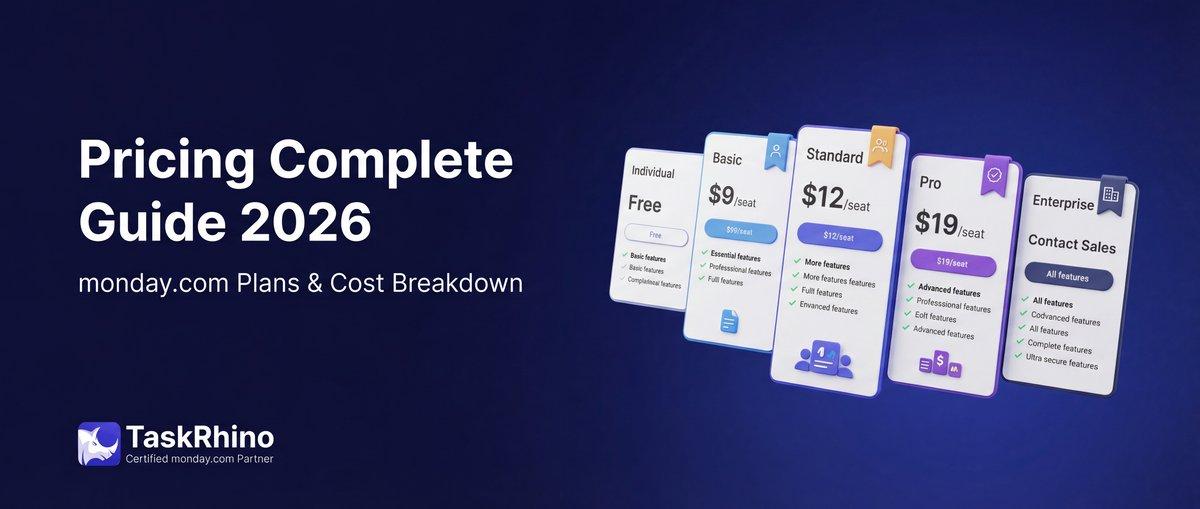
monday.com Pricing 2026: Complete Guide

Salesforce to Twenty Data Migration: Best Practices and Strategy
How to Self-Host Twenty CRM on AWS: Step-by-Step Guide