

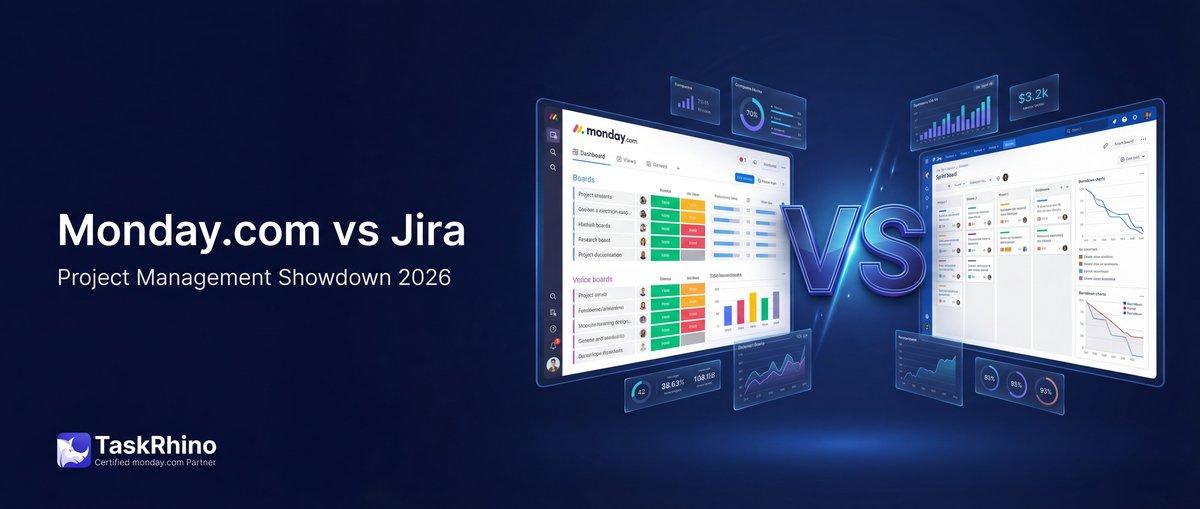
monday.com vs Jira [2026]: Which Tool Fits Your Team?
If your team writes code, start with Jira. If your team doesn’t write code, start with monday.com.
That’s the short version. But choosing between these two platforms isn’t quite that simple—especially when you’re evaluating them for a growing organization with both technical and business teams.
After helping 110+ teams implement monday.com and watching countless others wrestle with the Jira-versus-monday.com decision, we’ve learned this: most comparisons get it wrong by treating these as competing project management tools. They’re not. They’re fundamentally different products built for fundamentally different audiences.
Jira is a developer-first issue tracking and agile project management platform designed for software development teams. monday.com is a business-friendly Work OS designed for cross-departmental workflows, marketing teams, operations, sales, and non-technical project management.
Let’s dig into what that actually means for your team.
Quick Verdict: Who Wins?
Before we dive deep, here’s our honest assessment based on 110+ monday.com implementations and years of watching teams choose (and switch):
Choose Jira if:
- Your team writes code daily
- You run sprints, track story points, and need burndown charts
- You need native CI/CD integration with GitHub, GitLab, or Bitbucket
- Bug tracking and issue management are core to your workflow
- Your team already lives in the Atlassian ecosystem (Confluence, Bitbucket, Trello)
- You have 10+ developers who can handle Jira’s learning curve
Choose monday.com if:
- Your team is non-technical (marketing, operations, sales, HR)
- You need visual project management that anyone can use
- Cross-departmental collaboration is more important than agile ceremonies
- You want your team up and running in hours, not weeks
- You need flexible views (Kanban, Gantt, Timeline, Calendar, Workload, Chart)
- Ease of use matters more than developer-specific features
Use both if:
- You have development teams AND business teams
- You need Jira for engineering and monday.com for everything else
- You’re a mid-size or enterprise organization with diverse workflows
- You can afford to maintain two separate platforms (many companies do this)
Winner: Depends entirely on your team. Jira dominates software development. monday.com dominates business workflows. Neither is “better”—they solve different problems for different audiences.
Now let’s break down exactly why.
What Is Jira?
Jira is Atlassian’s issue tracking and agile project management platform, originally built for software development teams in 2002. Over 20+ years, it’s become the industry standard for bug tracking, sprint planning, and DevOps workflows.
Core strengths:
- Agile/Scrum features (sprints, story points, burndown charts, velocity tracking)
- Advanced issue tracking with custom workflows
- Deep integrations with development tools (GitHub, GitLab, Bitbucket, CI/CD pipelines)
- Powerful automation for development workflows
- Confluence integration for documentation
- Enterprise-grade permissions and governance
Who uses Jira:
- Software development teams
- DevOps and QA teams
- Product managers overseeing engineering work
- IT service management teams
- Agile/Scrum teams running formal sprint ceremonies
Jira comes in three main flavors: Jira Software (agile development), Jira Service Management (IT service desk), and Jira Work Management (business teams). When people compare “Jira vs monday.com,” they’re usually talking about Jira Software.
What Is monday.com?
monday.com is a cloud-based Work OS launched in 2012 (originally as daPulse), designed to help teams manage projects, workflows, and everyday work without requiring technical skills.
Core strengths:
- Visual, intuitive interface that non-technical teams love
- 8+ customizable views (Kanban, Gantt, Timeline, Calendar, Workload, Chart, Map)
- Sentence-builder automation that anyone can configure
- 200+ integrations with business tools
- Fast setup and onboarding (hours, not weeks)
- Flexible enough to handle CRM, project management, operations, marketing, and more
Who uses monday.com:
- Marketing teams managing campaigns and content calendars
- Operations teams running business processes
- Sales teams tracking deals and pipelines
- HR teams managing recruitment and onboarding
- Cross-functional teams collaborating on projects
- Non-technical teams who need powerful PM without the complexity
monday.com also has specialized products: monday work management (core platform), monday CRM, monday dev (for development teams), and monday service. Most business teams use monday work management.
For a deeper dive into monday.com’s capabilities, check out our guide: What is monday.com?
The Fundamental Difference: Developer Tool vs Business Tool
Here’s what most comparisons miss: Jira and monday.com were built with completely different philosophies.
Jira’s philosophy: Build a powerful, configurable system that developers can customize to match their exact agile workflows. Prioritize depth over ease of use. Assume users are technical and willing to learn complex features.
monday.com’s philosophy: Build an intuitive, visual platform that anyone can use within hours. Prioritize ease of use over technical depth. Assume users are non-technical and need instant productivity.
This philosophical difference shows up everywhere:
| Aspect | Jira | monday.com |
|---|---|---|
| Primary Audience | Software developers | Business teams |
| Design Philosophy | Power and configurability | Simplicity and visual clarity |
| Learning Curve | Steep (weeks to master) | Gentle (hours to productive) |
| Setup Time | Days to weeks | Hours |
| Ideal User | Technical, agile-trained | Non-technical, diverse roles |
| Workflow Type | Agile/Scrum development | Business processes, projects |
Neither approach is “better.” They’re optimized for different users with different needs.
Who Should Use Jira?
Jira wins decisively for these teams:
Software development teams If your daily work involves writing code, managing sprints, tracking bugs, and shipping software, Jira is built for you. It’s the industry standard for a reason.
Agile/Scrum teams with formal ceremonies Running daily standups, sprint planning, retrospectives, and tracking velocity? Jira has best-in-class support for every agile ceremony. Story points, burndown charts, velocity tracking, epic management, release planning—it’s all native.
DevOps and QA teams Jira integrates natively with the entire development ecosystem: GitHub, GitLab, Bitbucket, Jenkins, CircleCI, and every major CI/CD tool. You can link commits, pull requests, and deployments directly to issues. monday.com can’t compete here.
Teams already using Atlassian tools If you’re already using Confluence for documentation, Bitbucket for code, or Trello for simple boards, Jira fits seamlessly into your existing workflow.
Large engineering organizations Jira’s advanced permissions, cross-project dependencies, portfolio management (Jira Align), and enterprise governance features make it ideal for large-scale software organizations.
Who Should Use monday.com?
monday.com wins decisively for these teams:
Marketing teams Campaign planning, content calendars, creative workflows, event management—monday.com’s visual interface and flexible views make it perfect for marketing operations. Jira feels like overkill (and it is).
Operations and business process teams If you’re managing business workflows, vendor relationships, procurement, or operational processes, monday.com’s flexibility and ease of use win. You don’t need sprints and story points—you need clear task ownership and status tracking.
Cross-departmental collaboration When marketing, sales, operations, and leadership need to collaborate on initiatives, monday.com’s intuitive interface means everyone can participate. Jira requires training that non-technical teams resist.
Sales and customer success teams CRM workflows, deal tracking, customer onboarding, renewal management—monday.com’s visual pipeline views and customizable boards work perfectly. Jira’s issue-tracking paradigm doesn’t fit sales workflows naturally.
Teams that value speed and ease of use If you need your team productive today—not next month after extensive training—monday.com’s gentle learning curve wins. We’ve seen teams build working workflows in their first hour.
Non-technical teams who need powerful features monday.com gives you powerful automation, integrations, reporting, and customization without requiring technical skills. The sentence-builder automation interface means anyone can automate workflows.
Pricing Comparison: Jira vs monday.com
Both platforms offer free plans, but with very different limitations. Here’s the breakdown:
Jira Pricing (2026)
| Plan | Price | Users | Key Features |
|---|---|---|---|
| Free | $0 | Up to 10 users | 2GB storage, 100 automation rules/month, community support |
| Standard | $7.91/user/month | Up to 35,000 users | 250GB storage, 1,700 automation rules/month, business hours support |
| Premium | $14.54/user/month | Up to 35,000 users | Unlimited storage, 1,000 automation rules/user/month, 24/7 premium support, advanced roadmaps |
| Enterprise | Custom pricing | Unlimited | Unlimited automation, enterprise security, dedicated support, 99.95% SLA |
Prices based on annual billing. Monthly billing available at higher cost.
monday.com Pricing (2026)
| Plan | Price | Users | Key Features |
|---|---|---|---|
| Free | $0 | Up to 2 users | Up to 3 boards, 200+ templates, iOS/Android apps |
| Basic | $9/user/month | 3+ users | Unlimited boards, unlimited items, 5GB storage, prioritized support |
| Standard | $12/user/month | 3+ users | Timeline/Gantt views, calendar view, 250 automations/month, 250 integrations/month |
| Pro | $19/user/month | 3+ users | Private boards, time tracking, formula column, 25,000 automations/month, 25,000 integrations/month |
| Enterprise | Custom pricing | Custom | Advanced automations (250K/month), enterprise security, multi-level permissions, advanced analytics |
Prices based on annual billing (18% discount). Monthly billing available.
Free Plan Showdown
Winner: Jira
Jira’s free plan supports 10 users—a massive advantage for small teams or startups. monday.com’s free plan caps at 2 users, making it essentially a personal productivity tool rather than a team solution.
| Feature | Jira Free | monday.com Free |
|---|---|---|
| Max Users | 10 | 2 |
| Storage | 2GB | Included in boards |
| Boards/Projects | Unlimited | 3 |
| Automation | 100 rules/month | No |
| Integrations | Yes (limited) | No |
| Support | Community | Community |
For small development teams (3-10 people), Jira’s free plan is genuinely usable. monday.com’s free plan is too limited for team collaboration.
Paid Plan Value
Winner: Depends on team size and needs
For small teams (3-10 users):
- Jira Standard ($7.91/user/month) is cheaper than monday.com Basic ($9/user/month)
- But Jira requires more setup time and training
For mid-size teams (10-50 users):
- Costs are comparable
- Choose based on features needed, not price
For large teams (50+ users):
- Both offer volume discounts at Enterprise level
- Jira Premium ($14.54/user) vs monday.com Pro ($19/user) for advanced features
Key insight: Jira is more cost-effective at the entry level, but monday.com’s broader feature set in Standard and Pro plans may justify the higher cost for business teams.
Agile & Scrum Features: Jira Dominates
If you’re running agile/scrum workflows, there’s no contest. Jira was built for this.
Agile Feature Comparison
| Feature | Jira | monday.com |
|---|---|---|
| Scrum boards | Yes | Limited (monday dev only) |
| Kanban boards | Yes | Yes |
| Sprint planning | Yes | Basic (monday dev only) |
| Story points | Yes | No (custom fields only) |
| Burndown charts | Yes | No |
| Velocity tracking | Yes | No |
| Epic management | Yes | Limited |
| Release management | Yes | No |
| Backlog prioritization | Yes | Basic |
| Agile reporting | Yes (extensive) | No |
Winner: Jira (by a landslide)
Sprint Management
Jira’s sprint features:
- Dedicated sprint planning interface
- Drag-and-drop backlog prioritization
- Sprint capacity planning based on velocity
- Built-in story point estimation
- Burndown and burnup charts
- Velocity reports across sprints
- Sprint retrospective tools
- Release tracking and version management
monday.com’s sprint features:
- Basic sprint board (in monday dev product)
- Manual sprint tracking using custom fields
- No native burndown charts
- No velocity tracking
- Limited agile reporting
If your team runs formal sprints with sprint planning, daily standups, retrospectives, and sprint reviews, Jira provides everything you need out of the box. monday.com requires significant workarounds and custom fields to approximate basic agile workflows.
Issue Tracking
Winner: Jira
Jira is the industry standard for bug tracking and issue management.
| Capability | Jira | monday.com |
|---|---|---|
| Issue types | Customizable (bug, story, task, epic, etc.) | Generic items with custom labels |
| Issue linking | Yes (blocks, relates to, duplicates, etc.) | Basic item dependencies |
| Advanced workflows | Yes (custom states, transitions, validators) | Basic status columns |
| Version tracking | Yes (affects version, fix version) | No |
| Component tracking | Yes | No |
| Issue cloning | Yes | Yes (duplicate item) |
| Bulk issue operations | Yes (extensive) | Limited |
| Issue hierarchy | Yes (epic > story > subtask) | Basic subitems |
For software teams tracking bugs, feature requests, and technical debt, Jira’s issue-tracking capabilities are unmatched. monday.com can track tasks and items, but it lacks the specialized features developers expect.
See How BoardBridge Handles This Workflow
Book a free demo to see BoardBridge solve this exact problem — live, with your data.
Project Management Views: monday.com Wins for Variety
While Jira focuses on agile boards, monday.com offers 8+ different view types optimized for different workflows.
View Comparison
| View Type | Jira | monday.com |
|---|---|---|
| Kanban board | Yes | Yes |
| List/table | Yes | Yes |
| Timeline (Gantt) | Yes (Premium+) | Yes (Standard+) |
| Calendar | Yes | Yes (Standard+) |
| Workload | No | Yes (Pro+) |
| Chart | Limited | Yes (Pro+) |
| Map | No | Yes |
| Form | No | Yes |
Winner: monday.com
monday.com’s view variety makes it more versatile for business workflows:
Timeline/Gantt view: Perfect for project managers tracking dependencies and deadlines. monday.com’s implementation is more visual and intuitive than Jira’s timeline view.
Workload view: See team capacity and resource allocation at a glance. Jira doesn’t have a native workload view (requires third-party apps or Jira Align).
Calendar view: Visualize deadlines and events in calendar format. Both platforms offer this, but monday.com’s calendar is more flexible.
Chart view: Create custom charts and graphs directly from board data. Jira’s reporting is more agile-focused; monday.com’s is more flexible for business reporting.
Map view: Visualize items with location data on a map. Useful for field teams, event planning, or location-based workflows. Jira doesn’t offer this.
Form view: Collect structured data via forms that create board items. Great for intake requests, event registrations, or customer submissions. Jira has basic forms, but monday.com’s are more robust.
For business teams that need to visualize work in multiple ways, monday.com’s view flexibility is a major advantage. Development teams typically only need board and list views, making Jira’s simpler approach sufficient.
Automation: Different Approaches, Different Strengths
Both platforms offer powerful automation, but with very different philosophies.
Automation Comparison
| Aspect | Jira | monday.com |
|---|---|---|
| Automation interface | Rule-based with triggers/conditions/actions | Sentence builder (visual) |
| Ease of use | Requires technical understanding | Anyone can configure |
| Depth | Very powerful for dev workflows | Powerful for business workflows |
| Pre-built rules | Yes (agile-focused) | Yes (business-focused) |
| Custom automation | Yes (complex rules possible) | Yes (limited complexity) |
| Integration automation | Yes (extensive) | Yes (extensive) |
| Monthly limits (Free) | 100 rules | 0 |
| Monthly limits (Standard) | 1,700 rules | 250 actions |
| Monthly limits (Premium/Pro) | 1,000/user | 25,000 actions |
Winner: Tie (different use cases)
Jira automation excels at:
- Development-specific workflows (auto-transitioning issues based on PR status)
- Complex conditional logic with multiple branches
- Integration with dev tools (GitHub, Bitbucket, CI/CD)
- Agile ceremony automation (auto-closing sprints, moving to backlog)
monday.com automation excels at:
- Business workflow automation (notifications, status changes, assignments)
- Time-based automation (recurring tasks, deadline reminders)
- Cross-board automation (creating items in multiple boards)
- Approvals and handoffs between departments
- Ease of configuration for non-technical users
Example: Auto-assigning based on status change
Jira automation: “ WHEN: Issue transitions to "In Review" IF: Assignee = empty THEN: Assign to Project Lead “
monday.com automation: “ When status changes to "Ready for Review" Assign to John (Project Lead) “
Both accomplish the same goal. Jira’s approach is more technical and powerful. monday.com’s approach is more intuitive and visual.
Integrations: Jira’s Ecosystem vs monday.com’s Flexibility
Integration Comparison
| Platform | Number of Integrations | Key Strengths |
|---|---|---|
| Jira | 3,000+ marketplace apps | Atlassian ecosystem, dev tools, deep technical integrations |
| monday.com | 200+ native integrations | Business tools, automation-focused, bidirectional sync |
Winner: Jira (for breadth), monday.com (for ease of use)
Jira’s Integration Strengths
Atlassian ecosystem:
- Confluence (documentation)
- Bitbucket (code repository)
- Trello (simple kanban boards)
- Opsgenie (incident management)
- Statuspage (status communication)
Development tools:
- GitHub, GitLab, Azure DevOps (code repositories)
- Jenkins, CircleCI, Travis CI (CI/CD)
- Slack, Microsoft Teams (communication)
- Figma, Zeplin (design handoff)
3,000+ marketplace apps covering everything from test management to time tracking to advanced reporting.
monday.com’s Integration Strengths
Business tools:
- Gmail, Outlook (email)
- Slack, Microsoft Teams (communication)
- Zoom, Google Meet (video conferencing)
- Salesforce, HubSpot (CRM)
- Google Drive, Dropbox (file storage)
- Mailchimp, ActiveCampaign (email marketing)
Automation platforms:
- Zapier (5,000+ app connections)
- Make (advanced workflow automation)
- Integromat (complex integrations)
Key advantage: monday.com’s integrations are designed for non-technical users. Setting up a Slack notification or Gmail sync takes minutes, not hours.
CI/CD Integration
Winner: Jira (not even close)
If your team needs tight integration with development tools and CI/CD pipelines, Jira is the only real option.
| CI/CD Feature | Jira | monday.com |
|---|---|---|
| GitHub integration | Yes (native, deep) | Yes (basic) |
| GitLab integration | Yes (native) | Via Zapier |
| Bitbucket integration | Yes (native, Atlassian) | No |
| Link commits to issues | Yes | No |
| Link PRs to issues | Yes | No |
| Deployment tracking | Yes | No |
| Build status in issues | Yes | No |
For software teams running CI/CD pipelines, Jira’s native integrations with GitHub, GitLab, and Bitbucket are game-changers. You can see commit history, pull request status, and deployment tracking directly in your issues. monday.com can’t compete here.
Reporting & Dashboards
Both platforms offer reporting, but optimized for different audiences.
Reporting Comparison
| Feature | Jira | monday.com |
|---|---|---|
| Agile reports | Yes (extensive) | No |
| Custom dashboards | Yes | Yes |
| Pre-built widgets | Limited | 50+ widgets |
| Visual charts | Basic | Excellent |
| Burndown charts | Yes | No |
| Velocity reports | Yes | No |
| Custom formulas | Limited | Yes (Pro+) |
| Portfolio reports | Yes (Premium+) | Yes (Enterprise) |
| Time tracking reports | Yes (with apps) | Yes (Pro+) |
| Export options | Yes | Yes |
Winner: Jira for agile teams, monday.com for business teams
Jira’s Reporting Strengths
Jira excels at agile-specific reporting:
- Burndown charts: Track sprint progress against ideal completion
- Velocity charts: Measure team throughput over time
- Sprint reports: Detailed sprint completion metrics
- Cumulative flow diagrams: Identify bottlenecks in workflow
- Control charts: Track cycle time and lead time
- Version reports: Track release progress
If you’re running sprints and need agile metrics, Jira provides everything out of the box.
monday.com’s Reporting Strengths
monday.com excels at visual business dashboards:
- 50+ widget types: Battery, chart, timeline, numbers, status tracking
- Custom dashboards: Combine data from multiple boards
- Easy to build: Drag-and-drop interface, no technical skills required
- Beautiful visuals: Designed for stakeholder presentations
- Real-time updates: Dashboards update automatically
monday.com dashboards are easier to create and more visually appealing than Jira’s. Perfect for executive reporting, team status updates, and business metrics.
Learning Curve & Ease of Use
This is where monday.com pulls ahead decisively—unless your team is already technical.
Learning Curve Comparison
| Aspect | Jira | monday.com |
|---|---|---|
| Time to first productive use | Days to weeks | Hours |
| Training required | Extensive (formal training recommended) | Minimal (intuitive interface) |
| Admin complexity | High (requires technical knowledge) | Low (visual configuration) |
| User adoption resistance | High (non-technical users struggle) | Low (users enjoy interface) |
| Customization learning curve | Steep (workflows, schemes, permissions) | Gentle (visual builders) |
| Documentation needed | Extensive | Minimal |
Winner: monday.com (unless your team is already developers)
Why Jira Has a Steeper Learning Curve
Complex terminology: Issues, epics, stories, subtasks, components, versions, schemes, workflows, transitions, post-functions, validators… Jira’s vocabulary requires training.
Advanced configuration: Setting up custom workflows, issue types, and permissions requires understanding Jira’s architecture. Non-technical admins struggle.
Agile-specific concepts: If your team isn’t already trained in Scrum/Kanban, Jira’s agile features add another layer of complexity.
Power user features: Jira’s JQL (Jira Query Language) is powerful but requires learning a query syntax. monday.com’s filtering is visual and intuitive.
Why monday.com Is Easier
Visual interface: Everything is visual, colorful, and intuitive. Users understand status columns, timelines, and calendars without training.
Sentence-builder automation: “When status changes to Done, notify John” is easier to configure than Jira’s rule builders.
Faster onboarding: We’ve seen non-technical teams build working workflows in their first hour with monday.com. Jira takes days or weeks.
Less jargon: Items, boards, status, updates—monday.com’s terminology is business-friendly.
Better support for non-technical users: monday.com is designed for marketers, operations teams, and other non-technical roles. Jira assumes technical literacy.
When to Use Both: The Dual-Platform Strategy
Here’s a secret many organizations discover: you don’t have to choose one.
Hundreds of companies run Jira for development and monday.com for business teams. This dual-platform approach gives you the best of both worlds.
Typical Dual-Platform Setup
Jira for:
- Engineering/development team
- Product management
- DevOps and QA
- Technical issue tracking
- Sprint planning and agile workflows
monday.com for:
- Marketing campaigns and content calendars
- Sales pipeline and CRM
- Operations and business processes
- HR and recruiting
- Executive dashboards and cross-departmental initiatives
Integration Between Platforms
You can connect Jira and monday.com via:
- Zapier: Automate workflows between platforms
- monday.com’s Jira integration: Sync items and issues bidirectionally
- Custom API integrations: For advanced use cases
Common integration pattern:
- Development work lives in Jira
- Business stakeholders track high-level initiatives in monday.com
- When business requests require development work, monday.com items automatically create Jira issues
- When Jira issues are completed, monday.com items update automatically
This gives engineering teams the power tools they need while giving business teams the accessible interface they prefer.
Cost Considerations
Running both platforms costs more than choosing one, but for mid-size and enterprise organizations, the productivity gains often justify the cost:
- Jira: Development team (10-50 users) at $7.91-$14.54/user
- monday.com: Business teams (20-100 users) at $12-$19/user
For a company with 20 developers and 50 business users:
- Jira cost: ~$3,180-$5,820/year
- monday.com cost: ~$7,200-$11,400/year
- Total: ~$10,380-$17,220/year
Compared to the cost of low productivity from using the wrong tool, this is often worthwhile.
Need Help With Your monday.com Setup?
TaskRhino has implemented monday.com for 110+ teams. Get a free consultation.
Pros and Cons Summary
Jira Pros
✅ Industry standard for software development Jira is the default choice for dev teams. Mature, battle-tested, and trusted by thousands of engineering organizations.
✅ Best-in-class agile features Sprint planning, story points, burndown charts, velocity tracking, release management—everything agile teams need.
✅ Powerful issue tracking Advanced workflows, issue linking, custom issue types, version tracking, component management.
✅ Deep dev tool integration Native integration with GitHub, GitLab, Bitbucket, CI/CD pipelines, and 3,000+ marketplace apps.
✅ Generous free plan 10 free users make it viable for small development teams and startups.
✅ Enterprise-grade security and governance Advanced permissions, audit logs, compliance features for large organizations.
Jira Cons
❌ Steep learning curve Requires extensive training, especially for non-technical users. Expect weeks to full productivity.
❌ Complexity overkill for non-technical teams Marketing, operations, and sales teams struggle with Jira’s developer-focused interface.
❌ Limited view variety Primarily board and list views. No workload view, limited timeline/Gantt, no map view.
❌ Expensive at scale Premium plan ($14.54/user) required for advanced features like unlimited storage and cross-project roadmaps.
❌ Slow setup Configuring Jira for your workflow takes days or weeks. Requires technical admin knowledge.
❌ Poor fit for business workflows CRM, marketing campaigns, event planning, HR processes—Jira’s issue-tracking paradigm doesn’t fit naturally.
monday.com Pros
✅ Intuitive, visual interface Non-technical users love monday.com. Beautiful design, easy to understand, minimal training required.
✅ Fast setup and onboarding Build working workflows in hours, not weeks. Get your team productive immediately.
✅ 8+ flexible views Kanban, Gantt, Timeline, Calendar, Workload, Chart, Map, Form—visualize work the way your team thinks.
✅ Versatile for any workflow CRM, project management, marketing, operations, HR, sales—monday.com adapts to any business process.
✅ Easy automation for non-technical users Sentence-builder interface makes automation accessible to everyone.
✅ Beautiful dashboards 50+ widget types create stunning visual reports for stakeholders and executives.
✅ Strong mobile apps iOS and Android apps let teams stay productive on the go.
monday.com Cons
❌ Limited free plan Only 2 users on free plan makes it essentially a personal tool, not viable for teams.
❌ Weak agile features No native burndown charts, velocity tracking, or release management. Not built for formal Scrum teams.
❌ No native CI/CD integration Can’t compete with Jira for development workflows requiring GitHub/GitLab integration.
❌ Fewer integrations than Jira 200+ integrations vs Jira’s 3,000+. Limited options for specialized technical tools.
❌ Higher per-user cost at entry level Basic plan starts at $9/user vs Jira Standard at $7.91/user.
❌ Automation limits on lower plans Only 250 automation actions/month on Standard plan can be limiting for power users.
Critical Gaps: What Neither Tool Solves
Here’s where we need to be honest: neither Jira nor monday.com solves everything.
Both platforms have limitations that our clients run into regularly:
Form Limitations
monday.com forms can’t update existing items—they only create new items. This is a massive gap for:
- Event registration updates
- Customer information changes
- Recurring check-ins or surveys
- Status update requests from external stakeholders
Jira forms (via Jira Service Management) are similarly limited to creating new issues, not updating existing ones.
Solution: BoardBridge fills this gap for monday.com users by enabling forms to update existing items, including conditional logic and multi-board updates.
Cross-Board Workflow Gaps
Both platforms struggle with complex workflows that span multiple boards:
- Creating items in multiple boards simultaneously
- Updating related items across boards based on form submissions
- Cross-board dependencies that non-technical teams can manage
monday.com requires automations or integrations for cross-board workflows, which hit action limits quickly.
Jira handles cross-project work better but requires technical configuration.
Email Integration Gaps
Neither platform natively supports email CC/BCC for notifications:
- Can’t CC external stakeholders on item updates
- Can’t automatically send formatted emails with item details
- Limited email customization for client-facing communications
This is particularly painful for client-facing workflows, sales processes, and external collaboration.
Where TaskRhino’s Experience Helps
As a certified monday.com partner with 110+ implementations, we’ve helped teams work around these limitations through:
- Custom automation strategies
- Third-party integration solutions
- BoardBridge for form update and cross-board workflow needs
- Workflow redesign to leverage each platform’s strengths
If your team is hitting these limitations, reach out to us—we’ve likely solved your exact problem before.
Industry-Specific Recommendations
Different industries have different needs. Here’s where each platform excels:
Software Development & Technology
Winner: Jira
Use Jira for:
- Product development teams
- SaaS companies
- App development agencies
- DevOps organizations
- QA and testing teams
Jira’s agile features, dev tool integration, and issue tracking make it the obvious choice for software-focused companies.
Marketing Agencies & Teams
Winner: monday.com
Use monday.com for:
- Marketing agencies managing client campaigns
- In-house marketing teams
- Content production workflows
- Social media management
- Event planning
monday.com’s visual interface, content calendar views, and collaborative features fit marketing workflows perfectly.
Professional Services & Consulting
Winner: monday.com
Use monday.com for:
- Consulting firms managing client projects
- Accounting and legal services
- Architecture and engineering firms
- Creative agencies
Client-facing work requires clear visibility, beautiful reporting, and easy collaboration. monday.com delivers all three.
Manufacturing & Operations
Winner: monday.com
Use monday.com for:
- Production scheduling
- Inventory management
- Quality control workflows
- Vendor management
- Supply chain coordination
monday.com’s flexibility and visual boards work well for operational processes that don’t fit traditional project management molds.
IT Service Management
Winner: Jira Service Management
Use Jira for:
- IT help desk
- Internal service requests
- Incident management
- Change management
- ITIL processes
Jira Service Management (formerly Jira Service Desk) is purpose-built for IT service workflows.
Cross-Functional Organizations
Winner: Both (dual-platform strategy)
Use both when:
- You have both technical and business teams
- Engineering uses Jira while other departments use monday.com
- You need specialized tools for different workflows
- Budget allows for both platforms
Many mid-size and enterprise companies successfully run both platforms, integrating them via Zapier or native connectors.
Migration: Switching Between Platforms
Thinking about switching from Jira to monday.com (or vice versa)? Here’s what to expect.
Migrating from Jira to monday.com
Common reasons to switch:
- Team is non-technical and struggling with Jira’s complexity
- Need more flexible views for business workflows
- Want faster onboarding for new team members
- Expanding beyond software development to broader business use
Migration challenges:
- Losing agile-specific features (burndown charts, velocity tracking)
- Retraining team on new interface (though monday.com is easier to learn)
- Recreating custom workflows and automations
- Losing deep dev tool integrations
Migration process:
- Export Jira issues to CSV
- Import to monday.com boards
- Rebuild automations using monday.com’s sentence builder
- Set up new integrations
- Train team on monday.com interface (faster than initial Jira training)
Timeline: 1-2 weeks for small teams, 4-8 weeks for complex workflows.
Migrating from monday.com to Jira
Common reasons to switch:
- Team has grown more technical and needs agile features
- Expanding into software development
- Need deeper dev tool integration (GitHub, CI/CD)
- Want more powerful automation for technical workflows
Migration challenges:
- Steeper learning curve for Jira
- Losing monday.com’s visual simplicity
- Retraining non-technical users (significant resistance expected)
- Losing view variety (workload, chart, map views)
Migration process:
- Export monday.com boards to CSV
- Import to Jira as issues
- Configure Jira workflows to match your processes
- Set up Jira automation rules
- Extensive team training on Jira (weeks, not days)
Timeline: 4-8 weeks for small teams, 3-6 months for complex workflows with extensive training needs.
Our Recommendation: Don’t Migrate—Add
Instead of migrating from one platform to the other, consider:
- Keep Jira for development if that’s where it’s working
- Add monday.com for business teams that struggle with Jira
- Integrate the two via Zapier or native connectors
- Let each team use the tool that fits their workflow
This dual-platform approach costs more but eliminates the pain and productivity loss of migration.
Stop Creating Duplicates
BoardBridge forms update existing items — no Enterprise plan, no workarounds, no duplicates.
Frequently Asked Questions
Which is better for agile project management, Jira or monday.com?
Jira is significantly better for formal agile/Scrum teams. It has native support for sprints, story points, burndown charts, velocity tracking, epic management, and release planning—all essential for agile workflows. monday.com has basic sprint features in their monday dev product, but it lacks the depth that serious agile teams need. If your team runs daily standups, sprint planning, and retrospectives, choose Jira. If you just want a kanban board for visual task tracking, monday.com works fine.
Can monday.com replace Jira for software development teams?
Not for serious software development work. While monday.com offers a “monday dev” product with basic development features, it lacks the deep CI/CD integration, advanced issue tracking, and agile reporting that development teams rely on. monday.com can’t link commits and pull requests to issues, doesn’t have native GitHub/GitLab integration, and has no burndown or velocity tracking. For actual software development, Jira remains the industry standard. monday.com is better for product roadmapping, design workflows, or coordinating between development and business teams.
Is Jira too complicated for non-technical teams?
Yes, usually. Jira’s steep learning curve, developer-focused terminology (issues, epics, stories, workflows, transitions), and complex configuration make it a poor fit for marketing, operations, sales, and other non-technical teams. We regularly see companies where business teams reluctantly use Jira because “that’s what we have,” but productivity and user satisfaction suffer. Non-technical teams are much more productive with monday.com’s intuitive interface. If your team doesn’t write code, Jira is likely overkill.
Which platform has better automation, Jira or monday.com?
Both have powerful automation, but for different audiences. Jira’s automation is more powerful for technical workflows—it can handle complex conditional logic, integrate deeply with development tools, and automate agile ceremonies. But it requires technical understanding to configure. monday.com’s sentence-builder automation (“When status changes to X, do Y”) is easier for non-technical users to set up and understand. For business workflows, monday.com’s automation is sufficient and more accessible. For development workflows, Jira’s automation is more powerful.
Can you integrate Jira with monday.com?
Yes, via multiple methods. monday.com offers a native Jira integration that syncs items and issues bidirectionally. You can also use Zapier or Make to create custom workflows between the platforms. Common integration pattern: business teams track initiatives in monday.com, and when development work is needed, monday.com items automatically create Jira issues. When Jira issues are completed, monday.com items update automatically. This dual-platform approach works well for organizations with both technical and business teams.
Which platform is better for small teams or startups?
Jira wins for small development teams (3-10 people) because the free plan supports 10 users and includes core agile features. Small dev teams can run on Jira free indefinitely. monday.com wins for small business teams because it’s faster to set up and easier to use, despite the 2-user free plan limitation. For a 5-person startup, Jira Standard ($7.91/user = ~$40/month) is cheaper than monday.com Basic ($9/user = ~$45/month). But monday.com’s faster onboarding and easier learning curve may justify the extra $5/month for non-technical teams.
Does monday.com support Scrum methodology?
Only at a basic level. monday.com’s “monday dev” product includes sprint boards and basic sprint planning, but it lacks native burndown charts, velocity tracking, story point estimation, and other Scrum essentials. You can use custom fields and manual tracking to approximate Scrum workflows, but it requires significant workarounds. If your team is serious about Scrum methodology with formal ceremonies and agile reporting, Jira is the better choice. If you just want a visual board for task tracking without formal Scrum, monday.com works fine.
Which platform has better reporting and dashboards?
Jira has better agile reporting—burndown charts, velocity reports, sprint reports, cumulative flow diagrams, and control charts are all native. If you need agile metrics, Jira wins. monday.com has better business dashboards—50+ widget types, visual charts, customizable layouts, and easier configuration make it superior for executive reporting and stakeholder presentations. monday.com dashboards are also easier to create (drag-and-drop vs Jira’s configuration). For business reporting and visual dashboards, monday.com wins. For agile metrics, Jira wins.
What are the main security differences between Jira and monday.com?
Both platforms offer enterprise-grade security with SOC 2 Type II certification, ISO 27001 compliance, GDPR compliance, and SSO support. Jira includes more advanced security features in the base Premium plan (IP allowlisting, data residency options, advanced audit logs), while monday.com gates some security features to Enterprise tier. Jira’s Enterprise plan includes Atlassian Guard with advanced security controls. Both platforms are secure enough for most organizations, but Jira’s security features are more comprehensive at lower price tiers.
Can monday.com handle portfolio management like Jira?
Yes, but differently. Jira offers Jira Align (formerly Jira Portfolio) for enterprise portfolio management across multiple teams and projects—ideal for large software organizations. monday.com’s Enterprise plan includes portfolio management features that combine data from multiple boards for high-level visibility. For software portfolio management with dependencies, roadmaps, and capacity planning across dev teams, Jira Align is more powerful. For business portfolio management across diverse workflows, monday.com’s flexibility works well.
Final Verdict: Which Should You Choose?
After reviewing features, pricing, use cases, and real-world implementations, here’s our bottom-line guidance:
Choose Jira if:
You’re a software development team that needs:
- Formal agile/Scrum workflows with sprints and story points
- Deep integration with GitHub, GitLab, Bitbucket, and CI/CD tools
- Industry-standard bug tracking and issue management
- Advanced agile reporting (burndown, velocity, release tracking)
- A team of developers comfortable with technical tools
Or you’re an IT service management team needing:
- Help desk and ticketing workflows
- SLA management and incident tracking
- ITIL-compliant processes
Best for: Development teams, DevOps teams, QA teams, product managers overseeing engineering work, IT service desks, technical organizations.
Choose monday.com if:
You’re a business team that needs:
- Intuitive, visual project management without extensive training
- Flexible views (Gantt, Calendar, Workload, Chart) for diverse workflows
- Fast setup and onboarding (hours, not weeks)
- Collaboration across marketing, sales, operations, and leadership
- Beautiful dashboards for stakeholder reporting
- A platform that non-technical teams actually enjoy using
Or you’re managing:
- Marketing campaigns and content calendars
- Sales pipelines and CRM workflows
- Operations and business processes
- Event planning and coordination
- Cross-departmental initiatives
Best for: Marketing teams, operations teams, sales teams, HR teams, consulting firms, professional services, agencies, cross-functional business teams.
Use Both if:
You’re a mid-size or enterprise organization with:
- Development teams that need Jira’s agile features and dev tool integration
- Business teams that struggle with Jira’s complexity
- Budget to maintain both platforms (~$10K-$20K/year for 50-100 users)
- Need for specialized tools optimized for different workflows
Integration strategy:
- Jira for engineering, product, and DevOps
- monday.com for marketing, sales, operations, and executives
- Connect platforms via Zapier, native connectors, or APIs
- Let each team use the tool that maximizes their productivity
Our Honest Take (110+ Implementations)
After implementing monday.com for 110+ teams and watching countless Jira vs monday.com decisions:
The comparison is fundamentally flawed. Jira and monday.com aren’t competitors—they’re complementary tools designed for different audiences.
If your team writes code, use Jira. Its agile features, dev tool integration, and issue tracking are unmatched. Yes, it has a learning curve, but developers handle that fine.
If your team doesn’t write code, use monday.com. The visual interface, flexible workflows, and ease of use will make your team more productive immediately. Don’t torture marketers and operations folks with Jira’s complexity.
Many companies need both. Development teams need Jira’s power. Business teams need monday.com’s accessibility. Running both platforms and integrating them gives you the best of both worlds.
What About the Gaps?
Neither platform solves everything:
- Form updates to existing items (not just creating new ones)
- Complex cross-board workflows
- Email CC/BCC for external stakeholders
For monday.com teams hitting these limitations, we’ve built BoardBridge to fill the gaps. For workflow optimization, monday.com implementation, or choosing the right platform for your team, talk to us—we’ve helped 110+ teams make exactly this decision.
Bottom Line
Wrong question: “Which is better, Jira or monday.com?”
Right question: “Which tool fits my team’s workflow, technical capability, and specific needs?”
For development teams: Jira. For business teams: monday.com. For organizations with both: Both, integrated together.
Looking for more project management comparisons? Check out our guides on monday.com vs Asana, ClickUp vs monday.com, Trello vs monday.com, and Notion vs monday.com.
Need help choosing or implementing the right platform? Contact TaskRhino—we’re certified monday.com partners with 110+ implementations and deep experience in workflow optimization.


Editor's Choice
How to Calculate Hidden Costs of Salesforce Admin & Consulting

Twenty CRM vs Salesforce: Full Detailed Comparison
Asana vs monday.com vs Trello 2026: The Bicycle, The Sedan, and The SUV