

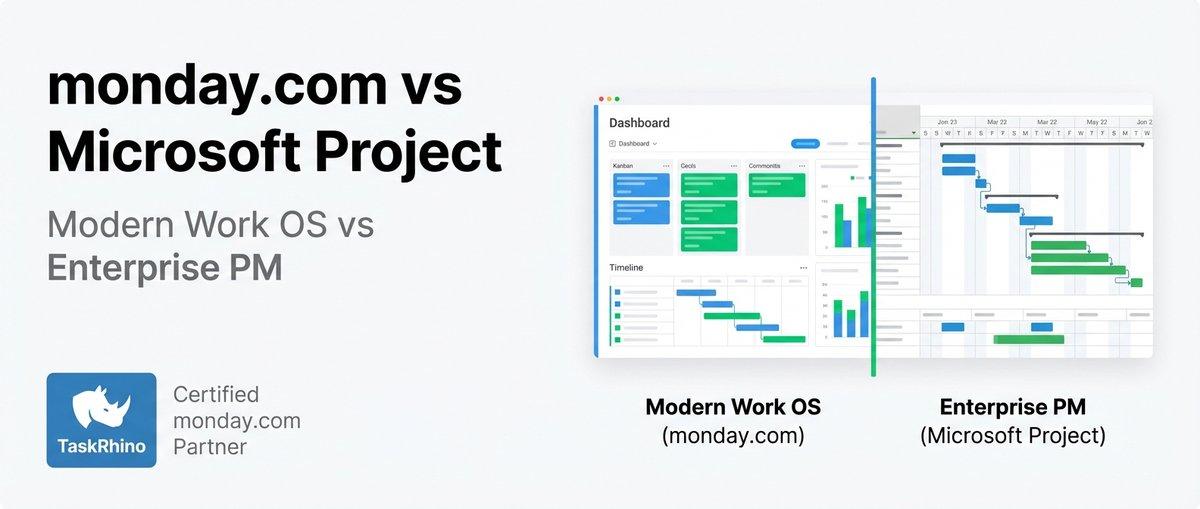
monday.com vs Microsoft Project 2026: Modern Work OS vs Enterprise PM Heavyweight
Microsoft Project is built for PMPs managing multi-million-dollar infrastructure builds. monday.com is built for everyone else. If you need critical path analysis and earned value management, you’re looking at MS Project. If you need your team actually using the tool on day one, you’re looking at monday.com.
This isn’t about which tool is “better.” It’s about which tool matches what you’re actually managing. Microsoft Project is traditional, heavyweight project management software designed for complex enterprise projects with rigid scheduling requirements. monday.com is a modern Work OS designed for cross-functional teams who need flexibility, automation, and a tool people don’t need two weeks of training to use.
We’ve implemented both platforms for clients across manufacturing, healthcare, finance, and retail. We’ve seen MS Project used brilliantly for construction portfolio management — and we’ve seen monday.com replace it entirely for marketing agencies who were drowning in Gantt chart complexity they didn’t need.
Here’s what actually separates these two platforms in 2026.
Quick Verdict
| Factor | Microsoft Project | monday.com |
|---|---|---|
| Best for | PMPs managing complex enterprise projects | Cross-functional teams, modern work management |
| Learning curve | Steep (weeks to months) | Minimal (hours to days) |
| Pricing (per user/month) | $10-$55 cloud; $430-$620 one-time | $0-$27 |
| Standout strength | Critical path, resource leveling, EVM | Modern UI, automation, integrations |
| Who should choose it | Construction, engineering, defense, enterprise PMO | Marketing, product, operations, SaaS, startups |
| Desktop app | Yes (standalone license) | No (web + mobile only) |
Bottom line: If you’re a certified PMP managing projects with CPM (Critical Path Method) and EVM (Earned Value Management), MS Project is purpose-built for your workflow. If your team needs to collaborate across functions, automate repetitive tasks, and onboard people in minutes instead of weeks — monday.com wins.
Pricing Breakdown: Cloud, Desktop, and Everything In Between
Microsoft Project Pricing (2026)
Microsoft Project has two pricing tracks: cloud-based subscriptions and one-time desktop licenses. This matters — many enterprises still require on-premise software with no cloud mandate.
| Plan | Price | Key Features | Who It’s For |
|---|---|---|---|
| Project Plan 1 | $10/user/month | Web-only, basic project and task management, timeline views, collaboration | Small teams, lightweight PM needs |
| Project Plan 3 | $30/user/month | Desktop + web, resource management, custom fields, Power BI reporting, roadmaps | Professional project managers |
| Project Plan 5 | $55/user/month | Enterprise portfolio management, demand management, resource capacity planning, advanced analytics | Enterprise PMO, portfolio management |
| Project Standard 2024 | $679.99 one-time | Desktop app only, no cloud sync, traditional PM features | Single-user desktop license |
| Project Professional 2024 | $1,129.99 one-time | Desktop app + Project Server connectivity | Enterprise deployments with on-prem infrastructure |
Key pricing notes:
- Cloud vs. desktop: Plan 1 is cloud-only. Plans 3 and 5 include both web and desktop apps. Desktop licenses (Standard/Professional) are one-time purchases with no subscription.
- Annual commitment: Cloud plans require annual contracts in most cases.
- No free plan: Microsoft Project has no free tier. Plan 1 is the entry point at $10/user/month.
monday.com Pricing (2026)
monday.com uses seat-based pricing with feature tiers. Pricing scales with team size and required features.
| Plan | Price | Key Features | Who It’s For |
|---|---|---|---|
| Free | $0 | Up to 2 seats, unlimited boards, 200+ templates, iOS/Android apps | Individuals, freelancers |
| Basic | $9/seat/month | Unlimited free viewers, 5GB storage, prioritized support | Small teams (3-10 people) |
| Standard | $12/seat/month | Timeline & Gantt views, calendar view, guest access, automations (250/month), integrations (250/month) | Growing teams with automation needs |
| Pro | $19/seat/month | Private boards, time tracking, formula column, dependency column, 25K automations/month, 25K integrations/month | Established teams managing complex workflows |
| Enterprise | Custom (starting ~$27/seat/month) | Enterprise-grade security, advanced reporting, multi-level permissions, dedicated success manager, 250K+ automations/month | Large organizations, compliance-heavy industries |
Key pricing notes:
- Minimum 3 seats: Paid plans start at 3 seats minimum ($27/month for Basic).
- Annual discount: Pricing above reflects annual billing (18% discount vs. monthly).
- Viewers: Standard and above include unlimited free viewers (read-only access).
- Add-ons: Advanced features like gantt chart timelines are included in Standard and above.
Pricing Comparison
| Factor | Microsoft Project | monday.com |
|---|---|---|
| Starting price | $10/user/month (Plan 1) | $0 (Free plan) |
| Mid-tier price | $30/user/month (Plan 3) | $12/seat/month (Standard) |
| Enterprise price | $55/user/month (Plan 5) | ~$27+/seat/month (Enterprise) |
| Desktop license available | Yes ($679-$1,129 one-time) | No |
| Free plan | No | Yes (up to 2 seats) |
| Annual contract required | Yes (cloud plans) | No (monthly available) |
Real cost example (10-person team, annual):
- MS Project Plan 3: $3,600/year ($30 × 10 × 12)
- monday.com Standard: $1,440/year ($12 × 10 × 12)
- monday.com Pro: $2,280/year ($19 × 10 × 12)
For teams that don’t need enterprise portfolio management, monday.com delivers 60-80% cost savings compared to MS Project Plan 3.
Feature-by-Feature Breakdown
1. Core Project Management Features
| Feature | Microsoft Project | monday.com |
|---|---|---|
| Task management | ✅ Full dependency management, lag/lead times, predecessor-successor relationships | ✅ Task tracking, subtasks, dependencies (Pro plan) |
| Gantt charts | ✅ The original — deep scheduling control, baselines, critical path highlighting | ✅ Timeline & Gantt view (Standard+), visual but less scheduling depth |
| Critical path analysis | ✅ Native CPM calculation, automatic updates | ❌ Not available |
| Resource leveling | ✅ Automatic resource conflict resolution | ❌ Manual resource balancing only |
| Earned Value Management (EVM) | ✅ Full EVM metrics (BCWP, ACWP, SPI, CPI, EAC, VAC) | ❌ Not available |
| Baseline management | ✅ Multiple baselines, variance tracking | ⚠️ Limited (snapshot view only) |
| Project templates | ✅ Industry-specific templates (construction, IT, engineering) | ✅ 200+ templates across all industries |
Verdict: Microsoft Project dominates traditional PM methodologies. If you’re running projects that require CPM, resource leveling, or EVM — MS Project is the only choice. monday.com handles task management and timelines well, but it’s not designed for traditional scheduling rigor.
2. Scheduling & Timeline Capabilities
| Feature | Microsoft Project | monday.com |
|---|---|---|
| Drag-and-drop scheduling | ✅ Desktop app (not cloud version) | ✅ All plans with timeline view |
| Auto-scheduling | ✅ Automatic task rescheduling based on dependencies | ⚠️ Limited (manual date adjustments) |
| Calendar integration | ✅ Outlook, Microsoft 365 calendar sync | ✅ Google Calendar, Outlook, iCal sync |
| Working days/hours | ✅ Custom calendars per resource and project | ✅ Global working days setting |
| Task constraints | ✅ Must Start On, Must Finish On, Start No Earlier Than, etc. | ❌ Manual date constraints only |
| Recurring tasks | ✅ Full recurrence patterns | ✅ Automations can create recurring items |
| Milestones | ✅ Zero-duration tasks with visual markers | ✅ Milestone column type with visual markers |
Verdict: MS Project’s scheduling engine is unmatched. It understands task constraints, resource calendars, and auto-adjusts downstream tasks when predecessors shift. monday.com’s timeline view is visual and easy to use, but it’s not a scheduling engine — it’s a timeline visualization tool.
3. Collaboration & Communication
| Feature | Microsoft Project | monday.com |
|---|---|---|
| Real-time collaboration | ⚠️ Limited (cloud only, not desktop) | ✅ Native real-time updates |
| Comments & mentions | ✅ Task-level comments (cloud only) | ✅ Item-level comments, @mentions, thread replies |
| File attachments | ✅ SharePoint integration (cloud), local files (desktop) | ✅ Native file uploads, Google Drive, Dropbox, OneDrive |
| Activity log | ⚠️ Limited audit trail | ✅ Full activity log per item and board |
| Email notifications | ✅ Email alerts for task assignments | ✅ Customizable email notifications, digests |
| Guest access | ❌ Requires license | ✅ Free guest access (Standard+) |
| Mobile app | ⚠️ Basic viewing only | ✅ Full-featured iOS/Android apps |
Verdict: monday.com is built for modern collaboration. Real-time updates, inline comments, mobile access, and guest collaboration are seamless. MS Project’s desktop app is single-user focused — collaboration exists only in the cloud version, and even then it feels tacked on.
4. Automation & Integrations
| Feature | Microsoft Project | monday.com |
|---|---|---|
| Built-in automations | ❌ None | ✅ 250-250K+ automations/month depending on plan |
| Custom automations | ⚠️ Requires Power Automate (separate subscription) | ✅ No-code automation builder (if-then-else logic) |
| Pre-built integrations | ⚠️ Limited (Microsoft 365, Teams, SharePoint) | ✅ 200+ integrations (Slack, Zoom, Gmail, Jira, Salesforce, etc.) |
| API access | ✅ REST API (Plan 3+) | ✅ REST and GraphQL API (all paid plans) |
| Zapier/Make support | ✅ Available | ✅ Native and Zapier/Make support |
| Webhook triggers | ❌ Not native | ✅ Native webhooks (Pro+) |
Verdict: monday.com wins automation decisively. MS Project has zero native automations — you need Power Automate, which is a separate Microsoft subscription. monday.com’s no-code automation builder lets you set up “when status changes to X, notify Y” workflows in seconds.
5. Reporting & Dashboards
| Feature | Microsoft Project | monday.com |
|---|---|---|
| Visual dashboards | ⚠️ Power BI integration required (Plan 3+) | ✅ Native drag-and-drop dashboards (Standard+) |
| Pre-built reports | ✅ Gantt, resource usage, task status, cost reports | ✅ 20+ widget types (charts, timelines, workload, battery, numbers) |
| Custom reports | ✅ Extensive custom reporting (desktop app) | ✅ Custom dashboards with filters and grouping |
| Real-time data | ⚠️ Cloud only | ✅ All plans |
| Export options | ✅ Excel, PDF, CSV | ✅ Excel, PDF, PNG |
| Cross-project reporting | ✅ Master projects, consolidated views | ✅ Dashboard can pull from multiple boards |
Verdict: MS Project’s reporting is powerful but dated. Desktop reports are comprehensive but feel stuck in 2010. Cloud reporting requires Power BI. monday.com’s dashboards are modern, visual, and easy to customize — no BI tool required.
6. Resource Management
| Feature | Microsoft Project | monday.com |
|---|---|---|
| Resource pool | ✅ Centralized resource pool across projects | ⚠️ Manual tracking via workload view |
| Resource leveling | ✅ Automatic conflict resolution | ❌ Not available |
| Capacity planning | ✅ Resource capacity vs. demand (Plan 5) | ✅ Workload view shows allocation (Pro+) |
| Cost tracking | ✅ Cost per resource, project budget tracking, variance analysis | ✅ Budget column, formula-based tracking |
| Time tracking | ⚠️ Via timesheets (Plan 3+) | ✅ Native time tracking (Pro+) |
| Skill-based assignment | ✅ Resource attributes and filtering | ❌ Manual assignment only |
Verdict: MS Project is designed for enterprise resource management — centralized resource pools, leveling, and cost tracking are core to its DNA. monday.com’s resource management is lighter — workload views show who’s overloaded, but you’re manually adjusting assignments.
7. User Experience & Learning Curve
| Factor | Microsoft Project | monday.com |
|---|---|---|
| Initial setup time | 2-4 hours (cloud) / 4-8 hours (desktop) | 15-30 minutes |
| Time to productivity | 2-4 weeks (with training) | Same day |
| Interface | Ribbon UI (desktop), web UI (cloud) — Microsoft 365 style | Modern, colorful, card-based UI |
| Learning resources | Microsoft Learn, third-party courses, certification programs | In-app tutorials, help center, webinars |
| Customization | Extensive (custom fields, views, formulas) | Extensive (columns, automations, integrations) |
| Keyboard shortcuts | ✅ Extensive | ✅ Basic shortcuts available |
Verdict: monday.com is usable on day one. MS Project requires formal training. We’ve seen teams abandon MS Project because no one wanted to become the “MS Project expert.” monday.com’s UI is intuitive enough that new users figure it out by clicking around.
8. Enterprise & Security Features
| Feature | Microsoft Project | monday.com |
|---|---|---|
| SSO (Single Sign-On) | ✅ Microsoft Entra ID (Azure AD) | ✅ SAML 2.0, Google Workspace, Okta (Enterprise) |
| Two-factor authentication | ✅ Microsoft 365 2FA | ✅ Native 2FA (all paid plans) |
| Role-based permissions | ✅ Detailed permissions per project | ✅ Board-level, group-level, column-level permissions |
| Data residency | ✅ Regional data centers | ✅ EU, US, Australia data centers (Enterprise) |
| Compliance certifications | ✅ SOC 2, ISO 27001, GDPR, HIPAA (with E5) | ✅ SOC 2 Type II, ISO 27001, GDPR, HIPAA (Enterprise) |
| Audit logs | ✅ Full audit trail (Plan 3+) | ✅ Full audit log (Enterprise) |
| IP restrictions | ✅ Conditional access policies | ✅ IP allowlisting (Enterprise) |
Verdict: Both platforms meet enterprise security requirements. MS Project has an edge if you’re already deep in the Microsoft 365 ecosystem. monday.com’s enterprise features are mature and cover the same compliance bases.
See How BoardBridge Handles This Workflow
Book a free demo to see BoardBridge solve this exact problem — live, with your data.
Microsoft Project’s Strengths: When It’s the Right Choice
1. Critical Path Method (CPM) Is Non-Negotiable
If your project requires CPM — construction schedules, engineering builds, infrastructure projects — MS Project is purpose-built for this. It automatically calculates the critical path, highlights tasks that impact the end date, and adjusts downstream schedules when predecessors shift.
Example: A client managing a $40M hospital build used MS Project to track 1,200+ tasks across 18 months. Critical path analysis showed that HVAC installation delays would push the opening date by 6 weeks. They reallocated resources to the critical path and recovered 4 weeks. monday.com can’t do this.
2. Earned Value Management (EVM) for Cost Control
EVM is standard in defense, government contracting, and large construction projects. MS Project calculates BCWP (Budgeted Cost of Work Performed), ACWP (Actual Cost of Work Performed), SPI (Schedule Performance Index), and CPI (Cost Performance Index) automatically.
If you’re required to report EVM metrics — or if you’re a certified PMP who thinks in BCWS, BCWP, and VAC — MS Project is the tool.
3. Resource Leveling Across Complex Projects
MS Project’s resource leveling feature automatically resolves resource conflicts. If two tasks need the same resource at the same time, MS Project delays one task to eliminate the overallocation. This is invaluable for managing 50+ resources across 10+ simultaneous projects.
Example: A defense contractor managing 200 engineers across 6 projects used MS Project’s resource leveling to eliminate conflicts without manual intervention. monday.com would require a PM manually dragging tasks around in workload view.
4. Desktop App for Offline Work
Many enterprises — especially in engineering, construction, and government — require desktop applications with no cloud dependency. MS Project Standard and Professional are standalone desktop licenses that work offline and store data locally.
If your organization has strict data sovereignty requirements or internet access restrictions, the desktop app is a requirement.
5. Legacy Compatibility & MPP File Format
MS Project’s .mpp file format is the industry standard. If you’re inheriting schedules from contractors, subcontractors, or other departments — they’re likely in .mpp format. MS Project opens them natively.
monday.com’s Strengths: When It’s the Right Choice
1. Modern UI That People Actually Want to Use
monday.com’s interface is colorful, visual, and intuitive. New users don’t need training — they figure it out. This matters when you’re managing cross-functional teams where project management isn’t their primary job.
Example: A 30-person SaaS startup replaced MS Project with monday.com because developers refused to update tasks in MS Project. monday.com’s UI felt like a modern web app, not enterprise software from 2005. Adoption went from 40% to 95%.
2. Automation That Doesn’t Require Power Automate
monday.com’s no-code automation builder handles 90% of workflow automation needs without external tools. “When status changes to Done, notify manager and archive item” takes 30 seconds to set up.
MS Project has zero native automations. You need Power Automate (separate subscription, additional learning curve).
3. Cross-Functional Collaboration Out of the Box
monday.com is designed for teams where not everyone is a project manager. Marketing, product, sales, and operations teams can all use the same platform with different workflows. MS Project is a PM tool — asking your marketing team to track campaigns in MS Project is painful.
Example: A healthcare client uses monday.com to manage product launches (product team), marketing campaigns (marketing team), and sales pipeline (sales team) — all in one platform. They tried MS Project first. It lasted 3 weeks before marketing revolted.
4. Integrations With the Tools Teams Already Use
monday.com integrates with Slack, Gmail, Jira, Salesforce, HubSpot, Zoom, Google Drive, and 200+ other tools. MS Project integrates with Microsoft 365 products and… that’s mostly it.
If your team lives in Slack and Google Workspace, monday.com fits your workflow. MS Project requires everyone to work in the Microsoft ecosystem.
5. Mobile App That’s Actually Useful
monday.com’s iOS and Android apps are full-featured. You can update statuses, add comments, upload files, and check dashboards from your phone. MS Project’s mobile app is view-only.
For remote teams or field workers, this is a dealbreaker.
Need Help With Your monday.com Setup?
TaskRhino has implemented monday.com for 110+ teams. Get a free consultation.
Real-World Use Cases: Who Should Choose What
Choose Microsoft Project If You:
- Manage complex enterprise projects with CPM requirements — Construction, engineering, defense, infrastructure, pharmaceutical R&D
- Are required to report EVM metrics — Government contracts, defense projects, projects with earned value reporting mandates
- Manage 50+ resources across multiple simultaneous projects — Enterprise PMO, portfolio management, resource-constrained environments
- Are a certified PMP managing projects with traditional PM methodology — You already think in WBS, Gantt charts, critical path, resource leveling
- Need offline desktop software — Secure environments, air-gapped networks, data sovereignty requirements
- Inherit schedules in .mpp format — You work with contractors, subcontractors, or partners who use MS Project
Example industries: Construction, civil engineering, defense, aerospace, government contracting, large-scale IT infrastructure, pharmaceutical development
Choose monday.com If You:
- Manage cross-functional teams where PM isn’t everyone’s primary job — Marketing campaigns, product launches, content calendars, event planning
- Need a tool people will actually use without training — High adoption is more important than advanced scheduling features
- Want automation without learning Power Automate — Repetitive workflows, status updates, notifications
- Work in a SaaS/startup/agile environment — Fast-moving teams, changing priorities, flexible workflows
- Integrate with non-Microsoft tools — Slack, Google Workspace, Salesforce, Jira, HubSpot
- Need mobile-first access — Remote teams, field workers, distributed teams
Example industries: SaaS, digital marketing, creative agencies, healthcare operations, retail operations, HR & recruiting, event management, product development (agile), professional services
Migration Considerations
Moving from MS Project to monday.com
What carries over easily:
- Task lists and names
- Due dates and owners
- Basic dependencies
- Status tracking
What doesn’t migrate:
- Critical path calculations
- Resource leveling configurations
- Earned value data
- Custom formulas and fields (require rebuilding)
- Baseline comparisons
Migration path: Export MS Project to Excel → Import to monday.com via CSV. Plan to manually rebuild automations, custom columns, and dashboards. Budget 2-4 weeks for a full migration with 10+ boards.
Moving from monday.com to MS Project
What carries over easily:
- Task lists
- Due dates
- Basic timeline data
What doesn’t migrate:
- Automations (none)
- Integrations (requires Power Automate)
- Custom dashboards (rebuild in Power BI)
- Board structure (MS Project uses project files, not boards)
Migration path: Export monday.com to Excel → Import to MS Project. Expect significant manual work to rebuild dependencies, resource assignments, and custom fields. Budget 4-8 weeks for complex setups.
Integrations Ecosystem
Microsoft Project Integrations
| Category | Integrations |
|---|---|
| Microsoft 365 | Teams, SharePoint, OneDrive, Outlook, Power BI, Power Automate, Excel |
| Third-party PM tools | Jira (via connector), ServiceNow, Azure DevOps |
| BI & reporting | Power BI (native), Tableau (via export), Excel |
| Communication | Microsoft Teams (native), email notifications |
| API | REST API (Plan 3+) |
Ecosystem assessment: MS Project lives inside the Microsoft 365 world. If you’re all-in on Microsoft, the integrations are seamless. If you use Google Workspace, Slack, or non-Microsoft tools, you’ll need Zapier or Make to bridge the gap.
monday.com Integrations
| Category | Integrations |
|---|---|
| Communication | Slack, Microsoft Teams, Gmail, Outlook, Zoom, Google Meet |
| Development | GitHub, GitLab, Bitbucket, Jira, Azure DevOps |
| CRM & sales | Salesforce, HubSpot, Pipedrive, Zoho CRM |
| Marketing | Mailchimp, Google Ads, Facebook Ads, LinkedIn Ads |
| File storage | Google Drive, Dropbox, OneDrive, Box |
| Time tracking | Harvest, Toggl, Everhour |
| Automation platforms | Zapier, Make (Integromat), Workato |
| API | REST API, GraphQL API (all paid plans) |
Ecosystem assessment: monday.com integrates with the modern SaaS stack. If your team uses Slack, Google Workspace, and Salesforce, monday.com fits immediately. 200+ pre-built integrations cover most workflows without custom development.
The Learning Curve Reality Check
Microsoft Project: Weeks to Competence
What new users struggle with:
- Understanding task types (fixed duration, fixed work, fixed units)
- Setting up dependencies correctly (finish-to-start, start-to-start, lag/lead)
- Interpreting resource allocation percentages
- Avoiding scheduling conflicts
- Understanding why tasks auto-reschedule
- Reading Gantt charts with critical path highlighting
Training requirements:
- Formal training recommended: 16-24 hours
- Time to basic proficiency: 2-4 weeks
- Time to advanced proficiency: 3-6 months
- Certification available: Yes (Microsoft Project certification, PMP uses MS Project)
Reality: MS Project is a professional tool with a professional learning curve. You don’t casually pick it up. Enterprises that deploy MS Project typically assign a dedicated PM or PMO team who becomes the “MS Project expert.”
monday.com: Hours to Competence
What new users struggle with:
- Understanding board vs. workspace structure
- Setting up automations (minor learning curve)
- Formula column syntax (if used)
- Dashboard widget configuration
Training requirements:
- Formal training recommended: 2-4 hours (webinar or in-app tutorial)
- Time to basic proficiency: Same day
- Time to advanced proficiency: 1-2 weeks
- Certification available: Yes (monday.com certification available)
Reality: monday.com is designed for mainstream users. You can onboard a new team member in 30 minutes. Advanced features (formulas, complex automations) take longer, but basic usage is intuitive.
Stop Creating Duplicates
BoardBridge forms update existing items — no Enterprise plan, no workarounds, no duplicates.
Frequently Asked Questions
Can monday.com replace Microsoft Project for construction projects?
Not for projects requiring Critical Path Method (CPM), resource leveling, or Earned Value Management (EVM). monday.com handles timelines and task tracking well, but it doesn’t calculate critical paths or auto-level resources. If you’re managing a $10M+ construction project with hard deadlines and contractual CPM requirements, MS Project is purpose-built for that workflow. If you’re managing internal renovations or smaller projects where timeline visualization matters more than CPM rigor, monday.com works fine.
Does Microsoft Project have a free plan?
No. MS Project starts at $10/user/month for Plan 1 (cloud-only). There’s no free tier. monday.com offers a free plan for up to 2 users — useful for freelancers or individuals, but limited for teams.
Can I use Microsoft Project offline?
Yes, with the desktop licenses (Project Standard or Project Professional). These are one-time purchases ($679-$1,129) that install on Windows and work offline. Cloud plans (Plan 1, 3, 5) require internet connectivity. monday.com is web-based only — no offline mode.
Which tool has better Gantt charts?
Microsoft Project. MS Project invented Gantt charts for PCs in the 1980s. Its Gantt view includes critical path highlighting, baseline comparisons, slack/float indicators, and detailed dependency chains. monday.com’s timeline view is visual and easy to use, but it’s a simplified Gantt — great for communication, not deep scheduling.
Can I import an MS Project file into monday.com?
Not directly. Export your MS Project file to Excel or CSV, then import the CSV into monday.com. You’ll need to manually rebuild dependencies, automations, and custom fields. Plan for 1-2 days of setup time per project.
Does monday.com support resource leveling?
No. monday.com has a workload view that shows resource allocation, but it doesn’t auto-level resources. If two tasks conflict, you manually adjust task dates or reassign tasks. MS Project’s resource leveling feature automatically resolves conflicts.
Which tool is better for agile teams?
monday.com. MS Project is designed for waterfall methodology with fixed schedules and dependencies. monday.com supports agile workflows with sprint boards, backlog management, and flexible column configurations. Many agile teams use monday.com for sprint planning and Jira for development tracking, integrating the two via API.
Can I use Microsoft Project with Google Workspace?
Technically yes, but it’s clunky. MS Project integrates natively with Microsoft 365 (Outlook, Teams, OneDrive, SharePoint). If you’re a Google Workspace shop, you’ll need third-party tools (Zapier, Make) to bridge the gap. monday.com integrates natively with Google Calendar, Gmail, Google Drive, and Google Sheets — better fit for Google users.
Which tool has better mobile apps?
monday.com. monday.com’s iOS and Android apps are full-featured — you can update tasks, add comments, upload files, check dashboards, and receive notifications. MS Project’s mobile app is view-only. You can see your schedule but not edit it. For field teams or remote workers, this is a significant limitation.
Does monday.com have earned value management (EVM)?
No. EVM requires baseline tracking, cost tracking, and performance index calculations (SPI, CPI, EAC, VAC). MS Project has native EVM support. monday.com does not. If you’re contractually required to report EVM metrics, MS Project is your only option.
Can Microsoft Project handle agile sprints?
Poorly. MS Project wasn’t designed for agile. You can force it to work (create tasks for sprints, use custom fields for story points), but it’s fighting the tool. Azure DevOps (Microsoft’s agile tool) or Jira are better choices. monday.com handles agile workflows more naturally with sprint boards and backlog views.
Which tool is easier to learn?
monday.com, decisively. New users are productive on day one. MS Project requires formal training and 2-4 weeks to reach basic proficiency. If ease of use and fast adoption matter more than advanced scheduling features, monday.com wins.
—
Final Verdict: The Question That Decides Everything
Are you managing projects that require Critical Path Method (CPM), resource leveling, or Earned Value Management (EVM)?
- Yes → Microsoft Project. You need a professional PM tool built for traditional project management methodology. MS Project speaks the language of PMP certification. It’s designed for complex enterprise projects with rigid scheduling requirements.
- No → monday.com. You need a modern Work OS that teams will actually use. monday.com handles timelines, collaboration, automation, and integrations better than MS Project — and people don’t need two weeks of training to figure it out.
The real dividing line isn’t features — it’s who’s using the tool.
If your project managers are certified PMPs managing multi-million-dollar builds with contractual CPM and EVM requirements, MS Project is purpose-built for your workflow. It’s the industry standard for traditional project management.
If your team is cross-functional (marketing, product, operations, sales) and project management is one of many things they do — not their entire job — monday.com is the better fit. It’s flexible, intuitive, and integrates with the tools teams already use.
Hybrid approach: Some organizations use both. MS Project for the PMO managing large construction or engineering projects. monday.com for everyone else — marketing campaigns, product launches, operational workflows. They don’t compete; they serve different audiences.
Bottom line: MS Project is for PMPs. monday.com is for everyone else. Choose based on who’s doing the managing, not just what’s being managed.
Need Help Choosing the Right Tool?
Choosing between Microsoft Project and monday.com depends on your team structure, project complexity, and existing workflow. We’ve implemented both platforms for clients across construction, healthcare, SaaS, and finance.
Book a free 30-minute consultation to talk through your specific needs. We’ll walk through your current workflow, identify gaps, and recommend the right platform (and configuration) for your team.
Schedule your free consultation here
Whether you choose MS Project, monday.com, or a hybrid approach — we’ll help you set it up right the first time.
Related reading:
- monday.com vs Asana: Which Work Management Platform Is Right for You?
- monday.com vs Jira: When to Use Each (and When to Use Both)
- monday.com Review 2026: Is It Worth It?
- What Is monday.com? A Complete Guide to the Work OS
- ClickUp vs monday.com: Feature-by-Feature Comparison
External resources:
- Microsoft Project Plans Comparison{:target=”_blank” rel=”nofollow noindex”}
- monday.com Pricing{:target=”_blank” rel=”nofollow noindex”}


Editor's Choice
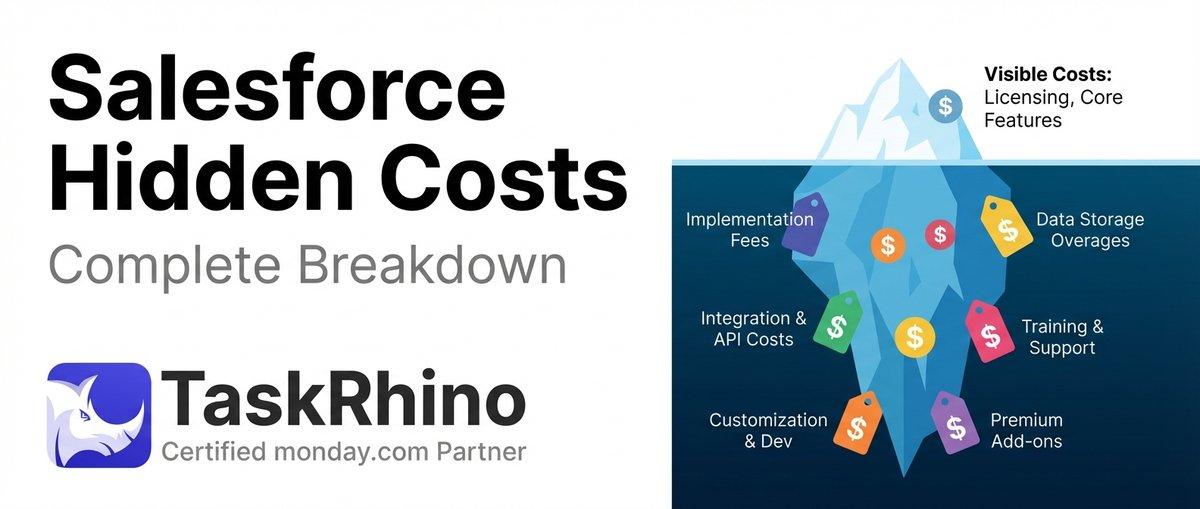
How to Calculate Hidden Costs of Salesforce Admin & Consulting

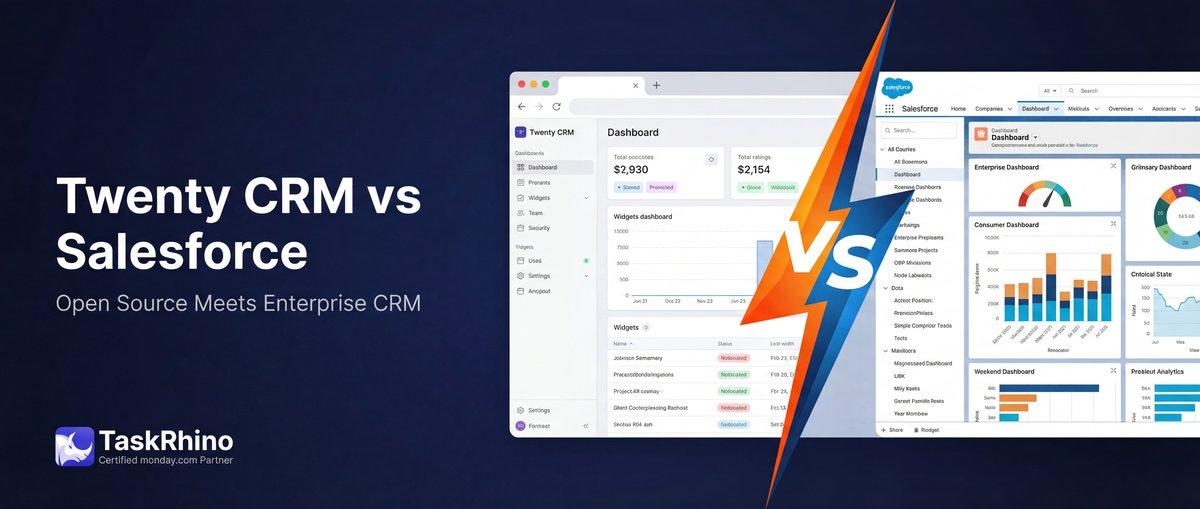
Twenty CRM vs Salesforce: Full Detailed Comparison
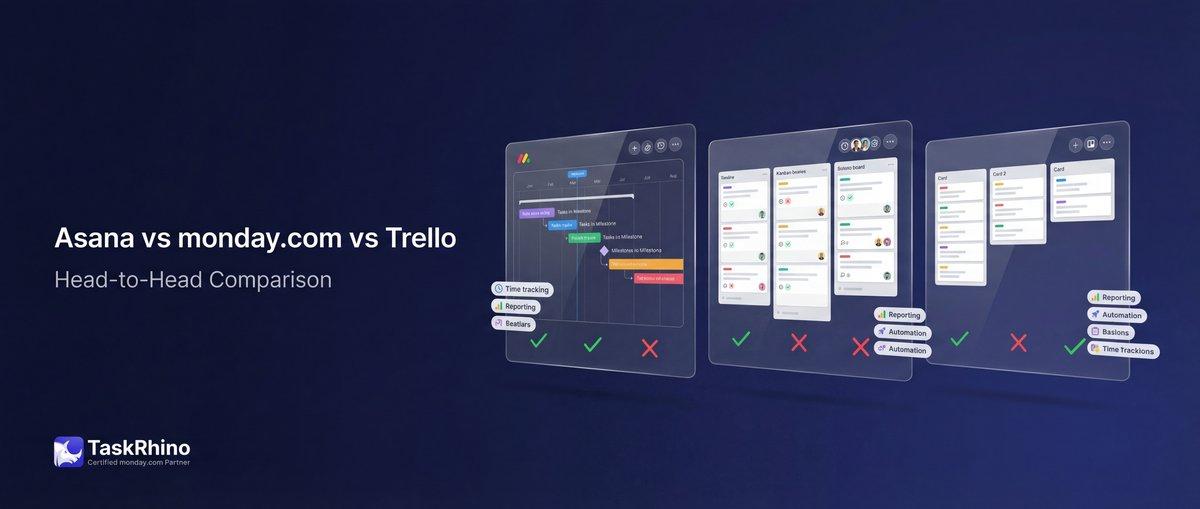
Asana vs monday.com vs Trello 2026: The Bicycle, The Sedan, and The SUV