

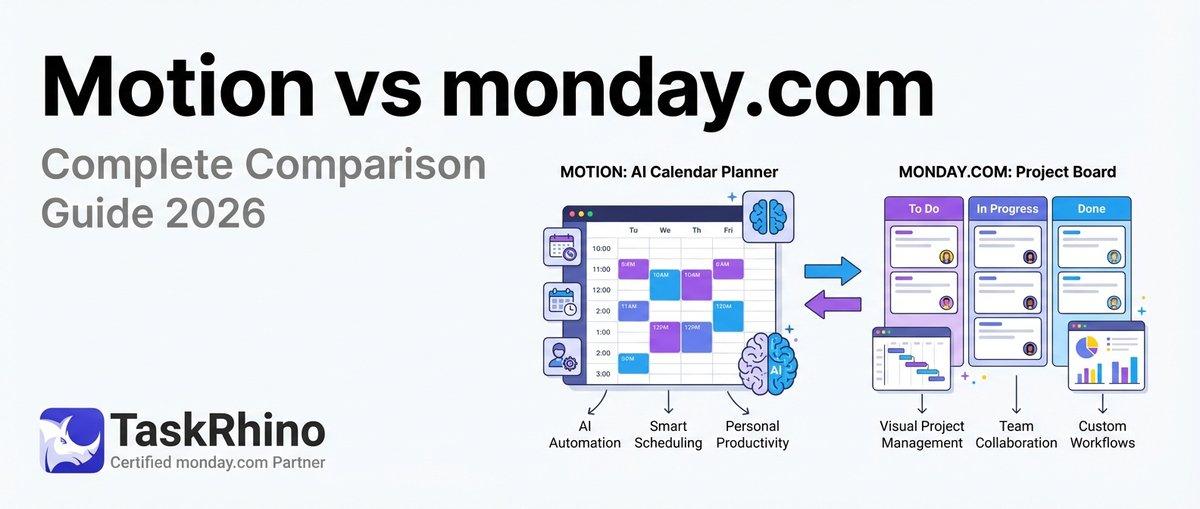
Motion vs monday.com: Complete Comparison Guide 2026
Motion’s AI schedules your day automatically. monday.com lets you build the workflow system you want. Both are powerful, but they solve completely different problems.
Here’s the reality: Motion is an AI-powered personal assistant that auto-schedules tasks onto your calendar. It’s calendar-first, deadline-focused, and built for individuals or small teams who want their day planned for them. monday.com is a flexible Work OS that gives teams custom boards, automation recipes, and visual project management. It’s workflow-first, highly customizable, and scales from 2 to 2,000 people.
If you’re a solo professional or small team drowning in task chaos and need AI to manage your time, Motion delivers. If you’re building a cross-functional team that needs custom workflows, automations, and views, monday.com wins. If you’re comparing pricing: Motion has no free plan and costs $34/month for individuals or $20/user/month for teams (annual). monday.com offers a free plan, with paid plans from $9-$27/seat/month.
This comparison breaks down the features, pricing, use cases, and limitations so you can decide which tool actually fits how your team works.
Quick Comparison at a Glance
| Factor | Motion | monday.com | Winner |
|---|---|---|---|
| Primary Purpose | AI-powered auto-scheduling & calendar management | Flexible Work OS & project management platform | Depends on need |
| Best For | Individuals & small teams (<25 people) who want AI to schedule their day | Teams of any size who want custom workflows & visual PM | Depends on team |
| Core Strength | AI auto-scheduling (killer feature) | Customization, automation recipes, scalability | Motion for AI / monday for flexibility |
| Pricing Start | $19/month (individual), $29/month (team) | Free plan, paid from $9/seat/month | monday.com |
| Free Plan | ❌ No free plan | ✅ Free for up to 2 users | monday.com |
| Team Size Limit | ~25 members practical max | Unlimited (scales to thousands) | monday.com |
| AI Capabilities | AI scheduling, task prioritization, calendar optimization | AI assistant, AI-powered automations, AI writing | Motion |
| Customization | Limited (calendar-first structure) | Extremely high (custom boards, columns, views) | monday.com |
| Integrations | 30+ integrations | 200+ integrations | monday.com |
| Views | Calendar, List, Board | 10+ views (Gantt, Calendar, Kanban, Timeline, Map, etc.) | monday.com |
| Automations | Limited automation features | Up to 250K actions/month (Enterprise) | monday.com |
| Learning Curve | Low (calendar-first is intuitive) | Medium (customization requires setup) | Motion |
| Use Case | Personal productivity, time blocking, deadline protection | Cross-functional project management, workflow automation | Depends on goal |
What Is Motion?
Motion is an AI-powered productivity tool that automatically schedules your tasks onto your calendar based on deadlines, priorities, and available time. Think of it as hiring a personal assistant who manages your calendar 24/7.
You give Motion your tasks with deadlines and durations. Motion’s AI figures out when to schedule them, blocks the time on your calendar, and automatically reshuffles everything when meetings pop up or priorities change. The core promise: you focus on the work, Motion handles the when.
Motion’s Core Features
1. AI Auto-Scheduling (The Killer Feature)
Motion analyzes your tasks, deadlines, calendar availability, and priorities to auto-schedule work blocks on your calendar. When something changes — a meeting runs long, a new urgent task appears, or you mark something complete — Motion instantly recalculates and reschedules your entire day (and week).
You don’t manually drag tasks into time slots. Motion does it for you based on:
- Task deadlines (it prioritizes what’s due soon)
- Task duration (how long you estimated it will take)
- Calendar availability (gaps between meetings)
- Priority levels (high-priority tasks get scheduled first)
- Work hours preferences (you set when you actually work)
2. Automatic Task Prioritization
Motion uses deadlines and priority flags to automatically rank what needs to happen first. If you have 20 tasks, Motion figures out which 5 should happen today and schedules those.
3. Calendar-First Approach
Everything lives on your calendar. Tasks aren’t just items on a list — they’re scheduled time blocks. Motion integrates with Google Calendar, Outlook, and iCloud, turning multiple calendars into a single unified view.
4. Deadline Protection
Motion tracks how much time is left until each deadline and warns you if you’re running out of runway. If you have a project due Friday and you’re behind, Motion flags it and adjusts your schedule to carve out more time.
5. Meeting Scheduling
Motion includes a built-in meeting scheduler (like Calendly). You share a link, people pick a time based on your availability, and Motion automatically books it and adjusts your task schedule around the new meeting.
6. Team Capacity Planning (Team Plans)
On team plans, Motion shows each team member’s workload and capacity. Managers can see who’s overloaded and redistribute tasks. Motion auto-balances work across the team.
7. Project & Task Management
Motion has projects, tasks, subtasks, comments, and file attachments. It’s a lightweight PM tool at its core. But unlike monday.com, it’s not built for complex workflows or custom fields. It’s task-list-first with AI scheduling layered on top.
What Motion Does Well
- AI scheduling is genuinely impressive. If you struggle with time management and never know what to work on next, Motion solves that problem.
- Calendar-first design is intuitive. If you live in your calendar, Motion feels natural.
- Automatic rescheduling saves hours. When your day blows up, Motion fixes your schedule in seconds instead of you manually moving 10 tasks.
- Deadline tracking keeps you honest. Motion won’t let you ignore a deadline. It’ll flag it days before and reschedule your week to give you time.
- Low learning curve. Add tasks, set deadlines, let Motion schedule them. You’re productive in 10 minutes.
What Motion Doesn’t Do
- No free plan. You have to pay $19-34/month to try it.
- Limited customization. You can’t build custom workflows, add custom fields beyond basic properties, or design your own board structure. Motion’s structure is fixed.
- Not built for large teams. Motion works for ~25 people max. Beyond that, the calendar-first approach breaks down.
- No Gantt charts or timeline views. If you need to visualize project timelines with dependencies, Motion doesn’t offer that.
- Limited automation beyond scheduling. Motion schedules tasks automatically, but it doesn’t have workflow automation recipes like “when status changes, notify team.”
- Integration ecosystem is smaller. Motion has 30+ integrations. monday.com has 200+.
- Expensive for what it offers beyond AI scheduling. Motion is $34/month individual or $20/user/month for teams. If you don’t need AI scheduling, you’re paying a lot for a lightweight PM tool.
What Is monday.com?
monday.com is a flexible Work Operating System (Work OS) that teams use to manage projects, workflows, and processes. It’s visual, customizable, and built for teams of any size — from freelancers to Fortune 500 companies.
Instead of forcing you into a fixed structure (like Motion’s calendar-first approach), monday.com gives you boards, columns, and views that you configure to match how your team works. You can build anything from a simple task list to a multi-board CRM with automations, dashboards, and cross-functional workflows.
monday.com’s Core Features
1. Custom Boards & Columns
Boards are the foundation of monday.com. Each board is a flexible table where you define the columns: Status, Person, Date, Text, Numbers, Timeline, Dropdown, Rating — 40+ column types.
You build boards that match your process: a marketing calendar, a sales pipeline, a product roadmap, a hiring tracker, a bug database. Each board is purpose-built instead of one-size-fits-all.
2. Multiple Views (10+ Visualization Options)
monday.com offers 10+ ways to view the same data:
- Kanban — Card-based, drag-and-drop workflow
- Calendar — See all date-based items on a calendar
- Gantt / Timeline — Visualize dependencies and project timelines
- Map — Geographic view (if you have location data)
- Chart — Visualize data with graphs and charts
- Workload — See team capacity and task distribution
- Table — Classic spreadsheet view
- Form — Public-facing intake forms that create items
Same data, different lenses. Marketing sees a calendar. Project managers see a Gantt chart. Executives see a dashboard.
3. Workflow Automations (250-250K Actions/Month)
monday.com has visual automation recipes: “When status changes to Done, notify the team and archive the item.” “When deadline is approaching, send a reminder 3 days before.”
You build automations with a no-code interface. Plans include 250 actions/month (Basic) up to 250,000 actions/month (Enterprise). Automations can span multiple boards, trigger integrations, and create complex workflows.
4. Integrations (200+ Apps)
monday.com connects with Slack, Gmail, Zoom, Microsoft Teams, Salesforce, HubSpot, Jira, Zapier, Make, and 200+ other tools. Native integrations plus API access for custom connections.
5. Dashboards & Reporting
Dashboards pull data from multiple boards to create executive views, team performance reports, or client status summaries. You add widgets: charts, timelines, workload views, battery charts (progress indicators), number widgets.
Each plan tier lets you combine more boards per dashboard: Basic (1 board), Standard (5 boards), Pro (20 boards), Enterprise (50 boards).
6. Collaboration Features
Comments, mentions, file attachments, guest access (for clients or contractors), update feeds, real-time sync. Teams collaborate inside each board without switching to email or Slack.
7. Templates & Pre-Built Workflows
monday.com offers 200+ templates for every industry: marketing campaigns, product launches, CRM pipelines, bug tracking, hiring workflows, event planning. Templates include boards, automations, and views already configured.
8. Scalability & Permissions
monday.com scales from 1 person to thousands. You control permissions at the workspace, board, and column level. Admins can lock down sensitive data, restrict editing, and manage who sees what.
What monday.com Does Well
- Customization is unmatched. You design the workflow, columns, automations, and views. It adapts to how you work instead of forcing a structure.
- Scales across teams and departments. Marketing, sales, product, HR, finance — each team gets its own boards, workflows, and integrations, all connected under one platform.
- Automation recipes save hours. Repetitive work (notifications, status updates, task creation) happens automatically.
- Visual and intuitive. Color-coded statuses, drag-and-drop Kanban, timeline views — it’s easy to see what’s happening at a glance.
- Free plan exists. You can test monday.com with up to 2 users and 3 boards before paying anything.
- Integrations cover the entire tech stack. If your team uses it, monday.com probably connects to it.
- Strong for cross-functional projects. When marketing, sales, and product need to work together, monday.com’s cross-board automations and dashboards tie it all together.
What monday.com Doesn’t Do
- AI scheduling doesn’t exist. monday.com won’t auto-schedule tasks onto your calendar like Motion. You manually assign dates and people.
- Customization = setup time. Out of the box, monday.com is an empty canvas. You have to configure boards, automations, and views to make it work.
- Can feel overwhelming at first. New users see 10+ views, 40+ column types, automation builders, and integration options and don’t know where to start.
- Not calendar-first. If you live in your calendar and want tasks auto-scheduled there, monday.com doesn’t prioritize that experience.
- Automation limits on lower plans. Basic plan gets 250 actions/month, which sounds like a lot until you have 10 automations running across 5 boards.
See How BoardBridge Handles This Workflow
Book a free demo to see BoardBridge solve this exact problem — live, with your data.
Head-to-Head: Motion vs monday.com
Pricing Comparison
| Plan | Motion | monday.com |
|---|---|---|
| Free Plan | ❌ No free plan | ✅ Free (up to 2 seats, 3 boards, limited features) |
| Individual | $19/month (Pro AI plan) | $9/seat/month (Basic — 3+ seats minimum) |
| Team (Small) | $19/month per seat (Pro AI) | $12/seat/month (Standard — includes automations, integrations, timeline) |
| Team (Advanced) | $29/month per seat (Business AI) | $19/seat/month (Pro — includes advanced features, private boards, formula column) |
| Enterprise | Custom pricing | $27/seat/month + custom features (Enterprise — includes unlimited automations, portfolio management) |
| Annual Discount | Save 33% (annual vs monthly) | Save 18% (annual vs monthly) |
| Minimum Seats | 1 (individual plan) / 3+ (team plan) | 3 minimum for paid plans |
Winner: monday.com for value and free tier. Motion is $19-34/month per user with no free option. monday.com starts free and offers lower entry pricing.
Motion is worth the premium IF: AI auto-scheduling is the feature you desperately need. If you don’t need that, you’re paying more for a tool with fewer features.
Feature Comparison (Detailed)
| Feature | Motion | monday.com | Winner |
|---|---|---|---|
| AI Auto-Scheduling | ✅ Core feature (automatically schedules tasks on calendar) | ❌ Not available | Motion |
| Task Management | ✅ Projects, tasks, subtasks, comments | ✅ Unlimited items, subtasks, files, comments | Tie |
| Custom Fields | ⚠️ Limited (basic properties only) | ✅ 40+ column types, fully customizable | monday.com |
| Views | Calendar, List, Board | 10+ views (Kanban, Gantt, Calendar, Timeline, Map, Chart, Workload, Table, Form) | monday.com |
| Gantt Charts | ❌ No timeline/dependency views | ✅ Timeline and Gantt views with dependencies | monday.com |
| Automations | ⚠️ Limited (AI scheduling is automatic, but no custom workflow automations) | ✅ 250-250K actions/month, visual automation builder | monday.com |
| Integrations | 30+ integrations | 200+ integrations + API | monday.com |
| Team Capacity Planning | ✅ Shows workload, auto-balances tasks (team plans) | ✅ Workload view, capacity tracking (Pro+ plans) | Tie |
| Deadline Protection | ✅ Tracks deadlines, warns if behind schedule | ⚠️ Notifications, but no AI-powered deadline tracking | Motion |
| Meeting Scheduling | ✅ Built-in (like Calendly) | ❌ Requires integration (Calendly, etc.) | Motion |
| Calendar Integration | ✅ Google, Outlook, iCloud — unified calendar view | ✅ Google, Outlook — calendar sync, but not calendar-first | Motion |
| Guest Access | ❌ No guest/client access | ✅ Guest access for clients/contractors | monday.com |
| Dashboards | ⚠️ Basic reporting | ✅ Advanced dashboards, multi-board widgets, custom reports | monday.com |
| Templates | ⚠️ Limited templates | ✅ 200+ templates for every industry | monday.com |
| Team Size Scalability | ~25 members practical max | Unlimited (scales to thousands) | monday.com |
| Mobile Apps | ✅ iOS, Android | ✅ iOS, Android | Tie |
| Time Tracking | ✅ Built-in (team plans) | ✅ Time tracking column (Pro+ plans) | Tie |
| Permissions & Access Control | ⚠️ Basic permissions | ✅ Multi-level permissions (workspace, board, column) | monday.com |
| Learning Curve | Low (calendar-first is intuitive) | Medium (customization requires setup) | Motion |
| Cross-Board Workflows | ❌ No cross-board automations | ✅ Cross-board automations, mirrored columns, dependencies | monday.com |
Winner: monday.com wins 12 categories. Motion wins 4 (AI scheduling, deadline protection, meeting scheduling, calendar integration). The question: is AI auto-scheduling worth trading away customization, automations, and scalability?
Use Case Comparison: Who Wins Where?
| Use Case | Winner | Why |
|---|---|---|
| Solo professional managing personal tasks & calendar | Motion | AI scheduling is game-changing for individuals who want their day planned for them. |
| Small team (5-15 people) with straightforward task management | Motion | If your team works on tasks with deadlines and wants AI to manage the calendar, Motion works. |
| Team that needs custom workflows | monday.com | Motion’s structure is fixed. If you need custom statuses, columns, or process flows, monday.com adapts. |
| Cross-functional team (marketing + sales + product) | monday.com | Cross-board automations, dashboards, and guest access make collaboration across departments seamless. |
| Project with dependencies & Gantt chart requirements | monday.com | Motion has no Gantt or timeline views. monday.com has both with full dependency tracking. |
| Team scaling from 10 to 100+ people | monday.com | Motion caps out around 25 people. monday.com scales infinitely with permissions and workspaces. |
| Team that lives in their calendar | Motion | Calendar-first design + AI scheduling means your calendar IS your task manager. |
| Team that needs 50+ integrations | monday.com | Motion has 30+ integrations. monday.com has 200+. |
| Team on a budget (or needs free plan) | monday.com | Motion has no free plan. monday.com is free up to 2 users. Paid plans start at $9/seat vs Motion’s $19/seat. |
| Team that needs advanced automation recipes | monday.com | Motion’s automations are limited to AI scheduling. monday.com has 250-250K automation actions/month. |
| Individual or team struggling with time management & procrastination | Motion | Deadline protection, AI prioritization, and automatic scheduling keep you on track. |
| Agency managing client projects with guest access | monday.com | Guest access lets clients see their boards without full platform access. Motion has no guest access. |
Summary: Motion wins for individuals and small teams (<25) who need AI to schedule their day and live in their calendar. monday.com wins for growing teams, custom workflows, cross-functional collaboration, and scalability.
Team Size & Scalability
| Team Size | Motion | monday.com | Recommendation |
|---|---|---|---|
| 1 person (solo) | ✅ Excellent (AI scheduling, calendar-first) | ✅ Good (free plan, customizable) | Motion IF you need AI scheduling / monday IF you need custom workflows |
| 2-10 people | ✅ Strong (team capacity planning, auto-balancing) | ✅ Strong (boards, automations, views) | Motion IF calendar-first / monday IF custom workflows |
| 10-25 people | ⚠️ Works but pushing limits | ✅ Excellent (cross-functional boards, dashboards) | monday.com (more scalable) |
| 25-100 people | ❌ Not practical (calendar-first breaks down at scale) | ✅ Excellent (permissions, workspaces, portfolio management) | monday.com |
| 100+ people | ❌ Not built for this | ✅ Excellent (enterprise features, governance, unlimited scale) | monday.com |
Motion is calendar-first, which works beautifully for small teams where everyone’s schedule is tightly coordinated. Beyond 25 people, that model breaks down.
monday.com scales indefinitely. Teams of 2,000+ use it. You add workspaces, boards, and permissions as you grow.
Automation Capabilities
| Automation Type | Motion | monday.com | Winner |
|---|---|---|---|
| Task Auto-Scheduling | ✅ AI schedules tasks on calendar automatically | ❌ Manual task assignment | Motion |
| Status-Based Automations | ❌ Not available | ✅ “When status changes to X, do Y” | monday.com |
| Notification Automations | ⚠️ Basic notifications | ✅ Notify person, team, email, Slack, etc. | monday.com |
| Cross-Board Automations | ❌ Not available | ✅ “When item created in Board A, create item in Board B” | monday.com |
| Recurring Tasks | ✅ Create recurring tasks | ✅ Recurring item automations | Tie |
| Integration Automations | ⚠️ Limited (30+ integrations, basic triggers) | ✅ 200+ integrations, custom automation triggers | monday.com |
| Deadline-Based Automations | ✅ AI tracks deadlines, warns if behind | ✅ “When deadline is approaching, notify team” | Motion for AI / monday for custom |
| Action Limits per Month | No public limit (AI scheduling is unlimited) | 250 (Basic) – 250K (Enterprise) actions/month | Motion (unlimited scheduling) |
Motion’s automation is mostly AI-driven scheduling. It automatically places tasks on your calendar, reschedules when things change, and warns about deadlines. That’s powerful, but it’s one narrow use case.
monday.com’s automation is recipe-based and customizable. You build workflows: “When status = Done, move to Archive board and notify client.” “When new form submitted, create item in 3 boards and assign to manager.” You can automate nearly any workflow logic.
Winner: Motion for AI scheduling automation. monday.com for everything else.
Integration Ecosystem
| Integration Category | Motion | monday.com | Winner |
|---|---|---|---|
| Total Integrations | 30+ | 200+ | monday.com |
| Calendar | Google, Outlook, iCloud | Google, Outlook | Tie |
| Communication | Slack | Slack, Microsoft Teams, Zoom, Gmail | monday.com |
| CRM | Limited | Salesforce, HubSpot, Pipedrive, Zoho | monday.com |
| Development | GitHub, GitLab | GitHub, GitLab, Jira, Bitbucket | monday.com |
| Automation Platforms | Zapier, Make | Zapier, Make, Integromat | Tie |
| File Storage | Google Drive, Dropbox | Google Drive, Dropbox, OneDrive, Box | monday.com |
| Time Tracking | Built-in | Harvest, Toggl, Everhour | Tie (Motion built-in / monday integrations) |
| Marketing | Limited | HubSpot, Mailchimp, Google Ads, Facebook Ads | monday.com |
| API Access | ✅ API available | ✅ Robust API + webhooks | Tie |
Winner: monday.com. If you need to connect your PM tool to your entire tech stack, monday.com has 6x more integrations.
Customization & Flexibility
| Customization Area | Motion | monday.com | Winner |
|---|---|---|---|
| Board Structure | Fixed (calendar-first, projects/tasks) | Fully customizable (you design columns, statuses, structure) | monday.com |
| Custom Fields | Basic properties (due date, priority, assignee) | 40+ column types (text, number, date, status, dropdown, people, timeline, formula, etc.) | monday.com |
| Workflow Design | Fixed workflow (task → schedule → calendar) | Custom workflows (design your process from scratch) | monday.com |
| Status Labels | Fixed statuses | Custom status labels + colors | monday.com |
| Views | Calendar, List, Board | 10+ views (you toggle what you need) | monday.com |
| Automation Customization | AI-driven (no custom automation builder) | Visual automation builder (if/then logic, triggers, actions) | monday.com |
| Branding | No custom branding | Custom logos, colors (Enterprise) | monday.com |
Motion is opinionated by design. The structure is fixed because the AI needs consistency to auto-schedule. If you like that structure, it’s great. If you don’t, you’re stuck.
monday.com is a blank canvas. You build the exact board structure, columns, statuses, views, and automations your team needs. That flexibility is powerful but requires setup time.
Winner: monday.com if you need customization. Motion if you want a fixed structure that just works.
Motion Strengths: When It’s the Right Tool
Motion wins in these specific scenarios:
1. You Live in Your Calendar
If your calendar is your single source of truth and you want tasks to exist as scheduled time blocks (not just a separate task list), Motion is perfect. It unifies your tasks, meetings, and availability in one calendar view.
2. You Struggle with Time Management & Prioritization
If you have 30 tasks and never know what to work on next, Motion solves that. Its AI prioritizes based on deadlines and schedules the most important work first. You just look at your calendar and do what’s scheduled.
3. You Need Deadline Protection
Motion tracks every deadline and warns you days in advance if you’re falling behind. It auto-adjusts your schedule to carve out more time for urgent projects. If you miss deadlines often, Motion keeps you honest.
4. Your Day Constantly Changes (Meetings, Interruptions, Emergencies)
Motion’s automatic rescheduling is a game-changer when your day blows up. A meeting runs long? Motion reshuffles your afternoon. An urgent task appears? Motion bumps lower-priority work and reschedules everything instantly.
5. You’re a Solo Professional or Small Team (<25 People)
Motion works beautifully for individuals, freelancers, consultants, or small teams where everyone’s work is tightly coordinated. At that scale, calendar-first makes sense.
6. You Want a Meeting Scheduler Built In
Motion includes a Calendly-like meeting scheduler. You share a link, people pick a time, Motion books it and adjusts your task schedule around it. One less tool to pay for.
7. You Don’t Need Complex Workflows
If your work is straightforward — tasks with deadlines, no multi-stage approval processes, no cross-functional workflows — Motion’s simplicity is a strength.
monday.com Strengths: When It’s the Right Tool
monday.com wins in these scenarios:
1. You Need Custom Workflows That Match Your Process
If your team has a specific process (sales pipeline, product development, content calendar, hiring workflow), monday.com lets you build that exact structure. Custom columns, statuses, automations, views — you design the workflow.
2. You’re Growing Beyond 25 People
monday.com scales to thousands of users. You add workspaces, control permissions, manage portfolios across departments. Motion caps out around 25 people.
3. You Need Gantt Charts & Timeline Views
If you manage projects with dependencies and need to visualize timelines, monday.com has Gantt charts and timeline views. Motion doesn’t.
4. You Need Cross-Functional Collaboration
When marketing, sales, product, and finance need to collaborate, monday.com’s cross-board automations and dashboards connect everyone. Guest access lets clients or contractors see specific boards without full platform access.
5. You Want Advanced Automations
monday.com’s automation builder lets you create complex workflows: “When form submitted, create item in 3 boards, assign to manager, notify Slack, and update CRM.” Motion’s automations are limited to AI scheduling.
6. You Need 100+ Integrations
If your tech stack includes Salesforce, HubSpot, Jira, Mailchimp, Zapier, and 20 other tools, monday.com connects to all of them. Motion has 30+ integrations.
7. You’re on a Budget or Need a Free Plan
monday.com is free for up to 2 users. Paid plans start at $9/seat/month. Motion has no free plan and starts at $19/month. If budget matters, monday.com wins.
8. You Need Dashboards & Executive Reporting
monday.com’s dashboards pull data from multiple boards and create executive views, team performance reports, and client status summaries. Motion’s reporting is basic.
Need Help With Your monday.com Setup?
TaskRhino has implemented monday.com for 110+ teams. Get a free consultation.
Limitations: What Each Tool Doesn’t Do Well
Motion Limitations
| Limitation | Impact | Workaround |
|---|---|---|
| No free plan | You pay $19-34/month to try it | 7-day free trial exists, but requires credit card |
| Limited customization | You can’t design custom workflows or add custom fields | Accept Motion’s structure or use a different tool |
| Caps out at ~25 people | Calendar-first approach doesn’t scale beyond small teams | Use monday.com or another PM tool for larger teams |
| No Gantt charts or timeline views | Can’t visualize project dependencies | Export tasks to another tool for Gantt visualization |
| Limited automation beyond scheduling | No custom workflow automations | Use Zapier to connect Motion to other tools for custom automations |
| Smaller integration ecosystem (30+ vs 200+) | May not connect to your full tech stack | Use Zapier or Make as a bridge |
| No guest access | Can’t give clients limited access to view projects | Share screenshots or use a separate client portal |
| Expensive for what you get beyond AI scheduling | If you don’t need AI scheduling, you’re paying $20-34/month for a lightweight PM tool | Use a cheaper tool if AI scheduling isn’t critical |
monday.com Limitations
| Limitation | Impact | Workaround |
|---|---|---|
| No AI auto-scheduling | You manually assign tasks and dates | Use Motion or a separate time-blocking tool |
| Customization = setup time | Out of the box, it’s an empty canvas — requires configuration | Use templates to speed up setup |
| Learning curve for new users | 10+ views, 40+ column types, automation builders — can feel overwhelming | Start with a simple board, add complexity gradually |
| Automation limits on lower plans | Basic plan: 250 actions/month (can run out if you have many automations) | Upgrade to Standard (250 actions) or Pro (25K actions) |
| Not calendar-first | If you live in your calendar, monday.com doesn’t prioritize that experience | Integrate monday.com with Google Calendar or use calendar view |
| Free plan is limited | 2 users, 3 boards, basic features only | Upgrade to Basic ($9/seat) for real workflows |
| Pricing adds up with larger teams | $12-27/seat/month × 50 people = $600-1,350/month | Factor cost into budget or negotiate Enterprise pricing |
Pricing Deep Dive: What You Actually Pay
Motion Pricing Breakdown
| Plan | Price | What’s Included | Who It’s For |
|---|---|---|---|
| Pro AI (Individual) | $19/month (annual) or $29/month (monthly) | AI Chat, AI Projects & Tasks, AI Calendar & Meetings, AI Docs, AI Task Planner, Unlimited Storage, 7,500 AI credits/month | Solo professionals, freelancers, individual contributors |
| Business AI (Team) | $29/month/seat (annual) or $43/month/seat (monthly) | Everything in Pro AI + Team Capacity Planning, Advanced Dashboards, Timeline & Gantt Charts, Time Tracking, Permissions, Central Billing, Priority Support, 15,000 AI credits/month | Teams, managers, businesses with 5-25 people |
| Enterprise | Custom pricing (contact sales) | Everything in Business AI + White Glove Onboarding, Priority Business Support, Custom AI credit packages | Large organizations, 25+ people |
Minimum commitment: None (month-to-month available). Annual saves 33%.
Hidden costs: AI credits power some features. Pro AI includes 7,500 credits/month ($0.25/100 credits after). Business AI includes 15,000 credits/month ($0.19/100 credits after). If you use AI features heavily, you may need to buy more credits.
Free trial: 7 days, credit card required.
monday.com Pricing Breakdown
| Plan | Price (Annual) | What’s Included | Who It’s For |
|---|---|---|---|
| Free | $0 | 2 seats, 3 boards, 3 docs, 200+ templates, 8 column types, mobile apps | Freelancers, individuals testing the platform |
| Basic | $9/seat/month (3-seat minimum = $27/month) | Unlimited boards, unlimited items, 5GB storage, AI credits (lite), dashboards (1 board), prioritized support | Small teams (3-10 people) with straightforward needs |
| Standard | $12/seat/month | Everything in Basic + AI Sidekick (lite), Timeline & Gantt views, Calendar view, Guest access, Automations (250/month), Integrations (250/month), Dashboards (5 boards) | Growing teams (10-30 people) who need automations & views |
| Pro | $19/seat/month | Everything in Standard + Private boards, Chart view, Time tracking, Formula column, Automations (25K/month), Integrations (25K/month), Dashboards (20 boards) | Established teams (30-100 people) with complex workflows |
| Enterprise | $27/seat/month + custom features | Everything in Pro + AI Sidekick (plus), Portfolio management, Resource management, Enterprise automations (250K/month), Multi-level permissions, Enterprise security, Dashboards (50 boards), 24/7 support | Large organizations (100+ people), regulated industries |
Minimum commitment: 3 seats on paid plans. Annual saves 18%. Monthly available at higher price.
Hidden costs: None on lower plans. AI Sidekick (advanced AI features) costs extra on Pro/Enterprise. Automations and integrations have monthly action limits — overages may require upgrade.
Free trial: 14 days (Pro plan), no credit card required.
Cost Comparison Example: 10-Person Team
| Scenario | Motion Cost (Annual) | monday.com Cost (Annual) | Winner |
|---|---|---|---|
| 10-person team, basic features | $190/month ($2,280/year) | $90/month Basic or $120/month Standard ($1,080-1,440/year) | monday.com saves $840-1,200/year |
| 10-person team, advanced features (automations, dashboards) | $290/month ($3,480/year) | $190/month Pro ($2,280/year) | monday.com saves $1,200/year |
Motion is 1.5-2x more expensive than monday.com for teams. The question: is AI auto-scheduling worth that premium?
Migration & Onboarding
Switching to Motion
Time to productive: 10-30 minutes. Add tasks, set deadlines, let Motion schedule them. Calendar-first design is intuitive.
Migration from another tool: Manual. Export tasks from your current tool (Asana, Todoist, ClickUp), import as CSV or manually re-create in Motion. Motion doesn’t have automated migration tools.
Learning curve: Low. If you understand calendars and task lists, you understand Motion.
Onboarding support: Documentation, video tutorials, 7-day trial. No free onboarding unless you’re on Enterprise plan.
Switching to monday.com
Time to productive: 1-3 hours (if using templates) to 1-2 days (if building custom workflows from scratch).
Migration from another tool: Easier. monday.com has import tools for Excel, CSV, Trello, Asana, and Jira. You can bulk-import data instead of recreating manually.
Learning curve: Medium. Customization power = more to learn. New users benefit from templates and step-by-step tutorials.
Onboarding support: Free webinars, template library, support docs, community forum. Enterprise plans include white-glove onboarding.
Winner: Motion for speed (you’re productive in 10 minutes). monday.com for migration tools (easier to bring existing data).
Real-World Use Cases: Who Uses Each Tool?
Teams Using Motion (Best Fit)
1. Solo Consultant Managing Client Projects
- Uses Motion to schedule client work, internal tasks, and meetings on one calendar. AI auto-schedules what to work on each day based on deadlines.
2. Small Startup (8 People) with Deadline-Driven Work
- Team uses Motion to track product launch tasks, content deadlines, and customer support work. Managers see team capacity and redistribute tasks when someone’s overloaded.
3. Freelance Designer Juggling Multiple Clients
- Adds client projects with deadlines. Motion schedules design work around client meetings and automatically reschedules when priorities shift.
4. Executive Who Needs a Personal Assistant (But Doesn’t Have One)
- Motion acts as the assistant: schedules tasks around meetings, protects deep work time, warns about approaching deadlines, and automatically adjusts when the day changes.
Teams Using monday.com (Best Fit)
1. Marketing Team Running Multi-Channel Campaigns
- Uses monday.com to manage content calendars, social media schedules, email campaigns, and design requests. Automations notify team when content is approved. Dashboards show campaign performance.
2. Product Development Team Building SaaS Software
- Uses monday.com for sprint planning, bug tracking, feature roadmaps, and QA workflows. Integrates with GitHub and Jira. Gantt charts visualize release timelines.
3. Sales Team Managing CRM Pipeline
- Uses monday.com as a CRM: tracks leads, deals, follow-ups, and customer onboarding. Automations move deals through stages. Dashboards show sales performance by rep.
4. HR Team Managing Hiring & Onboarding
- Uses monday.com to track candidates, schedule interviews, manage onboarding checklists, and store employee records. Forms collect applications. Automations notify hiring managers.
5. Agency Managing 30+ Client Projects
- Uses monday.com with guest access to give clients view-only access to their project boards. Cross-board automations tie client requests to internal task boards. Dashboards summarize client status for account managers.
6. Enterprise Company (500 People) Coordinating Multiple Departments
- Uses monday.com across marketing, sales, product, finance, and HR. Workspaces separate teams. Portfolio management tracks company-wide initiatives. Enterprise permissions control access.
Stop Creating Duplicates
BoardBridge forms update existing items — no Enterprise plan, no workarounds, no duplicates.
Frequently Asked Questions
Can Motion’s AI scheduling integrate with monday.com boards for hybrid individual-team workflows?
Motion’s AI excels at auto-scheduling individual tasks into calendars but lacks deep integration with monday.com’s board-based workflows, requiring manual task syncing via Google Workspace or Outlook. For seamless hybrid use, **BoardBridge** bridges this gap by pulling monday.com board items directly into Motion’s AI scheduler, enabling deadline-driven auto-rescheduling without duplicating data. This setup leverages Motion’s calendar-first approach alongside monday.com’s visual collaboration for small teams under 25 users.
How does Motion handle task dependencies compared to monday.com’s Gantt charts for sprint planning?
Motion focuses on AI-driven single-task prioritization and real-time adjustments but does not natively support complex dependencies or Gantt views like monday.com’s extensive timeline and Gantt charts. monday.com dominates for engineering sprints with visual dependency tracking across teams, while Motion prevents individual overcommitment. **BoardBridge** enhances Motion by importing monday.com dependencies as prioritized blocks, allowing AI scheduling within sprint constraints without full migration.
For a 10-person team, is Motion’s flat pricing more cost-effective than monday.com’s per-user model?
Both tools cost around $120/month for a 10-person team, but monday.com provides Gantt charts, 250 automations, and guest access, while Motion offers AI scheduling and a simpler interface. Motion’s flat pricing suits small teams needing time management over project oversight, but scales less efficiently for larger groups. Use **BoardBridge** to layer Motion’s AI onto existing monday.com setups, optimizing costs by avoiding redundant subscriptions.
Does Motion support custom automations as robustly as monday.com’s no-code recipes?
monday.com offers extensive no-code automations with 250+ actions for triggers like notifications and handoffs, far surpassing Motion’s limited task-priority adjustments. Motion’s real-time AI rescheduling automates personal calendars but lacks team workflow customization. **BoardBridge** acts as a middleware solution, triggering Motion AI schedules from monday.com automations for combined power in deadline-focused teams.
How well does Motion scale for teams beyond 10 people versus monday.com’s collaboration features?
Motion suits individuals and small teams (<25) with limited team features and basic collaboration, while monday.com scales to 300+ users with dashboards, client guest access, and multi-project views. Motion prevents overcommitment but lacks monday.com's visual boards for complex coordination. **BoardBridge** enables Motion-like AI scheduling across larger monday.com boards, ideal for growing teams blending personal productivity with enterprise workflows.
Can I use Motion’s meeting assistant alongside monday.com’s timeline views without app-switching?
Motion’s integrated meeting scheduler auto-blocks time like Calendly but operates separately from monday.com’s timeline/Gantt views for project handoffs. monday.com supports deep calendar sync but requires manual planning, unlike Motion’s AI. **BoardBridge** syncs Motion’s scheduled meetings back to monday.com timelines, creating a unified view for teams managing both personal calendars and shared project dependencies.
How do Motion’s AI scheduling algorithms handle task dependencies and critical path analysis compared to monday.com’s manual planning approach?
Motion’s AI automatically analyzes task complexities, deadlines, and team availability to generate optimal schedules while accounting for dependencies, but it lacks Gantt charts and timeline views for visualizing critical paths. monday.com requires manual planning but offers full Gantt chart and timeline visualization tools that let you see dependencies and critical paths visually, making it better for complex project planning where you need to understand task sequencing before execution.
What’s the actual automation capability gap between Motion’s limited automation actions and monday.com’s 250+ monthly actions per tier?
monday.com provides 250 automation actions per month even on lower tiers with deep integration across Slack, Zoom, and Microsoft Teams, while Motion’s automations are significantly more limited in scope. If your workflow depends on sophisticated multi-step automations—like triggering notifications across departments, updating multiple boards, or complex approval chains—monday.com’s automation engine is substantially more powerful for team-scale operations.
How should teams decide between Motion’s flat team pricing and monday.com’s per-user model when scaling from 5 to 50+ people?
Motion offers flat team pricing which favors small teams economically, but monday.com scales from 3 to 300+ people without breaking functionality and maintains per-user pricing that can become expensive at scale. For teams growing beyond 10-15 people with complex workflows, monday.com’s tiered approach often provides better feature access per dollar despite higher per-seat costs, while Motion’s flat pricing remains competitive for teams staying under 10 members.
Can you use Motion and monday.com together, and would a tool like BoardBridge help synchronize data between them?
Both platforms offer API access and integrations, enabling potential two-way synchronization through middleware solutions like BoardBridge, which could sync Motion’s AI-scheduled tasks back to monday.com boards for team visibility. This hybrid approach would let individuals benefit from Motion’s AI scheduling while keeping team members informed on monday.com’s collaborative boards, though you’d need to evaluate BoardBridge’s specific capabilities for maintaining data consistency between the platforms’ different data models.
What’s the real cost difference when accounting for implementation time, training overhead, and per-user expenses for a 20-person team over 12 months?
Motion is described as much easier to implement and adopt for small-medium teams due to its simpler interface, potentially saving weeks of configuration time compared to monday.com’s extensive customization options. However, monday.com’s per-user costs at scale may offset implementation savings, and the platform’s complexity pays dividends if your team manages multiple departments with distinct workflows—making the true cost comparison dependent on your team’s technical sophistication and workflow complexity rather than just seat pricing.
How do the platforms differ in preventing overcommitment and deadline misses—is Motion’s prediction capability a real operational advantage?
Motion’s AI analyzes projects and predicts potential delays weeks or months in advance with proactive alerts, while monday.com only notifies you when delays have already occurred. For teams managing tight deadlines or multiple concurrent projects, Motion’s predictive capability creates a meaningful operational advantage by enabling course correction before failures happen, though monday.com’s superior visibility tools (Gantt charts, dashboards, timeline views) help you react faster once issues are identified.


Editor's Choice
How to Calculate Hidden Costs of Salesforce Admin & Consulting

Twenty CRM vs Salesforce: Full Detailed Comparison
Asana vs monday.com vs Trello 2026: The Bicycle, The Sedan, and The SUV