

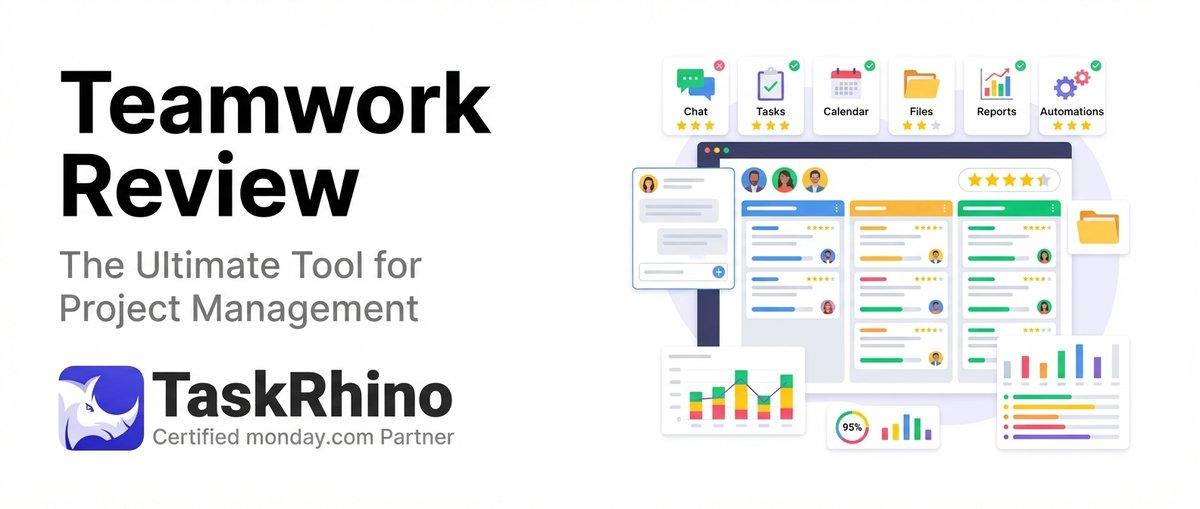
Teamwork Review: The Ultimate Tool for Efficient Project Management
Teamwork.com positions itself as the project management platform built specifically for client work—but does it deliver on that promise? After extensive testing and analysis of 1,000+ user reviews, we’re breaking down everything you need to know about Teamwork.com’s features, pricing, limitations, and whether it’s the right fit for your team in 2026.
Quick Verdict: Is Teamwork.com Worth It?
| Category | Rating | Assessment |
|---|---|---|
| Best For | ⭐⭐⭐⭐⭐ | Agencies, consultancies, professional services managing billable client projects |
| Ease of Use | ⭐⭐⭐ | Powerful but steep learning curve; expect 2-3 weeks for team adoption |
| Value for Money | ⭐⭐⭐⭐ | Strong ROI for client-facing teams; built-in time tracking and budgeting justify the cost |
The Bottom Line
✅ Choose Teamwork.com if you:
- Manage multiple client projects with billable hours
- Need robust financial tracking (budgets, profitability, invoicing)
- Want time tracking built-in without paying for add-ons
- Run an agency, consultancy, or professional services firm
❌ Skip Teamwork.com if you:
- Need a simple tool for internal projects only
- Want minimal setup with instant team adoption
- Require advanced automation (limited to 100 actions/month on Free plan)
- Need a client portal (requires workarounds or third-party tools)
Bottom Line: Teamwork.com excels at what it’s designed for—client-facing project work with financial tracking—but struggles with complex automation and has a steeper learning curve than competitors like monday.com or ClickUp.
Real-World Impact: 3 TaskRhino Success Stories
Story #1: Creative Agency Recovers $40K in Unbilled Hours
The Challenge: A 15-person digital marketing agency was losing track of billable hours across 30+ active client projects. They estimated 10-15% of work was going unbilled due to forgotten time entries and poor visibility into project budgets.
The TaskRhino Solution: After migrating from Trello to Teamwork.com with our implementation support, the agency:
- Set up project templates with pre-configured budgets and milestones
- Implemented built-in time tracking with automatic billable/non-billable categorization
- Created weekly utilization reports to identify unbilled time before invoice cycles
The Results: Within 90 days, the agency recovered approximately $40,000 in previously unbilled hours, improved billable utilization from 62% to 78%, and reduced time-to-invoice from 2 weeks to 3 days.
Story #2: IT Consultancy Eliminates Email Chaos with Client Collaboration
The Challenge: A 25-person IT consultancy was drowning in client emails—critical requests buried in threads, no centralized project history, and constant “Where are we on this?” questions from clients.
The TaskRhino Solution: We configured Teamwork.com’s collaboration features to:
- Create client-facing project views with controlled access
- Set up intake forms for new client requests with automatic task creation
- Implement automated status updates via email so clients stay informed without constant check-ins
The Results: Client satisfaction scores increased from 7.2 to 8.9 (out of 10), internal team reported 40% reduction in “status check” emails, and project managers saved an estimated 6 hours per week previously spent on client communications.
Story #3: Architecture Firm Gains Visibility Across 50+ Projects
The Challenge: A growing architecture firm with 50+ concurrent projects had zero visibility into resource allocation. Partners couldn’t answer basic questions like “Who’s available next week?” or “Are we over-budget on the downtown project?”
The TaskRhino Solution: Our team implemented:
- Teamwork.com’s Workload Planner to visualize resource allocation across all projects
- Custom reports showing planned vs. actual hours and budget burn rates
- Project health dashboards for leadership visibility without micromanaging
The Results: The firm identified 3 projects that were 25%+ over budget (enabling course correction), improved resource utilization by 18%, and gave partners real-time visibility that previously required 4+ hours of manual spreadsheet work weekly.
Features: What Teamwork.com Actually Delivers
Teamwork.com packs an extensive feature set designed around client work. Here’s what matters most in 2026:
Core Project Management Features
| Feature | Free Plan | Paid Plans | Notes |
|---|---|---|---|
| Task Management | ✅ Unlimited | ✅ Unlimited | Subtasks, dependencies, multiple assignees supported |
| Project Templates | ✅ 1 template | ✅ 20-Unlimited | Huge time-saver for repeatable client work |
| Multiple Views | ✅ List, Board, Table | ✅ + Gantt, Calendar | Gantt requires Grow plan or higher |
Task Management Deep Dive
Teamwork.com’s task management goes beyond basic to-dos:
✅ What Works Well:
- Subtasks with dependencies — Create complex task hierarchies with predecessor/successor relationships
- Multiple assignees — Assign tasks to entire teams, not just individuals
- Custom fields — Add dropdowns, text fields, numbers to capture project-specific data
- Task templates — Pre-configure recurring task structures with one click
⚠️ Limitations:
- No native Kanban board limits — Unlike monday.com or ClickUp, you can’t set WIP limits on boards
- Task visibility issues — Users report difficulty seeing all assigned tasks across projects (requires custom filters)
- Learning curve — Takes 2-3 days to master task creation workflow due to numerous options
Time Tracking & Financial Management
This is where Teamwork.com truly differentiates itself from competitors:
| Capability | Details | Available On |
|---|---|---|
| Built-in Time Tracking | ✅ Manual and timer-based entries | All plans (even Free) |
| Billable vs Non-Billable | ✅ Categorize time automatically | All plans |
| Project Budgeting | ✅ Set hours and dollar budgets | Deliver plan+ |
| Profitability Reports | ✅ Actual vs. planned profit margins | Scale plan only |
Why This Matters: Most competitors (including monday.com) charge $5-8/user/month extra for time tracking. Teamwork.com includes it standard, saving teams $600-1,000+ annually for a 10-person team.
Real-World Example: Budget Tracking
Let’s say you’re running a website redesign project with a $25,000 budget and 100-hour estimate:
- Set budget in Teamwork.com — Enter $25,000 and 100 hours when creating the project
- Team logs time automatically — Designers and developers track time as they work
- Get real-time alerts — Teamwork.com warns you at 75% and 90% budget consumption
- Run profitability reports — See actual profit margins including overhead, not just hours vs. budget
Competitor Comparison:
| Platform | Time Tracking | Budgets | Profitability |
|---|---|---|---|
| Teamwork.com | ✅ Built-in | ✅ Built-in (Deliver+) | ✅ Built-in (Scale+) |
| monday.com | ❌ Add-on ($8/user) | ⚠️ Basic only | ❌ Not available |
| ClickUp | ✅ Built-in | ⚠️ Hour estimates only | ❌ Not available |
| Asana | ❌ Third-party only | ⚠️ Basic milestones | ❌ Not available |
Collaboration & Communication
| Feature | Capability | Best Use Case |
|---|---|---|
| Comments & Mentions | ✅ Rich text, @mentions, file attachments | Reduce email threads by centralizing discussions on tasks |
| Proofing | ✅ Visual markup on images/PDFs | Design teams reviewing creative deliverables |
| Intake Forms | ✅ Create client request forms (Deliver+) | Standardize how clients submit new work requests |
⚠️ Major Gap: No Native Client Portal
Unlike competitors like monday.com (which offers client-facing boards), Teamwork.com doesn’t have a true client portal. Your options:
- Guest access — Give clients limited login access (works but feels clunky)
- Email updates — Automatic notifications keep clients informed (one-way only)
- Third-party integrations — Use tools like Clientjoy or Copilot (added cost)
Impact: Many agencies report this as a dealbreaker, forcing them to maintain separate client communication tools.
Automation & Integrations
| Category | Details | Plan Availability |
|---|---|---|
| Automation Actions | 100-100,000/month depending on plan | All plans (limits vary) |
| Conditional Logic | ⚠️ Basic if/then on Free; if/and/or/then on paid | Deliver plan for advanced |
| Native Integrations | ✅ Slack, MS Teams, QuickBooks, HubSpot, 80+ apps | All plans (some require higher tiers) |
Automation Reality Check:
Teamwork.com’s automation is functional but limited compared to monday.com or ClickUp:
- 100 actions/month on Free plan — Sounds like a lot but burns quickly (each triggered automation = 1 action)
- No multi-step workflows — Can’t chain multiple actions like “When task completes → Create follow-up task → Notify manager → Update budget”
- Limited triggers — Focused on task status changes, assignments, and dates—missing triggers like “form submission” or “custom field changes”
Who This Works For: Teams with straightforward needs like “When task marked complete → notify client” or “When project created → apply template.”
Who This Doesn’t Work For: Teams needing complex workflows like demand generation agencies tracking leads through multi-stage pipelines.
Reporting & Analytics
Teamwork.com offers strong reporting for client-facing work:
| Report Type | What It Shows | Available On |
|---|---|---|
| Project Health | ✅ On-track/at-risk status | Deliver plan+ |
| Utilization Reports | ✅ Billable vs. available capacity | Deliver plan+ |
| Time & Budget Reports | ✅ Planned vs. actual breakdown | All plans |
| Profitability Reports | ✅ Gross profit margins by project/client | Scale plan only |
Custom Reporting Limits:
- 1 active chart on Deliver plan — Upgrade to Scale ($19.99/user/month) to unlock 3+ custom report charts
- No dashboard widgets — Unlike monday.com’s customizable dashboards, Teamwork.com reports are standalone
- Export flexibility — ✅ Can export all reports to CSV/Excel/PDF
See How BoardBridge Handles This Workflow
Book a free demo to see BoardBridge solve this exact problem — live, with your data.
Pricing Breakdown: What You’ll Actually Pay in 2026
Teamwork.com uses per-user pricing with five tiers. Here’s what you need to know:
Pricing Plans Comparison
| Plan | Price/User/Month | Best For | Key Limitations |
|---|---|---|---|
| Free Forever | $0 | Solopreneurs, 5-person teams testing Teamwork | 5 users, 5 projects, 100 automations/month |
| Deliver | $10.99 (annual) | Small agencies getting serious about client work | 300 projects, 5K automations, 100GB storage |
| Grow | $19.99 (annual) | Growing agencies needing financials + resource planning | 600 projects, 20K automations, 250GB storage |
| Scale | Custom pricing | Established firms (usually 25+ users) | Unlimited projects, profitability reports, 500GB+ |
| Enterprise | Custom pricing | Large organizations requiring SSO, dedicated support | Advanced security, 1TB storage, dedicated account manager |
💡 Pricing Notes:
- Annual billing required for listed prices — Monthly billing costs ~20% more
- Minimum 3 users on Deliver plan — Can’t purchase for 1-2 people
- Storage overages — Additional storage available but costs vary (contact sales)
- 30-day free trial — Test Deliver plan features before committing
Real-World Cost Scenarios
Let’s break down actual costs for typical teams:
Scenario 1: 10-Person Digital Agency
Setup:
- 10 users on Grow plan ($19.99 × 10 = $199.90/month)
- Paid annually: $2,398.80/year
- ~20 active client projects
- 150 hours of billable work tracked weekly
Alternative Cost (monday.com):
- 10 users on Pro plan ($12 × 10 = $120/month)
- Time Tracking add-on ($8 × 10 = $80/month)
- Total: $200/month OR $2,400/year
Verdict: Nearly identical cost, but Teamwork.com includes budgeting and profitability reports that monday.com lacks.
Scenario 2: 3-Person Consultancy
Setup:
- 3 users on Deliver plan ($10.99 × 3 = $32.97/month)
- Paid annually: $395.64/year
- 5-10 client projects
- Basic time tracking needs
Alternative Cost (ClickUp):
- 3 users on Unlimited plan ($10 × 3 = $30/month)
- Total: $360/year
Verdict: ClickUp slightly cheaper with more automation, but lacks Teamwork.com’s financial management depth.
Scenario 3: 50-Person Enterprise Firm
Setup:
- 50 users on Scale plan (custom pricing, estimate $17/user)
- Estimated cost: ~$850/month or $10,200/year
- 200+ projects
- Advanced profitability reporting
- Dedicated account manager
Verdict: At enterprise scale, Teamwork.com competes favorably with monday.com Enterprise (~$20/user) and Wrike Enterprise (~$25/user), especially for teams prioritizing financial visibility.
Hidden Costs to Consider
| Cost Category | Details | Estimated Annual Cost |
|---|---|---|
| Training & Onboarding | Steep learning curve may require training investment | $500-2,000 |
| Integration Tools | Zapier Premium for advanced automation | $600-1,200 |
| Client Portal Workaround | Third-party tool if client portal required | $300-600 |
Total Cost of Ownership: For a 10-person team, expect $3,000-4,000/year when factoring in Teamwork.com subscription + hidden costs.
Pros and Cons: The Honest Assessment
What Teamwork.com Does Well ✅
| Strength | Why It Matters | Who Benefits Most |
|---|---|---|
| Built-in Time Tracking | No add-ons required; billable/non-billable categorization automatic | Agencies, consultancies billing clients hourly |
| Financial Management | Budget tracking, profitability reports, invoice readiness | Professional services firms needing profit visibility |
| Project Templates | Massive time savings for repeatable client deliverables | Teams running similar projects repeatedly |
Additional Strengths
✅ Mature, stable platform — 16+ years in business; rarely experiences downtime (99.9% uptime)
✅ Excellent customer support — Highly rated support team; most issues resolved within 24 hours
✅ Strong reporting — Pre-built reports cover 80% of agency/consultancy needs without custom development
✅ Gantt chart functionality — Robust dependency management for complex project schedules
✅ Flexible permissions — Granular control over what team members and clients can see/edit
What Teamwork.com Struggles With ❌
| Weakness | Real-World Impact | Workaround |
|---|---|---|
| Steep Learning Curve | 2-3 weeks for team adoption; users report “overwhelming” interface | Invest in structured onboarding; start with templates |
| Limited Automation | 100 actions/month on Free; no multi-step workflows | Upgrade to Deliver+ or use Zapier ($) |
| No Client Portal | Clients can’t easily submit requests or track project status | Use intake forms + guest access (clunky) |
Additional Limitations
❌ Task visibility problems — Seeing all assigned tasks across projects requires custom filters (users report frustration)
❌ Mobile app limitations — iOS/Android apps lag behind web version; missing features like bulk editing
❌ Email integration weakness — Can’t manage project communications via email within Teamwork (many competitors offer this)
❌ Scaling challenges with diverse projects — System performance degrades with 100+ highly varied projects
❌ Pricing transparency — Scale and Enterprise pricing hidden; requires sales calls (frustrating for self-serve buyers)
Need Help With Your monday.com Setup?
TaskRhino has implemented monday.com for 110+ teams. Get a free consultation.
Who Should Use Teamwork.com? (And Who Shouldn’t)
Ideal Use Cases ✅
| Team Type | Why Teamwork.com Fits | Key Features to Use |
|---|---|---|
| Digital Agencies | Client project management + time tracking + budgets in one platform | Time tracking, project templates, client collaboration |
| Consulting Firms | Strong financial management and profitability visibility | Budget tracking, utilization reports, profitability dashboards |
| Professional Services | Built for billable hour tracking and resource allocation | Workload planner, time reports, invoice readiness |
✅ You’re a Great Fit If You:
- Manage 5+ client projects simultaneously with distinct budgets
- Bill clients hourly or need detailed time/budget tracking
- Run an agency, consultancy, or professional services firm with 5-50 team members
- Value financial visibility (profitability, utilization) as much as task management
- Can invest 2-3 weeks in proper onboarding and team training
Poor Fit Scenarios ❌
| Team Type | Why Teamwork.com Doesn’t Fit | Better Alternative |
|---|---|---|
| Internal Product Teams | Overkill for non-billable internal work; better tools exist | ClickUp, Linear, or Jira |
| Solopreneurs | Steep learning curve not worth it for 1-person operations | Notion, Trello, or Asana (free) |
| Teams Needing Heavy Automation | Limited automation capabilities vs. competitors | monday.com or ClickUp |
❌ Skip Teamwork.com If You:
- Need instant adoption with zero training investment (choose Trello or Asana)
- Require advanced automation for complex workflows (choose monday.com or ClickUp)
- Want a client portal out-of-the-box (choose monday.com with client-facing boards)
- Manage primarily internal projects without time/budget tracking needs (choose Jira or Linear)
- Have a team under 5 people and simple needs (use free tools like Trello or Notion)
Confused about which tool fits your team? We’ll help you decide with a free 30-minute consultation →
Limitations & Dealbreakers: What Teamwork.com Can’t Do
Even supporters acknowledge Teamwork.com’s shortcomings. Here are the most commonly reported limitations in 2026:
Critical Limitations
| Limitation | Impact | Severity |
|---|---|---|
| No Native Client Portal | Clients can’t easily submit requests or track status self-service | 🔴 High (dealbreaker for many) |
| Weak Email Integration | Can’t manage client emails within Teamwork; requires separate inbox | 🟡 Medium (workaround: forwarding rules) |
| Limited Automation Logic | Can’t build complex multi-step workflows | 🟡 Medium (Zapier integration helps) |
Frequently Mentioned Frustrations
1. Overwhelming Interface for New Users
With 100+ features, Teamwork.com’s interface intimidates new users. Common complaints:
- “Too many settings and options to learn”
- “Takes 2-3 weeks before team stops asking ‘how do I…?’ questions”
- “Wish there was a simplified ‘lite mode’ for basic users”
Mitigation: Start with project templates and limit access to advanced features until team masters basics.
2. Task Visibility Across Projects
Users report difficulty seeing all assigned tasks across multiple projects. The default “My Tasks” view requires manual filtering to be useful.
Mitigation: Create custom filters and save them, or use the mobile app’s task list (ironically better than desktop).
3. Automation Limits on Lower Plans
100 automation actions/month on the Free plan sounds generous but burns quickly:
- Project creation from template = ~10 actions
- Daily automation checking overdue tasks = 30 actions/month
- Client notification workflow = 2-3 actions per trigger
Reality: Active teams hit the 100-action limit within 10-15 days, forcing upgrade to Deliver plan.
4. Mobile App Feature Gaps
The iOS/Android apps lack key features available on web:
❌ Can’t bulk edit tasks ❌ Limited custom field editing ❌ No access to advanced reports ❌ Gantt chart viewing only (no editing)
Impact: Team members working remotely or on-site with clients report needing laptop access for full functionality.
5. Storage Limits
Storage allocation across plans:
- Free: 100MB (basically nothing for real projects)
- Deliver: 100GB (adequate for most small teams)
- Grow: 250GB
- Scale: 500GB+
Reality Check: A design agency uploading client deliverables (PSDs, videos, raw footage) can fill 100GB in 6-12 months, forcing upgrade.
When to Choose Alternatives
Choose ClickUp instead if:
- You need unlimited automation even on free/low tiers
- Your team lives in “everything view” mode (ClickUp’s hierarchy is more flexible)
- You want built-in docs, wikis, and knowledge management
Choose monday.com instead if:
- You need client-facing boards/portals
- Visual, colorful interfaces help your team adoption
- You want pre-built industry templates (monday.com has 200+)
Choose Asana instead if:
- You’re managing internal projects without billable hour tracking
- Simplicity and fast adoption trump feature depth
- Budget is tight (Asana’s free plan is more generous)
Alternatives to Teamwork.com: How Competitors Stack Up
Top 4 Teamwork.com Alternatives in 2026
1. monday.com — Best for Visual Teams & Client Portals
| Factor | monday.com | Advantage |
|---|---|---|
| Ease of Use | ⭐⭐⭐⭐⭐ (extremely intuitive) | monday.com (colorful, visual) |
| Time Tracking | ⭐⭐ (paid add-on) | Teamwork.com (built-in) |
| Client Portal | ⭐⭐⭐⭐⭐ (native client-facing boards) | monday.com |
| Pricing | $$$ ($12-20/user) | Similar |
Best For: Teams prioritizing ease of use and client collaboration over financial management depth.
Why Choose monday.com Over Teamwork.com:
- Your team struggles with complex tools (monday.com faster adoption)
- You need a true client portal for self-service status updates
- Visual, colorful boards motivate your team
Why Choose Teamwork.com Over monday.com:
- You need built-in time tracking and profitability reports without add-ons
- Financial management is critical to your operations
- You’re managing 20+ client projects with distinct budgets
2. ClickUp — Best for Automation & Flexibility
| Factor | ClickUp | Advantage |
|---|---|---|
| Automation | ⭐⭐⭐⭐⭐ (unlimited on all plans) | ClickUp |
| Financial Management | ⭐⭐ (basic budgets only) | Teamwork.com |
| Customization | ⭐⭐⭐⭐⭐ (infinitely flexible) | ClickUp |
| Complexity | ⭐⭐ (overwhelming for non-power users) | Tie (both complex) |
Best For: Power users and technical teams wanting ultimate customization and automation.
Why Choose ClickUp Over Teamwork.com:
- You need unlimited automation on free/low-cost plans
- Your workflows are highly custom and don’t fit standard PM templates
- You want docs, wikis, and knowledge base in same tool
Why Choose Teamwork.com Over ClickUp:
- You need robust financial management (budgets, profitability, invoicing)
- Your team prefers opinionated tools with best-practice workflows
- Client-facing work is your primary use case (ClickUp more generic)
3. Asana — Best for Simplicity & Internal Projects
| Factor | Asana | Advantage |
|---|---|---|
| Ease of Use | ⭐⭐⭐⭐⭐ (simplest to learn) | Asana |
| Time Tracking | ⭐ (third-party only) | Teamwork.com |
| Free Plan | ⭐⭐⭐⭐ (generous limits) | Asana |
| Client Work Features | ⭐⭐ (basic) | Teamwork.com |
Best For: Teams managing internal projects without billable hour tracking or complex financial needs.
Why Choose Asana Over Teamwork.com:
- You’re managing internal projects (no clients, no billable hours)
- Simplicity and fast adoption are top priorities
- Your team is under 15 people with straightforward needs
Why Choose Teamwork.com Over Asana:
- You bill clients hourly and need time tracking
- Financial visibility (budgets, profit margins) matters
- You’re running an agency or consultancy with client work
4. Wrike — Best for Large Enterprises
| Factor | Wrike | Advantage |
|---|---|---|
| Enterprise Features | ⭐⭐⭐⭐⭐ (advanced security, SSO, etc.) | Wrike |
| Ease of Use | ⭐⭐ (steep learning curve) | Tie (both complex) |
| Pricing | $$$$ (expensive) | Teamwork.com (better value) |
| Proofing/Approvals | ⭐⭐⭐⭐⭐ (best-in-class) | Wrike |
Best For: Large enterprises (100+ users) with complex approval workflows and strict security requirements.
Why Choose Wrike Over Teamwork.com:
- You have 100+ users and need enterprise-grade security
- You require advanced proofing and approval workflows for creative assets
- Compliance and audit trails are critical (finance, healthcare, government)
Why Choose Teamwork.com Over Wrike:
- Your team is under 50 people (Wrike overkill and overpriced)
- You want better value (Teamwork.com costs 30-40% less at scale)
- Financial management matters more than enterprise governance
Stop Creating Duplicates
BoardBridge forms update existing items — no Enterprise plan, no workarounds, no duplicates.
Frequently Asked Questions
How does Teamwork.com’s per-user pricing scale for agencies with fluctuating team sizes across multiple client projects?
Teamwork.com offers flexible per-user/monthly pricing billed yearly, starting at $10.99 for Deliver (1 user min), $19.99 for Grow (5 user min), and $54.99 for Scale, allowing upgrades or downgrades anytime via settings without contracts or fees. This self-serve scalability suits agencies managing variable team sizes, though minimums on Grow may increase costs for small temporary teams. The Free plan caps at 5 users, ideal for testing but limits advanced client work features.
What advanced financial tracking features are exclusive to Teamwork.com’s Scale plan for billable client services?
The Scale plan at $54.99/user/month includes profitability reporting, unlimited financial budgets, and 500 GB storage, essential for agencies tracking billable hours and project margins. Lower tiers like Grow ($19.99) offer project time budgets and resource scheduling but lack unlimited budgets and profitability insights. This tiered access ensures client-focused teams pay for comprehensive invoicing and reporting only when scaling complex portfolios.
Can Teamwork.com’s Free plan handle time tracking and invoicing for small consultancies before upgrading?
Yes, the Free plan ($0, up to 5 users) includes time tracking, timesheets, billable time tracking, estimated time management, user rates, clients view, client company management, and invoices, making it viable for small teams starting client work. However, it lacks advanced features like custom fields, automations, or workload management available in paid plans starting at $10.99. Users can seamlessly upgrade to Deliver or higher as project volume grows without data loss.
What are the key limitations of Teamwork.com’s Grow plan for professional services firms needing custom workflows?
The Grow plan ($19.99/user/month, 5-user min) provides 50 project templates, custom fields, HubSpot integration, project time budgets, and resource scheduling but caps projects and excludes profitability reports or unlimited budgets found in Scale. Some users note restrictive access controls and missing advanced automations/forms compared to competitors, potentially requiring Scale for complex client approvals. Agencies can add premium support or SSO as optional upgrades.
How does Teamwork.com’s pricing compare to monday.com for agencies prioritizing client billing and resource allocation?
Teamwork.com’s tiers ($10.99 Deliver to $54.99 Scale) offer average pricing with strong client-focused features like invoicing and billable tracking, balancing cost better than monday.com for agencies per reviews. While monday.com may have more templates at entry levels, Teamwork excels in profitability reporting at Scale, though its user minimums can be costlier for small teams. Flexible upgrades and a 30-day trial aid evaluation without commitment.
What integration and reporting gaps exist in Teamwork.com’s lower tiers for consultancies using HubSpot or Mailchimp?
HubSpot integration is exclusive to Grow ($19.99+) and above, while Mailchimp is limited to higher Desk tiers ($17+), unavailable in core Deliver ($10.99). Lower plans lack advanced reports like profitability (Scale-only) and workload management, forcing upgrades for full client pipeline visibility. Enterprise custom pricing bundles Desk, Spaces, and One for comprehensive needs, potentially saving over $220/month for 5 users vs. separate purchases.


Editor's Choice

ClickUp Review 2026: Honest Analysis

monday.com Review 2026: Honest Analysis
The Detailed Twenty CRM Review: Features and limitations