

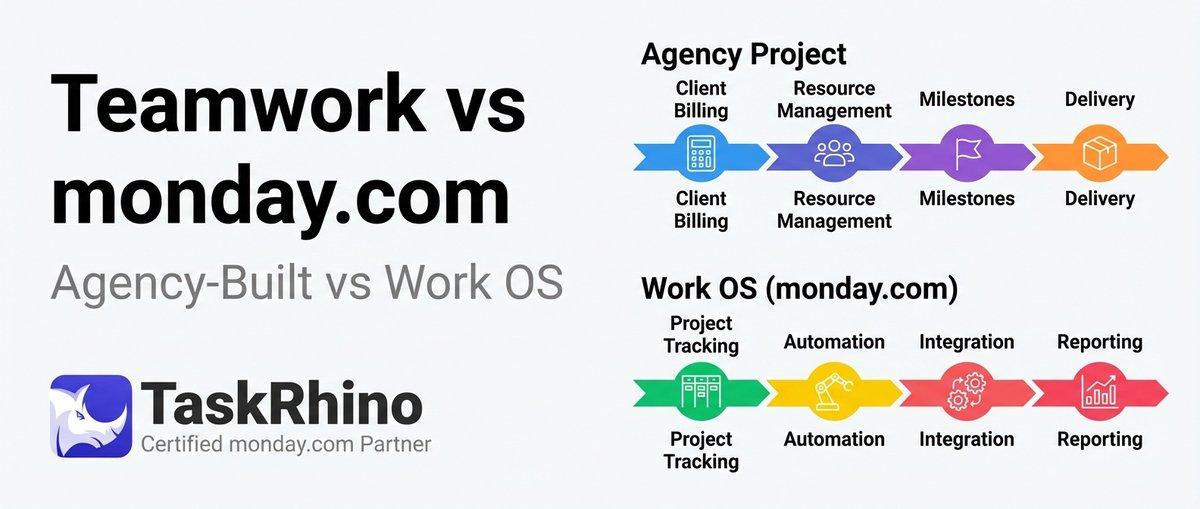
Teamwork vs monday.com 2026: Agency-Built vs Work OS (Which Fits Your Business?)
Choosing between Teamwork and monday.com comes down to one question: are you billing clients by the hour, or managing internal workflows?
Teamwork is purpose-built for agencies, consultancies, and professional services firms that need client billing, time tracking, and profitability reports baked into their project management tool. monday.com is a flexible Work OS designed for any team that wants customizable workflows, powerful automations, and visual project tracking across departments.
I’ve worked with both platforms extensively — setting up workflows for marketing agencies on Teamwork and building custom dashboards for remote teams on monday.com. This comparison breaks down exactly what each tool does well, where they fall short, and which one fits your specific needs.
Quick Verdict
Choose Teamwork if:
- You bill clients hourly and need built-in time tracking + invoicing
- You run an agency, consultancy, or professional services firm
- You need project budgets, profitability reports, and resource scheduling out of the box
- Client portals and retainer management matter to your business model
Choose monday.com if:
- You need flexible workflows that adapt to any team or department
- You want more board views (10+ options vs. Teamwork’s 6)
- Automations and integrations are central to your workflow (250+ pre-built automations)
- You’re scaling beyond pure project management into CRM, dev workflows, or service management
At-a-Glance Comparison
| Feature | Teamwork | monday.com |
|---|---|---|
| Best For | Agencies billing clients | Any team, any workflow |
| Starting Price | Free (5 users) | Free (2 users) |
| Paid Plans Start | $13.99/user/mo | $9/seat/mo |
| Built-in Time Tracking | ✅ Yes (all plans) | ❌ No (column type only) |
| Client Billing/Invoicing | ✅ Yes | ❌ No |
| Profitability Reports | ✅ Yes | ❌ No |
| Automations | Basic | Advanced (250+ templates) |
| Board Views | 6 | 10+ |
| Client Portal | ✅ Yes | ⚠️ Guest access only |
| Resource Scheduling | ✅ Yes (Grow+ plans) | ⚠️ Enterprise only |
| Custom Workflows | Limited | Highly flexible |
| Learning Curve | Moderate | Easy |
What Is Teamwork?
Teamwork is a project management platform designed specifically for client-facing businesses. It’s built around the assumption that you’re juggling multiple client projects, tracking billable hours, managing budgets, and need to prove profitability on every engagement.
The platform includes native time tracking (not a third-party add-on), project budgets with real-time burn rates, billable vs. non-billable hour tracking, client portals for collaboration, and profitability reports that show exactly which clients and projects are making you money.
Teamwork is trusted by agencies, IT service providers, consulting firms, and professional services teams. If your business model involves selling hours to clients, Teamwork speaks your language.
What Is monday.com?
monday.com started as a project management tool but evolved into what they call a “Work OS” — a flexible platform that teams customize to run any workflow. That means product launches, marketing campaigns, CRM pipelines, software development sprints, HR onboarding, event planning, or whatever your team needs to track.
The platform gives you building blocks: boards, views, dashboards, automations, and integrations. You configure them to match your process rather than adapting your process to the tool. monday.com is used by over 250,000 teams across industries — from 3-person startups to enterprise organizations.
If you want to learn more about how monday.com works, check out What Is monday.com?.
Pricing Breakdown
Pricing is where these two platforms diverge significantly — both in structure and value proposition.
Teamwork Pricing (2026)
| Plan | Price | Best For | Key Features |
|---|---|---|---|
| Free | $0 | Freelancers, small teams | Up to 5 users, 5 projects, 100 automations/month, time tracking, client work foundations |
| Deliver | $13.99/user/mo (billed yearly: $10.99/user/mo) | Growing agencies | Project health reports, intake forms, planned vs. actual reports, 5,000 automations/month, 100GB storage, integrations (QuickBooks, Harvest) |
| Grow | $25.99/user/mo (billed yearly: $19.99/user/mo) | Established agencies | Budgeting, HubSpot integration, workload resource planner, utilization reports, 20,000 automations/month, 250GB storage, 600 projects |
| Scale | Custom pricing | Large agencies | Unlimited projects/templates/budgets, profitability reports, resource scheduling, retainer management (beta), custom reporting, 100,000 automations/month, 500GB storage |
| Enterprise | Custom pricing | Enterprise teams | Advanced security + SSO, premium support, dedicated infrastructure, increased API limits, 1TB storage, dedicated account manager, up to 10 hours tech services |
Annual discount: 29% off when paying yearly.
External pricing reference: Teamwork Pricing
monday.com Pricing (2026)
| Plan | Price | Best For | Key Features |
|---|---|---|---|
| Free | $0 | Individuals | Up to 2 seats, 3 boards, 3 Docs, 200+ templates, iOS/Android apps |
| Basic | $9/seat/mo (billed yearly) | Small teams | Unlimited items, 5GB storage, unlimited free viewers, AI credits, prioritized support, 1-board dashboards |
| Standard | $12/seat/mo (billed yearly) | Growing teams | Timeline & Gantt views, calendar view, guest access, 250 automations/month, 250 integrations/month, 5-board dashboards |
| Pro | $19/seat/mo (billed yearly) | Teams at scale | Private boards, chart view, time tracking column, formula column, 25,000 automations/month, 25,000 integrations/month, 20-board dashboards |
| Enterprise | Custom pricing | Large organizations | Portfolio management, resource management (Enterprise-grade), 250,000 automations/month, multi-level permissions, enterprise security, advanced analytics, 50-board dashboards, 24/7 support |
Annual discount: 18% off when paying yearly.
Minimum seats: 3 users for paid plans.
External pricing reference: monday.com Pricing
Pricing Verdict
Teamwork costs more upfront, but includes features agencies need: Time tracking, billing, and profitability reports are built-in starting at $13.99/user/month. To replicate this on monday.com, you’d need third-party integrations (Harvest, Toggl) plus custom dashboards, which adds cost and complexity.
monday.com is cheaper for general project management: If you don’t need client billing or profitability tracking, monday.com starts at $9/seat/month and delivers more views, better automations, and broader use cases.
For a detailed breakdown of monday.com pricing and plans, see our monday.com Review.
Feature Comparison: What Each Tool Does Best
Time Tracking & Billing
This is Teamwork’s killer differentiator.
Teamwork:
- Built-in time tracking across all plans, including Free
- Billable vs. non-billable hours tagged at the task level
- Timesheets with approval workflows
- Budget tracking with real-time burn rates and alerts
- Profitability reports showing revenue vs. cost per project and client
- Integrations with QuickBooks, Harvest, Xero for invoicing and accounting
- Client billing with customizable rates (per user, per role, or flat fee)
A marketing agency I worked with used Teamwork to track 40+ concurrent client projects. Every task had a time estimate and billable rate. At the end of each month, they exported timesheets directly into QuickBooks for invoicing. The profitability dashboard showed which clients were profitable and which were burning hours.
monday.com:
- Time tracking column (Pro plan and above)
- Tracks time spent, but not designed for client billing
- No native invoicing, budgeting, or profitability reports
- Requires third-party tools (Harvest, Toggl, Clockify) for billing workflows
- Formula columns can calculate costs, but it’s manual setup
Verdict: If you bill clients by the hour, Teamwork wins decisively. monday.com can track time, but it’s not built for agencies that need to tie hours to revenue.
| Capability | Teamwork | monday.com |
|---|---|---|
| Built-in time tracking | ✅ All plans | ⚠️ Pro+ only (column type) |
| Billable vs. non-billable | ✅ Yes | ❌ No |
| Budget tracking | ✅ Yes | ❌ No (manual via formulas) |
| Profitability reports | ✅ Yes (Scale plan) | ❌ No |
| Invoicing integration | ✅ Yes (QuickBooks, Harvest, Xero) | ❌ Requires third-party tools |
| Timesheet approval | ✅ Yes | ❌ No |
Project Views
Teamwork:
- List view
- Table view
- Board/Kanban view
- Gantt chart
- Calendar view
- Everything view (cross-project overview)
Total: 6 views
monday.com:
- Table view (default)
- Kanban board
- Timeline (Gantt)
- Calendar
- Chart view
- Map view
- Files view
- Workload view
- Form view
- Docs
Total: 10+ views
Verdict: monday.com offers significantly more views and visualization options. If your team switches between calendar, Gantt, and Kanban frequently, monday.com’s flexibility wins. Teamwork covers the basics but doesn’t offer map, chart, or files views.
For teams comparing monday.com to other flexible platforms, see ClickUp vs monday.com and monday.com vs Asana.
Automations
Teamwork:
- Automation limits: 100 actions/month (Free), 5,000 (Deliver), 20,000 (Grow), 100,000 (Scale)
- Basic if/then logic
- Limited to project management triggers (task status, due dates, assignments)
- Newer feature — not as mature as monday.com’s automation engine
monday.com:
- Automation limits: 250 actions/month (Standard), 25,000 (Pro), 250,000 (Enterprise)
- 250+ pre-built automation templates
- If/then logic with conditions and dependencies
- Trigger types: status changes, date arrives, item created, column changes, recurring schedules, and more
- Cross-board automations
- Integration automations (Slack, email, Zoom, Google Calendar, etc.)
A remote team I set up on monday.com automated their entire onboarding workflow: when a new employee was added to the “New Hires” board, automations created tasks across HR, IT, and Manager boards, assigned deadlines, sent Slack notifications, and scheduled a welcome Zoom call. Zero manual work.
Verdict: monday.com’s automations are far more powerful and flexible. If automation is central to your workflow, monday.com is the clear winner.
| Capability | Teamwork | monday.com |
|---|---|---|
| Pre-built templates | Limited | 250+ |
| Automation actions/month (mid-tier plan) | 5,000 (Deliver) | 25,000 (Pro) |
| Cross-board automations | ❌ No | ✅ Yes |
| Integration automations | ⚠️ Limited | ✅ Extensive |
| Conditional logic | Basic | Advanced |
For more on monday.com’s automation capabilities, see Wrike vs monday.com.
Customization & Flexibility
Teamwork:
- Structured for client work: The platform assumes you’re managing projects with tasks, milestones, time tracking, and budgets. You can customize fields and workflows, but the core structure is fixed.
- Custom fields available, but limited compared to monday.com
- Template library focused on agency/client work scenarios
- Not designed for non-PM workflows (CRM, event planning, HR)
monday.com:
- Work OS approach: You’re not limited to project management. Teams use monday.com for CRM pipelines, content calendars, event planning, recruitment tracking, IT ticketing, product roadmaps, and more.
- 40+ column types: Status, text, numbers, dates, people, files, dropdowns, ratings, formulas, dependencies, timelines, location, and more.
- 200+ templates across industries and use cases
- Build from scratch or customize templates to match your exact workflow
- Supports workflows far beyond traditional PM
Verdict: monday.com is significantly more flexible. If you need a platform that adapts to multiple departments or evolves as your team grows, monday.com wins. Teamwork is purpose-built for client work — which is perfect if that’s what you do, limiting if you need more.
Dashboards & Reporting
Teamwork:
- Custom reports: Limited on Free/Deliver plans, expanded on Grow+ plans
- Profitability reports (Scale plan): Revenue vs. cost per project and client
- Utilization reports (Grow plan): Billable vs. non-billable hours per team member
- Time reports: Planned vs. actual hours, budget burn rates
- Project health reports (Deliver plan): Status overviews, overdue tasks, upcoming deadlines
- Reporting is purpose-built for agencies — focused on budgets, billability, and profitability
monday.com:
- Dashboards available on all paid plans
- Number of boards per dashboard: 1 (Basic), 5 (Standard), 20 (Pro), 50 (Enterprise)
- 25+ dashboard widgets: Charts, timelines, battery widgets, workload views, numbers, countdowns, and more
- Custom dashboards for any metric — sales pipelines, marketing campaign performance, product roadmaps, team capacity
- Real-time updates — dashboards pull live data from boards
- Not built for profitability tracking — you’d need custom formulas and widgets to replicate Teamwork’s financial reports
Verdict: Teamwork wins for financial and profitability reporting. monday.com wins for visual, customizable dashboards across any workflow.
| Report Type | Teamwork | monday.com |
|---|---|---|
| Profitability reports | ✅ Yes (Scale plan) | ❌ No (manual setup) |
| Utilization reports | ✅ Yes (Grow plan) | ❌ No |
| Budget tracking | ✅ Yes | ⚠️ Manual (formula columns) |
| Custom dashboards | ⚠️ Limited | ✅ Highly flexible |
| Visual widgets | Basic | 25+ options |
| Cross-board dashboards | ⚠️ Limited | ✅ Yes (up to 50 boards) |
Client Collaboration
Teamwork:
- Client access: Unlimited free client users
- Client portals: Dedicated view for clients to see their projects, tasks, files, and messages without accessing your full workspace
- Permissions: Granular control over what clients can see and edit
- Client billing: Send invoices directly from the platform or integrate with QuickBooks/Xero
- Built for agencies that need to collaborate with external clients regularly
monday.com:
- Guest access: Invite external users to specific boards (Standard plan and above)
- Guests see only the boards they’re invited to
- No dedicated client portal — guests interact with the same board interface as internal team members
- Free viewers (Basic plan and above): Read-only access to boards
- Not designed for client billing or invoicing
Verdict: Teamwork is built for client-facing businesses. If you regularly collaborate with external clients and need dedicated portals, Teamwork wins. monday.com’s guest access works, but it’s not as tailored for client services.
Resource Management & Scheduling
Teamwork:
- Workload Resource Planner (Grow plan and above)
- Resource scheduling (Scale plan)
- View team capacity, allocate hours to projects, and identify bottlenecks
- Billable utilization targets per team member
- Designed for agencies managing multiple client projects simultaneously
monday.com:
- Workload view shows task distribution across team members
- Resource management available on Enterprise plan (portfolio and resource management features)
- Not as robust as Teamwork for capacity planning and billable hour allocation
Verdict: Teamwork offers better resource management for agencies at lower pricing tiers. monday.com’s resource features are strong but locked behind the Enterprise plan.
Integrations
Teamwork:
- Integrates with QuickBooks, Harvest, Xero (accounting/invoicing)
- Slack, Microsoft Teams (communication)
- Zapier (connects to 5,000+ apps)
- HubSpot (Grow plan and above)
- Google Workspace, Dropbox, OneDrive (file storage)
- Stripe (payments)
- Focus on integrations that support client work and billing
monday.com:
- Integrates with Slack, Microsoft Teams, Gmail, Outlook
- Zoom, Google Calendar
- Salesforce, HubSpot, Mailchimp (CRM and marketing)
- Jira, GitHub, GitLab (development)
- Dropbox, Google Drive, OneDrive (file storage)
- Zapier, Make (Integromat) (connects to thousands of apps)
- Adobe Creative Cloud, Figma (design)
- Shopify, WooCommerce (ecommerce)
- Broader integration ecosystem — covers more use cases beyond PM
Verdict: Both platforms integrate with the tools you’re already using. Teamwork focuses on agency/client work integrations (QuickBooks, Harvest). monday.com covers a wider range of use cases (CRM, dev, ecommerce, marketing).
| Integration Type | Teamwork | monday.com |
|---|---|---|
| Accounting (QuickBooks, Xero, Harvest) | ✅ Yes | ⚠️ Via Zapier |
| Communication (Slack, Teams) | ✅ Yes | ✅ Yes |
| CRM (Salesforce, HubSpot) | ⚠️ HubSpot (Grow+) | ✅ Yes |
| Development (Jira, GitHub) | ❌ No | ✅ Yes |
| Marketing (Mailchimp, Google Ads) | ❌ No | ✅ Yes |
| File storage (Dropbox, Google Drive) | ✅ Yes | ✅ Yes |
| Zapier/Make | ✅ Yes | ✅ Yes |
Mobile Experience
Teamwork:
- iOS and Android apps
- Track time on mobile
- View tasks, projects, and timelines
- Add comments and updates
- Functionality mirrors desktop for core features
monday.com:
- iOS and Android apps (available on all plans, including Free)
- Full board views: table, Kanban, calendar, timeline
- Add items, update statuses, assign tasks
- Notifications and activity feed
- Mobile experience is smooth and visually polished
Verdict: Both platforms offer solid mobile apps. monday.com’s mobile interface feels slightly more polished, but Teamwork’s mobile time tracking is a key advantage for agencies.
Learning Curve & Ease of Use
Teamwork:
- Moderate learning curve
- Structured around traditional project management concepts (projects, milestones, tasks, time tracking)
- Teams familiar with agency workflows adapt quickly
- Can feel overwhelming if you’re used to simpler tools (Trello, Asana)
monday.com:
- Easy to learn, especially for non-technical teams
- Visual, drag-and-drop interface
- Color-coded statuses and intuitive board layouts
- Customization power adds complexity — but you can start simple and build
Verdict: monday.com is easier to learn initially. Teamwork requires more setup and understanding of budgets, time tracking, and client workflows.
See How BoardBridge Handles This Workflow
Book a free demo to see BoardBridge solve this exact problem — live, with your data.
Use Case Recommendations
When Teamwork Is the Right Choice
You’re an agency, consultancy, or professional services firm: Teamwork is designed for you. If your business model involves selling hours to clients, tracking project budgets, and proving profitability, Teamwork gives you those tools out of the box.
You bill clients hourly: Built-in time tracking, billable vs. non-billable hours, and integrations with QuickBooks/Harvest make Teamwork the clear choice for billing workflows.
You manage multiple client projects simultaneously: Client portals, resource scheduling, and utilization reports help you juggle dozens of client engagements without losing track of capacity or profitability.
You need profitability reporting: If you need to know which clients and projects are making you money, Teamwork’s profitability reports (Scale plan) show revenue vs. cost per engagement.
Example: A 15-person marketing agency managing 30 client retainers. They track hours per client, set budgets, monitor burn rates, and export timesheets to QuickBooks for invoicing. Teamwork’s client portals let clients view progress without cluttering the internal workspace.
When monday.com Is the Right Choice
You need flexibility beyond project management: If your team runs workflows across departments — marketing campaigns, CRM pipelines, event planning, HR onboarding, product roadmaps — monday.com adapts to all of it. Teamwork doesn’t.
Automations drive your workflow: 250+ pre-built automations, cross-board workflows, and integration triggers make monday.com the automation powerhouse. If you want to eliminate manual work, monday.com delivers.
You want more board views: 10+ views (table, Kanban, timeline, calendar, chart, map, files, workload, form, Docs) beat Teamwork’s 6 views. If your team visualizes work differently, monday.com gives you options.
You’re scaling across teams and use cases: monday.com grows with you. Start with project management, expand into CRM (monday Sales CRM), developer workflows (monday Dev), or service management (monday Service). Teamwork stays in its lane: client work.
You don’t bill clients hourly: If you’re managing internal workflows, product launches, or fixed-fee projects where time tracking isn’t central, monday.com’s lower price point and broader features make it the better value.
Example: A 50-person remote startup managing product development, marketing, sales, and HR workflows. They use monday.com boards for sprint planning, content calendars, lead pipelines, and onboarding checklists. Automations sync tasks across teams, and dashboards show real-time progress.
Need Help With Your monday.com Setup?
TaskRhino has implemented monday.com for 110+ teams. Get a free consultation.
Direct Feature-by-Feature Breakdown
| Feature | Teamwork | monday.com | Winner |
|---|---|---|---|
| Time Tracking | Built-in (all plans) | Column type (Pro+) | Teamwork |
| Client Billing | Yes (native) | No | Teamwork |
| Profitability Reports | Yes (Scale plan) | No | Teamwork |
| Automations | Basic (100-100K/month) | Advanced (250-250K/month) | monday.com |
| Board Views | 6 | 10+ | monday.com |
| Customization | Moderate | High | monday.com |
| Dashboards | Basic | Advanced (25+ widgets) | monday.com |
| Client Portal | Yes | Guest access only | Teamwork |
| Resource Scheduling | Yes (Grow+ plans) | Enterprise only | Teamwork |
| Integrations | Agency-focused | Broad ecosystem | monday.com |
| Mobile App | Good | Excellent | monday.com |
| Ease of Use | Moderate | Easy | monday.com |
| Starting Price | Free (5 users) | Free (2 users) | Teamwork |
| Paid Plans Start | $13.99/user/mo | $9/seat/mo | monday.com |
| Best For | Agencies billing clients | Any team, any workflow | Depends |
Migration & Switching
Moving from Teamwork to monday.com
monday.com doesn’t offer a native Teamwork importer. You’ll need to:
- Export projects, tasks, and time logs from Teamwork (CSV format)
- Import data into monday.com boards using CSV import
- Rebuild automations and integrations manually
- Note: Time tracking and billing data won’t transfer directly — you’ll need to set up new workflows
Expect: A few days to a week for full migration, depending on project volume.
Moving from monday.com to Teamwork
Teamwork offers a native monday.com importer that transfers:
- Boards → Projects
- Items → Tasks
- Subitems → Subtasks
- Updates → Comments
- Files → Attachments
Process:
- Go to Settings > Import Data in Teamwork
- Select monday.com as the source
- Authenticate and choose boards to import
- Teamwork maps data automatically
Expect: Faster migration than the reverse. Most teams complete imports in a few hours.
Note: Automations and custom integrations won’t transfer — you’ll need to rebuild them in Teamwork.
Teamwork vs monday.com: The Final Decision Framework
Use this decision tree to cut through the noise:
Step 1: Do you bill clients by the hour?
- Yes → Teamwork (built-in time tracking, billing, profitability)
- No → Go to Step 2
Step 2: Do you manage workflows beyond project management (CRM, marketing, dev, HR)?
- Yes → monday.com (flexible Work OS)
- No → Go to Step 3
Step 3: Is automation central to your workflow?
- Yes → monday.com (250+ automation templates, cross-board workflows)
- No → Go to Step 4
Step 4: Do you need advanced dashboards and reporting?
- Financial profitability → Teamwork
- Visual, customizable dashboards → monday.com
Step 5: What’s your budget?
- Higher budget + need client billing → Teamwork ($13.99-$25.99/user/mo)
- Lower budget + general PM → monday.com ($9-$19/seat/mo)
Stop Creating Duplicates
BoardBridge forms update existing items — no Enterprise plan, no workarounds, no duplicates.
Frequently Asked Questions
Can monday.com replace Teamwork for agency work?
Not out of the box. monday.com can track time via a column type and calculate costs with formula columns, but it lacks native invoicing, profitability reports, and client billing workflows. You’d need to integrate third-party tools (Harvest, Toggl, QuickBooks) to replicate Teamwork’s financial features. If client billing is central to your business, Teamwork is purpose-built for you. If you can work with integrations and custom setups, monday.com offers more flexibility.
Does Teamwork have automations like monday.com?
Yes, but they’re more basic. Teamwork supports if/then automations for task assignments, status changes, and notifications. monday.com offers 250+ pre-built automation templates, cross-board triggers, and integration automations (Slack, email, Zoom, etc.). If automation is a core part of your workflow, monday.com is significantly more powerful.
Which tool is better for remote teams?
Both work well for remote teams. monday.com’s visual boards, real-time updates, and extensive integrations (Slack, Zoom, Google Calendar) make it slightly better for distributed collaboration. Teamwork excels if your remote team bills clients and needs time tracking across time zones. Both offer mobile apps and cloud-based access.
Can I use Teamwork without billing clients?
Absolutely. Teamwork works for internal project management, even if you’re not tracking billable hours. You’d simply ignore the billing and profitability features. However, at that point, you’re paying for features you’re not using. monday.com offers more flexibility and better value for non-client work.
Does monday.com have a client portal like Teamwork?
No. monday.com offers guest access (Standard plan and above), where you invite external users to specific boards. Guests see only the boards they’re invited to, but they interact with the same interface as internal team members. Teamwork’s client portal is a dedicated view designed for client collaboration, with granular permissions and a cleaner client-facing experience.
Which platform has better integrations?
Depends on your use case. Teamwork integrates tightly with accounting and invoicing tools (QuickBooks, Harvest, Xero), making it ideal for agencies. monday.com integrates with a broader ecosystem: CRM (Salesforce, HubSpot), development (Jira, GitHub), marketing (Mailchimp, Google Ads), and ecommerce (Shopify, WooCommerce). If you need integrations beyond client work, monday.com wins.
Can I import data from monday.com to Teamwork (or vice versa)?
Yes. Teamwork offers a native monday.com importer that transfers boards, items, subitems, updates, and files. The process is straightforward and takes a few hours. monday.com doesn’t offer a Teamwork importer, so you’d need to export data from Teamwork (CSV) and manually import it into monday.com boards. Expect a longer migration time in that direction.
Which tool is easier to learn?
monday.com is easier to pick up, especially for non-technical teams. The visual, drag-and-drop interface is intuitive, and you can start with simple boards and add complexity over time. Teamwork has a moderate learning curve — it assumes you understand project management concepts like milestones, budgets, and time tracking. Teams familiar with traditional PM tools (MS Project, Wrike) adapt quickly to Teamwork.
Does Teamwork offer a free plan?
Yes. Teamwork’s Free plan supports up to 5 users, 5 projects, time tracking, and basic client work features. It’s ideal for freelancers or small agencies testing the platform. monday.com’s Free plan supports up to 2 users and 3 boards, making it better for individuals than teams.
Which platform scales better for large teams?
monday.com scales more flexibly. The Enterprise plan supports portfolio management, resource management, and advanced security for large organizations. Teamwork scales well for agencies but stays focused on client work. If you’re scaling beyond project management into CRM, dev, or service workflows, monday.com grows with you. If you’re scaling an agency with hundreds of client projects, Teamwork’s resource scheduling and profitability reports scale better.
Final Verdict: Teamwork vs monday.com
Teamwork wins for agencies and professional services firms. If you bill clients by the hour, track project profitability, and need client portals baked into your PM tool, Teamwork is purpose-built for you. The built-in time tracking, financial reports, and resource scheduling justify the higher price for client-facing businesses.
monday.com wins for everyone else. If you’re managing internal workflows, need flexibility across departments, or want powerful automations and visual dashboards, monday.com delivers more value at a lower price. It’s a Work OS that adapts to any team, not just agencies.
The decision comes down to your business model:
- Selling hours to clients? → Teamwork
- Managing workflows for your own team? → monday.com
Both platforms are excellent at what they do. Choose the one that matches how you work, not the one with the most features.
Need help choosing the right project management platform for your team? We’re monday.com certified consultants who’ve set up workflows for agencies, startups, and remote teams. Book a free 30-minute consultation to map out your setup: Contact us here.


Editor's Choice
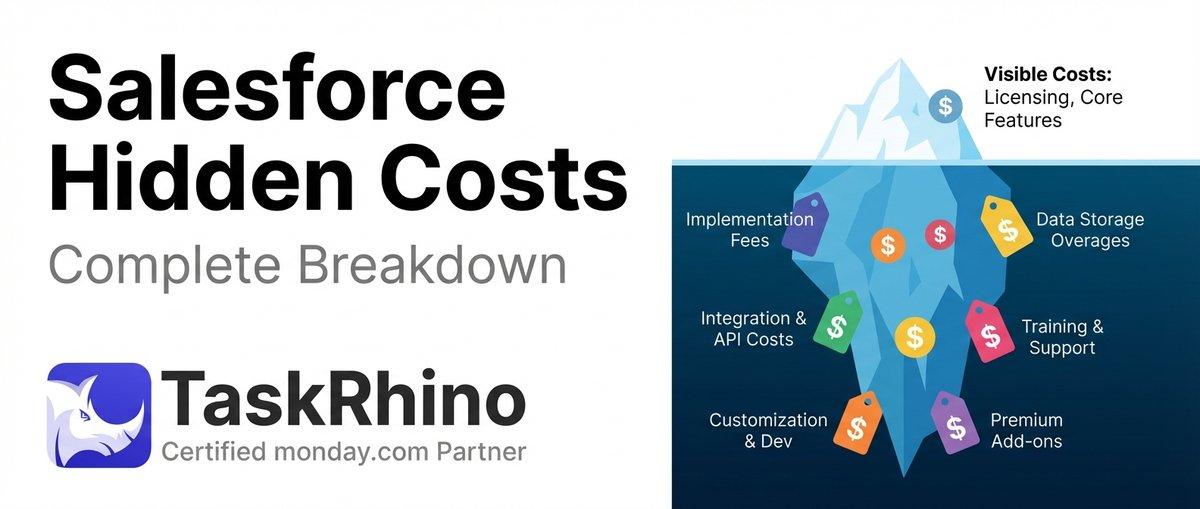
How to Calculate Hidden Costs of Salesforce Admin & Consulting

Twenty CRM vs Salesforce: Full Detailed Comparison
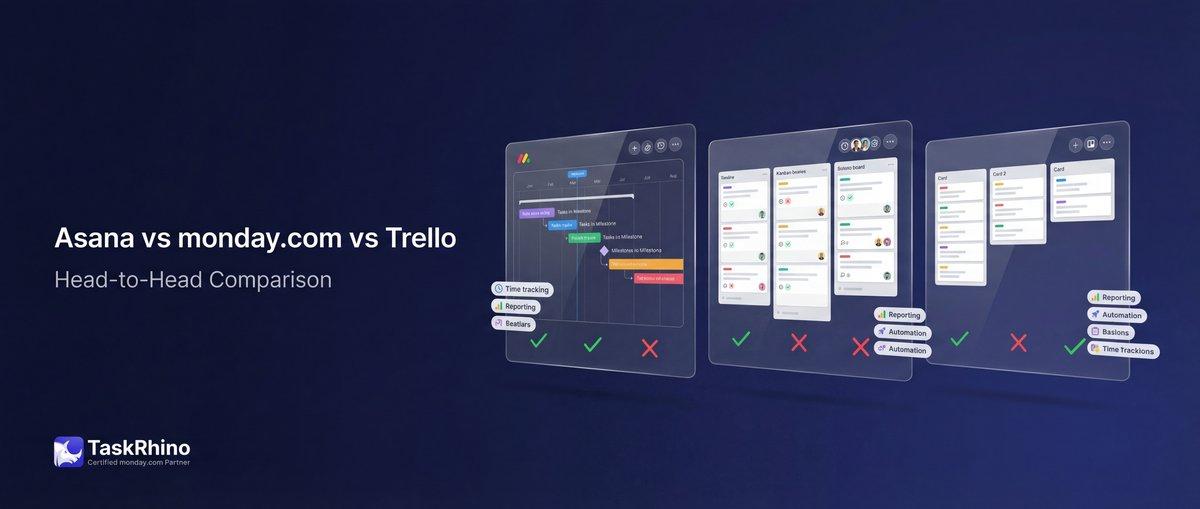
Asana vs monday.com vs Trello 2026: The Bicycle, The Sedan, and The SUV