

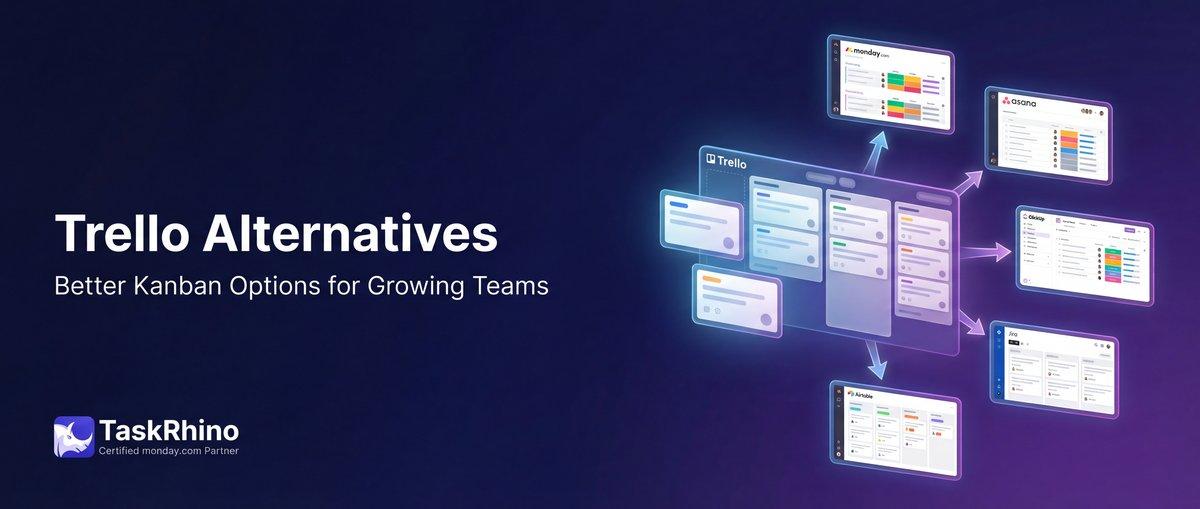
Top 10 Trello Alternatives for 2026: Complete Comparison Guide
If Trello’s basic kanban boards and limited automation are holding your team back, you’re not alone. While Trello works great for simple task tracking, teams scaling beyond 10 people or managing complex workflows quickly hit the ceiling. The good news? There are powerful alternatives that give you everything Trello offers — plus the automation, reporting, and customization features you actually need.
This guide breaks down 7 proven Trello alternatives we’ve tested with real teams across healthcare, finance, legal, and retail. We’ll show you exactly what each tool does well, where it falls short, and which one fits your team’s specific needs. No fluff, just practical comparisons based on hands-on implementation experience with 110+ clients.
Quick Verdict: Which Trello Alternative Is Right for You?
| Tool | Best For | Starting Price | Key Advantage |
|---|---|---|---|
| monday.com | Growing teams needing automation | $9/user/month | ✅ Most flexible views & workflows |
| Asana | Enterprise teams with complex dependencies | $10.99/user/month | ✅ Strongest task dependency tracking |
| ClickUp | Teams wanting all-in-one workspace | $7/user/month | ✅ Most features per dollar |
| Notion | Knowledge + project hybrid teams | $10/user/month | ✅ Best for documentation + tasks |
| Wrike | Marketing & creative agencies | $9.80/user/month | ✅ Advanced proofing & approval workflows |
| Basecamp | Remote teams prioritizing communication | $15/user/month (flat) | ✅ Flat pricing for unlimited users |
| MeisterTask | European teams needing GDPR compliance | €8.25/user/month | ✅ EU-hosted with strict data privacy |
1. monday.com — Best Overall Trello Alternative for Growing Teams
Monday.com transforms Trello’s basic kanban boards into a full operating system for your business. While Trello gives you cards and lists, monday.com gives you 20+ view types, 250+ automation recipes, and the flexibility to build workflows that match how your team actually works — not force your processes into rigid templates.
We moved a 35-person retail operations team from Trello to monday.com last year. Their inventory tracking, vendor management, and seasonal planning workflows that required five separate Trello boards and three Zapier integrations now run on two connected monday.com boards with built-in automations. Setup took two weeks; they’ve saved 8 hours per week on manual status updates ever since.
monday.com Features & Capabilities
| Feature | monday.com | Trello |
|---|---|---|
| Views | Kanban, Gantt, Calendar, Timeline, Map, Form, Chart | Kanban only |
| Automations | ✅ 250+ recipes, custom triggers | ❌ Butler automations (limited) |
| Time tracking | ✅ Built-in with reporting | ❌ Requires power-ups |
| Dependencies | ✅ Full task dependencies | ❌ Basic checklist linking only |
monday.com Pricing (2026)
| Plan | Price | Best For |
|---|---|---|
| Individual | Free | Solo users, up to 2 boards |
| Basic | $9/user/month | Small teams needing unlimited boards |
| Standard | $12/user/month | ✅ Timeline, Gantt, Calendar views |
| Pro | $19/user/month | Advanced automations, time tracking |
Note: 3-seat minimum on paid plans. Annual billing required for Standard and above.
monday.com: Pros & Cons
| ✅ Pros | ❌ Cons |
|---|---|
| Highly customizable board structures | Steeper learning curve than Trello |
| 250+ automation templates out of the box | 3-seat minimum even for small teams |
| 20+ view types for different use cases | Can feel overwhelming initially |
| Robust API for custom integrations | Higher price point than Trello |
Best for: Teams of 10-100 people who’ve outgrown Trello’s simplicity and need automation, multiple project views, and workflow customization without hiring developers.
Skip if: You’re a solo user or team of 2-3 who just needs simple task tracking. Trello or MeisterTask will serve you better at lower cost.
2. Asana — Best for Complex Task Dependencies & Enterprise Workflows
Asana is what you graduate to when your projects have too many moving parts for Trello’s linear boards. While Trello lets you link cards with checklists, Asana gives you true task dependencies — when Task A is delayed, every dependent task automatically shifts. For teams managing multi-phase projects with 20+ stakeholders, this alone justifies the switch.
A healthcare client running patient onboarding workflows across 4 departments moved from Trello to Asana specifically for dependency management. Their 18-step onboarding process (intake → assessment → treatment plan → insurance approval → scheduling) now flows automatically. When insurance approval gets delayed, the entire downstream timeline adjusts without manual rework.
Asana Features & Capabilities
| Feature | Asana | Trello |
|---|---|---|
| Task dependencies | ✅ Full dependency mapping | ❌ Manual workarounds only |
| Workload management | ✅ Team capacity planning | ❌ Not available |
| Portfolio management | ✅ Multi-project dashboards | ❌ Requires third-party tools |
| Custom fields | ✅ Unlimited custom fields | ❌ Limited on free plan |
Asana Pricing (2026)
| Plan | Price | Best For |
|---|---|---|
| Personal | Free | Small teams under 15 |
| Starter | $10.99/user/month | ✅ Timeline, workflow builder |
| Advanced | $24.99/user/month | Portfolios, workload, advanced reporting |
| Enterprise | Custom | Large orgs with SSO & admin controls |
Asana: Pros & Cons
| ✅ Pros | ❌ Cons |
|---|---|
| Best-in-class task dependency tracking | More expensive than most alternatives |
| Clean, intuitive interface | Limited customization vs. monday.com |
| Strong mobile apps (iOS & Android) | Advanced features locked behind higher tiers |
| Excellent for cross-functional collaboration | Storage limits on lower plans |
Best for: Enterprise teams (50+ people) managing complex projects with dependencies, marketing agencies running campaigns with multiple deliverables, or any team where “if X is late, Y needs to shift” happens weekly.
Skip if: Your projects are mostly independent tasks without dependencies, or you’re a small team under 10 people. The dependency features are Asana’s core strength — without needing them, you’re overpaying.
3. ClickUp — Best All-in-One Workspace for Feature-Hungry Teams
ClickUp is the Swiss Army knife of project management. Where Trello does one thing well (kanban boards), ClickUp does everything: tasks, docs, wikis, goals, time tracking, whiteboards, dashboards, and more. It’s positioned as “one app to replace them all” — and for teams willing to invest time in setup, it delivers on that promise.
We set up ClickUp for a SaaS startup that was juggling Trello (tasks), Notion (docs), Google Sheets (reporting), and Harvest (time tracking). After two weeks of migration and training, they consolidated everything into ClickUp. Their team of 18 now manages sprints, writes documentation, tracks OKRs, and invoices clients from a single platform.
ClickUp Features & Capabilities
| Feature | ClickUp | Trello |
|---|---|---|
| Built-in docs | ✅ Full wiki & doc editor | ❌ Requires separate tool |
| Time tracking | ✅ Native with reporting | ❌ Power-up required |
| Custom dashboards | ✅ 50+ widget types | ❌ Basic reporting only |
| Goal tracking | ✅ Built-in OKR system | ❌ Not available |
ClickUp Pricing (2026)
| Plan | Price | Best For |
|---|---|---|
| Free | $0 | Unlimited users, 100MB storage |
| Unlimited | $7/user/month | ✅ Unlimited storage, dashboards |
| Business | $12/user/month | Advanced automations, timelines |
| Enterprise | Custom | White labeling, SSO, dedicated support |
ClickUp AI available as $5/user/month add-on.
ClickUp: Pros & Cons
| ✅ Pros | ❌ Cons |
|---|---|
| Massive feature set for the price | Overwhelming for new users |
| No seat minimums on any plan | Performance can lag with large datasets |
| Generous free plan (unlimited users) | Too many features can create analysis paralysis |
| Highly customizable views and workflows | Requires significant setup time |
Best for: Tech-savvy teams (10-50 people) who want to consolidate 3-5 tools into one platform and are willing to invest 2-3 weeks learning the system. Ideal for startups, dev teams, and digital agencies.
Skip if: You need something simple that your team can adopt in a day. ClickUp’s power comes with complexity — if your team struggles with new software, this will be a tough sell.
See How BoardBridge Handles This Workflow
Book a free demo to see BoardBridge solve this exact problem — live, with your data.
4. Notion — Best for Teams Who Need Documentation + Project Management
Notion isn’t purely a project management tool — it’s a hybrid wiki/database/task manager. While Trello gives you task boards, Notion gives you connected databases, embedded docs, and a knowledge base all in one workspace. For teams who spend as much time documenting decisions as executing tasks, Notion eliminates the context-switching between tools.
A legal consulting firm we worked with runs their entire practice in Notion. Client intake forms feed into case databases, which link to task boards, research notes, and contract templates. Everything’s interconnected — when a case status changes, related tasks, documents, and invoices update automatically through database relations.
Notion Features & Capabilities
| Feature | Notion | Trello |
|---|---|---|
| Database relations | ✅ Link pages, tasks, docs | ❌ Not available |
| Rich docs & wikis | ✅ Full content editor | ❌ Basic descriptions only |
| Templates | ✅ 1,000+ community templates | ✅ Basic board templates |
| Kanban boards | ✅ Database views | ✅ Native functionality |
Notion Pricing (2026)
| Plan | Price | Best For |
|---|---|---|
| Free | $0 | Personal use, unlimited pages |
| Plus | $10/user/month | ✅ Unlimited file uploads, version history |
| Business | $18/user/month | Advanced permissions, bulk export |
| Enterprise | Custom | SAML SSO, advanced security controls |
Notion: Pros & Cons
| ✅ Pros | ❌ Cons |
|---|---|
| Powerful database and relation system | Not built specifically for project management |
| Beautiful, flexible page layouts | Can become messy without structure |
| Excellent for documentation + tasks combined | Slower performance with large workspaces |
| Strong template library and community | Lacks native time tracking or Gantt views |
Best for: Knowledge-work teams (consulting, research, creative agencies) who need both project tracking and robust documentation in one place. Teams transitioning from Confluence + Jira or Trello + Google Docs.
Skip if: You need dedicated project management features like Gantt charts, resource planning, or time tracking. Notion can handle tasks, but it’s not built for PM-first teams.
monday.com vs. Trello: Real Customer Story
The Problem: A 28-person marketing agency was managing client campaigns across 47 Trello boards. Each client had 3-5 boards (strategy, content calendar, design reviews, reporting). Switching between boards killed 45 minutes per day per person. Automations required 12 separate Zapier workflows. Reporting meant manually exporting data from Trello, combining it in spreadsheets, and reformatting for client dashboards.
The Solution: We consolidated their entire operation into monday.com with a hub-and-spoke architecture: one master “Clients” board linked to individual campaign boards. Cross-board automations replaced all Zapier workflows. Client-facing dashboards pulled live data from multiple boards.
The Result: Setup took 3 weeks (board architecture, automations, training, data migration). Within 30 days:
- Daily context-switching reduced by 67% (45 min → 15 min per person)
- Reporting time cut from 4 hours to 25 minutes per client per month
- Client satisfaction scores increased 18% due to real-time dashboard access
- Team capacity increased by 1.5 FTE worth of hours (recovered from admin work)
They still pay $342/month for monday.com vs. $140/month for Trello — but they’ve eliminated $299/month in Zapier costs and recovered 140+ billable hours monthly. The ROI paid back in 6 weeks.
5. Wrike — Best for Marketing Teams & Creative Agencies
Wrike is built for teams who manage campaigns, creative assets, and approval workflows. While Trello can track creative projects, Wrike adds proofing and approval workflows, creative request forms, and real-time collaboration on assets. If your team spends hours emailing PDFs back and forth for feedback, Wrike eliminates that entirely.
Wrike Features & Capabilities
| Feature | Wrike | Trello |
|---|---|---|
| Proofing & approvals | ✅ In-app markup & sign-off | ❌ Requires external tools |
| Creative request forms | ✅ Intake forms with routing | ❌ Basic power-up only |
| Workload view | ✅ Team capacity planning | ❌ Not available |
| Adobe Creative Cloud | ✅ Native integration | ❌ Manual upload only |
Wrike Pricing (2026)
| Plan | Price | Best For |
|---|---|---|
| Free | $0 | 2 users, basic task management |
| Team | $9.80/user/month | ✅ Gantt charts, 2GB storage |
| Business | $24.80/user/month | Proofing, request forms, 5GB storage |
| Enterprise | Custom | Advanced security, unlimited storage |
Wrike: Pros & Cons
| ✅ Pros | ❌ Cons |
|---|---|
| Best-in-class creative proofing workflow | More expensive than Trello/Asana/ClickUp |
| Strong Gantt charts and resource management | Learning curve for non-PM users |
| Excellent Adobe Creative Cloud integration | Limited features on lower-tier plans |
| Custom request forms for intake | Proofing requires Business plan ($24.80/user/month) |
Best for: Marketing teams, creative agencies, and in-house design teams managing 50+ projects per year. The proofing and approval workflow alone justifies the cost if you’re currently emailing files for feedback.
Skip if: You’re not managing creative workflows. Wrike’s core differentiator is proofing — without needing that feature, you’re paying for functionality you won’t use.
6. Basecamp — Best for Remote Teams Prioritizing Communication
Basecamp takes a fundamentally different approach than Trello. Where Trello (and most alternatives) focus on task management, Basecamp focuses on communication and context. Every project is a conversation space with tasks attached — not a task board with comments added. For remote teams drowning in Slack messages and scattered context, Basecamp brings everything into one thread.
Basecamp Features & Capabilities
| Feature | Basecamp | Trello |
|---|---|---|
| Message boards | ✅ Threaded discussions per project | ❌ Card comments only |
| Automatic check-ins | ✅ Scheduled team updates | ❌ Not available |
| Real-time chat | ✅ Campfire (group chat) | ❌ Requires Slack integration |
| Docs & files | ✅ Centralized per project | ❌ Attachments on cards |
Basecamp Pricing (2026)
| Plan | Price | Best For |
|---|---|---|
| Basecamp Free | $0 | 3 projects, 1GB storage |
| Basecamp Pro Unlimited | $15/user/month | ✅ Unlimited projects & users |
| Basecamp Pro (Flat) | $299/month | ✅ Flat pricing for any team size |
Flat pricing option means $299/month whether you have 5 users or 500.
Basecamp: Pros & Cons
| ✅ Pros | ❌ Cons |
|---|---|
| Flat pricing eliminates per-seat cost anxiety | Weak task management vs. alternatives |
| Excellent for async remote communication | No Gantt charts, dependencies, or timelines |
| Simple, clean interface | Limited reporting and analytics |
| Built-in client access (no extra seats) | Not built for complex project workflows |
Best for: Fully remote teams (20-200 people) where communication and alignment are bigger problems than task tracking. Consulting firms, agencies, and distributed teams where conversations matter more than Gantt charts.
Skip if: Your projects require task dependencies, resource planning, or advanced reporting. Basecamp intentionally keeps things simple — which means sacrificing PM features other tools provide.
Need Help With Your monday.com Setup?
TaskRhino has implemented monday.com for 110+ teams. Get a free consultation.
7. MeisterTask — Best for European Teams & GDPR-Compliant Workflows
MeisterTask is Germany-based and EU-hosted, making it the go-to Trello alternative for teams with strict data residency requirements. While feature-wise it’s similar to Trello (kanban boards, automations, integrations), its GDPR compliance and European data hosting set it apart. If your contracts require EU data storage, MeisterTask is one of the few viable options.
MeisterTask Features & Capabilities
| Feature | MeisterTask | Trello |
|---|---|---|
| Data hosting | ✅ EU servers (Frankfurt) | ❌ US-based (AWS) |
| GDPR compliance | ✅ Full compliance & DPA | ⚠️ Compliant but US-hosted |
| Mind mapping integration | ✅ MindMeister native integration | ❌ Requires third-party tools |
| Kanban workflow | ✅ Core feature | ✅ Core feature |
MeisterTask Pricing (2026)
| Plan | Price | Best For |
|---|---|---|
| Basic | Free | Unlimited users, 3 projects |
| Pro | €8.25/user/month | ✅ Unlimited projects, automations |
| Business | €14.50/user/month | Roles, permissions, time tracking |
| Enterprise | Custom | Custom integrations, dedicated support |
MeisterTask: Pros & Cons
| ✅ Pros | ❌ Cons |
|---|---|
| EU-hosted for GDPR compliance | Smaller feature set vs. monday.com/ClickUp |
| Clean, intuitive interface | Limited integrations compared to Trello |
| Strong mind mapping integration | Pricing in EUR only (no USD option) |
| Generous free plan (unlimited users) | Weak reporting and analytics |
Best for: European teams, companies with GDPR/data residency requirements, or organizations specifically seeking EU-based software vendors for compliance reasons.
Skip if: Data hosting location doesn’t matter to you. If you don’t need EU hosting, monday.com, Asana, or ClickUp offer more features at similar or lower prices.
ClickUp Success Story: SaaS Startup Consolidation
The Problem: An 18-person SaaS startup was paying for Trello ($280/month), Notion ($180/month), Harvest time tracking ($216/month), and Google Sheets for reporting. Team members were constantly switching between tools. Time entries didn’t connect to tasks. Documentation lived separately from work. Reporting required manual data pulls from three systems.
The Solution: We migrated everything to ClickUp over two weeks. Their sprint planning, documentation, time tracking, and reporting now live in one workspace. Custom dashboards pull metrics directly from tracked time and completed tasks. Docs embed directly into task views.
The Result:
- Monthly tool costs dropped from $676 to $216 (ClickUp Business plan)
- $460/month saved ($5,520/year)
- Context-switching eliminated — 90% of work happens in ClickUp now
- Time tracking compliance increased from 64% to 91% (easier to track when it’s one click)
- Reporting time reduced by 75% (dashboards auto-update vs. manual exports)
The team spent the first week complaining about “too many features.” By week three, they’d customized ClickUp to match their exact workflow and stopped opening other tools entirely. Two team members even set up personal ClickUp workspaces for side projects.
Asana Success Story: Healthcare Patient Onboarding
The Problem: A 47-person healthcare clinic managed patient onboarding across 4 departments (intake, assessment, insurance, scheduling) using Trello. Their 18-step onboarding process required manual handoffs between boards. When insurance approvals were delayed, downstream tasks had to be manually rescheduled across 3 Trello boards. Team members missed handoffs. Patients experienced scheduling gaps.
The Solution: We rebuilt their workflow in Asana with task dependencies. When “Insurance Approval” is marked complete, “Schedule Initial Appointment” automatically becomes available. When insurance gets delayed, all dependent tasks shift forward automatically. Intake, assessment, insurance, and scheduling teams see one unified timeline.
The Result:
- Patient onboarding time reduced from 14 days to 9 days average
- Scheduling gaps eliminated — dependencies prevent tasks from being missed
- Manual rework reduced by 83% (no more manually updating 18 downstream tasks when one step delays)
- Patient satisfaction scores increased 22% (faster, smoother onboarding experience)
- Staff reported 40% less time spent on “coordination” (finding out what’s blocked, what’s next)
The clinic now handles 30% more new patient intake with the same staff size. Task dependencies weren’t just a “nice feature” — they eliminated the entire category of “coordination overhead” that was killing 6-8 hours per person per week.
Decision Framework: How to Choose Your Trello Alternative
This table helps you pick based on your team’s specific situation and pain points.
| If Your Team… | Choose This | Why |
|---|---|---|
| Needs automation but isn’t technical | monday.com | 250+ pre-built automation recipes require no coding |
| Manages projects with task dependencies | Asana | Best dependency mapping and automatic timeline adjustments |
| Wants to consolidate 3-5 tools into one | ClickUp | All-in-one platform (tasks, docs, time, goals, dashboards) |
| Spends as much time documenting as doing | Notion | Hybrid wiki + database + task manager in one workspace |
| Runs creative approval workflows | Wrike | Built-in proofing with markup, approvals, and Adobe integration |
| Is fully remote and drowning in messages | Basecamp | Communication-first with tasks attached, not vice versa |
| Requires EU data hosting or GDPR compliance | MeisterTask | EU-hosted servers and full GDPR compliance out of the box |
What Features Actually Matter? (Beyond Trello’s Basics)
Before you pick a Trello alternative, understand what features unlock real productivity — not just “nice to have” checkboxes.
Must-Have Features for Teams Over 10 People
| Feature | Why It Matters | Which Tools Have It |
|---|---|---|
| Automation | Eliminates manual status updates, notifications, and handoffs | monday.com, Asana, ClickUp, Wrike |
| Multiple views | Different roles need different views (board, timeline, calendar, list) | monday.com, ClickUp, Asana |
| Task dependencies | Critical for projects where “A must finish before B starts” | Asana, monday.com, Wrike |
| Time tracking | Essential for billing, capacity planning, and reporting | ClickUp, Wrike, monday.com (Pro plan) |
Features That Sound Good But Rarely Get Used
- Whiteboards — Teams excited about this rarely use it after week 2
- Goal tracking — Only valuable if your team already tracks OKRs religiously
- Mind mapping — Nice for brainstorming, but most teams default to doc lists
- Custom fields — Useful, but don’t choose a tool solely for this
Pricing Reality Check: True Cost of Switching from Trello
Don’t just compare list prices. Factor in the full switching cost.
| Cost Category | What Most Teams Miss |
|---|---|
| Tool subscription | Trello: $5-10/user/month → Alternatives: $7-25/user/month |
| Seat minimums | monday.com requires 3 seats minimum even if you have 2 users |
| Add-ons | ClickUp AI ($5/user/month), Wrike proofing (locked behind $24.80/user plan) |
| Integration costs | Zapier/Make workflows may need rebuilding (or be eliminated entirely) |
| Migration time | 1-4 weeks depending on board count, data volume, and automation complexity |
| Training time | 2-10 hours per person for onboarding to new platform |
Switching Cost Example: 15-Person Team
| Item | Trello | monday.com | Difference |
|---|---|---|---|
| Monthly subscription | $150 | $270 | +$120/month |
| Zapier integrations | $50 | $0 | -$50/month |
| Net monthly cost | $200 | $270 | +$70/month |
| One-time migration cost | — | $2,400 | 40 hours @ $60/hour |
| Break-even timeline | — | — | 8 months if saving 5 hours/week |
The math only works if the new tool actually saves time. If you’re switching for features you won’t use, you’re burning money.
Common Migration Mistakes (And How to Avoid Them)
After migrating 110+ teams from Trello to alternatives, these are the mistakes that kill adoption.
❌ Mistake 1: Recreating Trello’s Structure in the New Tool
Why it fails: You’re paying for monday.com/Asana but still thinking in Trello’s limitations. The new tool has features Trello doesn’t — use them.
What to do instead: Rebuild your workflows from scratch based on the new tool’s strengths. Don’t copy-paste board structures.
❌ Mistake 2: Migrating Everything at Once
Why it fails: Trying to move 40 Trello boards, train the entire team, and maintain productivity simultaneously creates chaos.
What to do instead: Pilot with 1-2 teams for 3-4 weeks. Learn the tool, refine the setup, then roll out to others. Use their feedback to prevent repeated mistakes.
❌ Mistake 3: Assuming “Better Features” Means “Instant Adoption”
Why it fails: People resist change even when the new tool is objectively better. If your team was comfortable in Trello, they’ll find reasons not to learn the new system.
What to do instead: Identify 2-3 power users per team. Train them deeply, make them champions, and let them help teammates. Top-down mandates without peer support fail.
❌ Mistake 4: Skipping Automation Setup
Why it fails: You’ve switched to a tool with powerful automation but haven’t set it up. You’re now paying more for features you’re not using.
What to do instead: Build 5-10 core automations in the first week. Status change notifications, recurring task creation, and assignment rules are the quick wins that prove value immediately.
Stop Creating Duplicates
BoardBridge forms update existing items — no Enterprise plan, no workarounds, no duplicates.
Frequently Asked Questions
How do automation capabilities scale across Trello alternatives, and which tools offer the highest action limits for enterprise workflows?
Monday.com provides more extensive automation capabilities with higher action limits compared to Trello, particularly in higher-tier plans, making it better suited for complex enterprise workflows. ClickUp offers automation features but focuses more on proofing and approval workflows with the ability to mark changes or leave comments on up to six uploaded file types. If you’re migrating from Trello specifically because of automation constraints, Monday.com and ClickUp are the strongest candidates, though their automation depth varies by pricing tier.
Which Trello alternatives provide the best integration ecosystems, and how do they compare in terms of native features versus Power-Up equivalents?
Wrike leads with 400+ integrations compared to Asana’s 200 ready-made integrations, while Rock integrates messaging, tasks, notes, and files natively alongside popular apps like Figma, Google Drive, and Zoom without requiring separate Power-Ups. The key distinction is that Rock and Asana bundle collaboration features natively, whereas Trello requires Power-Ups for equivalent functionality, which impacts both complexity and monthly costs for teams.
For teams already invested in Google Workspace, which alternative provides the tightest ecosystem integration without requiring third-party connectors?
Kanbanchi is purpose-built specifically for Google’s ecosystem and integrates seamlessly with Gmail, Google Drive, Calendar, and other Google apps as a native solution. If your team relies heavily on Google Workspace and wants to avoid managing multiple integration layers, Kanbanchi eliminates the friction of connecting through external tools like Zapier.
What’s the real difference in reporting and visualization capabilities between Trello alternatives, and which tools move beyond Kanban boards for complex project visibility?
Monday.com offers advanced views including Gantt, Timeline, and Calendar visualizations that provide detail for complex projects, whereas Trello focuses primarily on boards and cards requiring Power-Ups for similar functionality. Asana, Wrike, and Smartsheet similarly provide Gantt charts and real-time dashboards, making them essential if your projects require timeline-based planning or portfolio-level visibility that Kanban alone cannot deliver.
How do support models differ between Trello and its alternatives, and does this matter for teams without dedicated technical resources?
Awork offers first-class live support with a multilingual team and quick responses via chat, email, or phone with an extensive help center, while Trello relies on community forums and English-speaking support with inherent response time delays. For non-technical teams or those requiring rapid issue resolution, platforms like Awork, ClickUp, and Monday.com provide superior support infrastructure compared to Trello’s community-first model.
Which Trello alternatives best handle the transition from simple task management to agile/scrum methodologies without requiring a platform switch?
Asana, ClickUp, and Monday.com all support Agile methodologies, Gantt charts, and SCRUM boards with built-in reports and analytics, while Taiga is specifically designed for Scrum teams and sprints as an open-source, self-hosted option for developers. If you anticipate evolving from basic task tracking to structured agile workflows, these platforms provide the native methodology support that prevents future migration costs.
Frequently Asked Questions
How do ClickUp’s automation capabilities compare to Monday.com when managing cross-functional workflows at scale?
Monday.com provides more extensive automation capabilities with higher action limits, especially in higher-tier plans, making it better for teams requiring complex, multi-step workflows. However, ClickUp offers automation alongside docs, dashboards, and time tracking in a single platform, so the choice depends on whether you need Monday’s depth of automation or ClickUp’s breadth of integrated features for tool consolidation.
Which Trello alternative offers the best ROI for teams trying to eliminate tool sprawl without breaking the budget?
ClickUp stands out with a ‘free forever’ plan and pricing starting at $7 per user per month, combining tasks, docs, dashboards, automation, time tracking, and goal-setting in one platform. For budget-conscious teams, Notion ($10/month) also offers strong value with kanban boards, knowledge bases, and databases, though it has limited scalability compared to ClickUp.
If we’re migrating from Trello and need enterprise-grade reporting and resource planning, should we choose Wrike or Asana?
Wrike is the better choice for enterprises prioritizing reporting and resource planning capabilities, with pricing starting at $9.80 per user/month and 400+ integrations. Asana excels at overall project management, timelines, and team coordination but has limited reporting features compared to Wrike, making it better suited for teams that need structured workflows over deep resource analytics.
What’s the key technical difference between ClickUp’s and Notion’s kanban implementations for teams with complex task dependencies?
Notion offers a flexible kanban view alongside collaborative wikis and databases but has limited scalability and features, making it less suitable for complex dependency management. ClickUp includes kanban as one of several view options while also providing automation, subtasks, and team chat, giving it superior capability for teams that need to manage intricate task relationships and hierarchies.
For engineering teams specifically, why would Shortcut or Jira be preferable to general-purpose alternatives like Asana?
Shortcut offers built-in hierarchy (Stories, Epics, Objectives), native velocity and progress reports, and deep GitHub/GitLab/Slack integrations specifically designed for software workflows, while Jira provides deep configuration and enterprise-grade reporting tailored to agile development. General-purpose tools like Asana lack the developer-centric features and native code repository integrations that engineering teams require for efficient sprint planning and velocity tracking.
How does customer support quality differ between Trello alternatives, and which should we prioritize if support responsiveness is critical?
Awork offers first-class live support with a multilingual team and quick answers via chat, email, or phone, plus an extensive help center with FAQs, whereas Trello does not offer live support and instead relies on community forums and asynchronous English-speaking support with response delays. For organizations where downtime or implementation issues could impact operations, awork’s real-time support model significantly reduces risk compared to Trello’s community-based approach.


Editor's Choice
2026 Accounting Seed Review: Top Alternatives & Comparisons

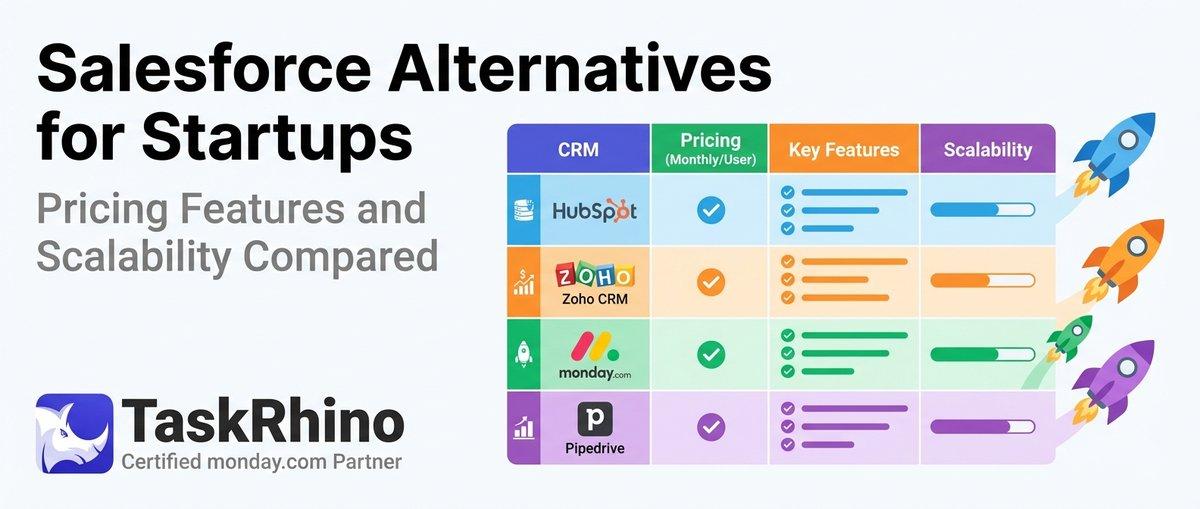
10 Best Salesforce Alternatives for Startups: Pricing, Features & Scalability Compared
10 Best Salesforce Alternatives for Growing SMBs ( Latest Rankings)