

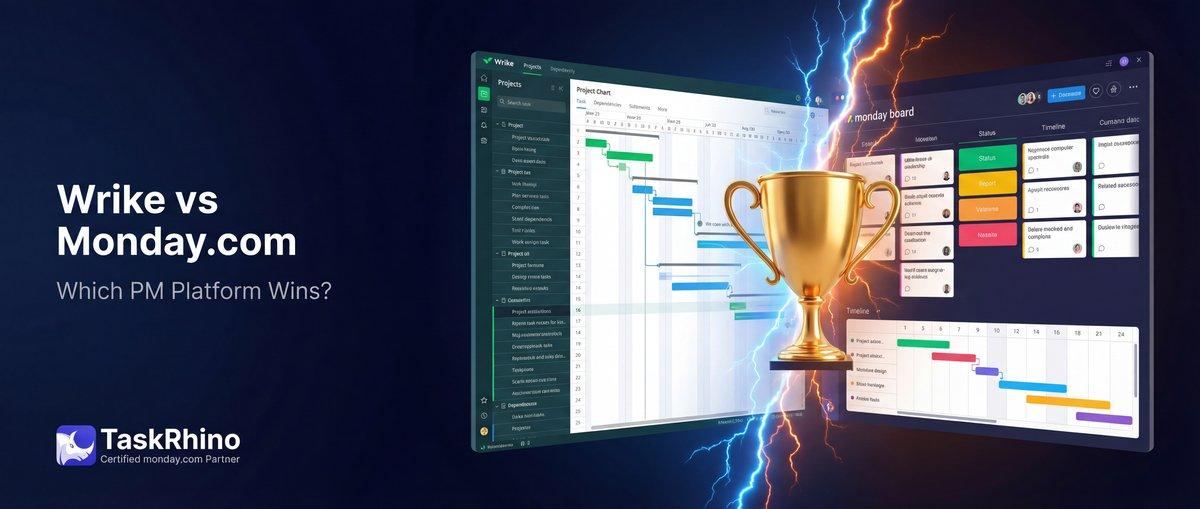
Wrike vs monday.com 2026: Enterprise PM vs Flexible Work OS (Expert Comparison)
Choosing between Wrike and monday.com comes down to one question: do you need enterprise-grade project controls for professional services, or a flexible Work OS that adapts to any workflow? Wrike delivers structured project management with built-in resource planning, proofing workflows, and Gantt charts on all plans. monday.com offers visual flexibility, automation recipes, and a platform that works for project teams and non-PM departments alike.
Both tools handle projects, but they’re built for different teams. Wrike targets agencies, consultancies, and professional services managing complex client work with approval workflows. monday.com serves cross-functional teams that need customizable workflows without the enterprise learning curve.
This comparison breaks down pricing, features, strengths, and ideal use cases so you can pick the right tool for your team in 2026.
Quick Comparison: Wrike vs monday.com at a Glance
| Feature | Wrike | monday.com |
|---|---|---|
| Starting Price | $10/user/month (Team plan) | $9/seat/month (Basic plan) |
| Free Plan | Yes (limited features) | Yes (up to 2 seats, 3 boards) |
| Best For | Agencies, professional services, enterprise PM | Cross-functional teams, flexible workflows, visual management |
| Time Tracking | Built-in on all plans | Add-on column (available on all paid plans) |
| Gantt Charts | All paid plans | Standard plan and above |
| Resource Management | Business plan and above | Enterprise plan only |
| Proofing & Approvals | Built-in visual proofing tool | Basic approvals via status columns |
| Views | 9 views (List, Board, Table, Gantt, Calendar, Workload, Analytics, Files, Stream) | 15+ views (Kanban, Timeline, Gantt, Calendar, Map, Workload, Chart, and more) |
| Automations | Included, usage-based limits | 250 actions/month (Standard), 25K (Pro), 250K (Enterprise) |
| Learning Curve | Steeper, enterprise-focused | Gentler, visual and intuitive |
| Mobile Apps | iOS, Android | iOS, Android |
| Integrations | 400+ native integrations | 200+ integrations via marketplace |
What Is Wrike?
Wrike is an enterprise-focused project management platform built for teams that manage complex, multi-phase projects with strict timelines and resource constraints. Originally designed for professional services, marketing agencies, and engineering teams, Wrike emphasizes control, visibility, and structured workflows.
Key characteristics:
- Top-down structure — Admins define project hierarchies, templates, and workflows. Teams work within predefined structures.
- Built-in time tracking — Every task includes time tracking on all plans, not just enterprise tiers.
- Proofing and approval workflows — Visual markup tools for creative assets, documents, and deliverables. Route work through approval chains with version control.
- Gantt charts and dependencies — Available on all paid plans. Wrike treats dependencies as a core feature, not an upgrade.
- Resource management — View team workload, balance capacity, and allocate hours across projects starting at the Business plan.
Wrike works best when you need detailed project controls, billable hour tracking, and approval workflows for client-facing deliverables.
What Is monday.com?
monday.com is a Work OS — a flexible platform that adapts to project management, CRM, marketing workflows, product development, and operations. Instead of forcing teams into a rigid PM structure, monday.com provides building blocks: boards, columns, automations, and views that teams configure to match their processes.
Key characteristics:
- Visual and flexible — Highly customizable boards with color-coding, drag-and-drop simplicity, and multiple view options.
- Low-code automations — Pre-built automation recipes written in plain language. No scripting required.
- Multiple views — 15+ ways to visualize work: Kanban, Gantt, Timeline, Calendar, Map, Workload, Chart, and more.
- Works beyond PM — Teams use monday.com for sales pipelines, content calendars, hiring workflows, and event planning — not just projects.
- Gentle learning curve — Non-technical users get productive quickly. The interface feels more like a spreadsheet than enterprise software.
monday.com works best when you need a flexible platform that serves multiple departments, adapts to unique workflows, and doesn’t require PM certification to configure.
Pricing Comparison: Wrike vs monday.com
Wrike Pricing (2026)
| Plan | Price | Users | Key Features |
|---|---|---|---|
| Free | $0 | Up to 5 | Basic task management, board and table views, 2GB storage, limited tasks |
| Team | $10/user/month | 2-15 users | Gantt charts, shareable dashboards, custom fields, unlimited tasks, AI Essentials |
| Business | $24.80/user/month | 5-200 users | Resource management, time tracking reports, workflow automation, AI Elite, integrations (min 5 users) |
| Enterprise | Custom pricing | 5-200 users | Advanced resource planning, budgeting, advanced analytics, SSO, compliance controls |
| Pinnacle | Custom pricing | 5+ users | Work Intelligence, advanced security, custom integrations, dedicated success manager |
Wrike paid add-ons:
- Wrike Whiteboard — $15/user/month
- Wrike Integrate — Custom pricing (no-code automation platform)
- Wrike Sync — Custom pricing (bi-directional integrations)
- Wrike Datahub — Custom pricing (advanced data management)
- Wrike Lock — Custom pricing (encryption key management)
Pricing notes:
- Billed annually (monthly billing available at higher cost)
- 14-day free trial on Team and Business plans
- Business plan requires minimum 5 users ($124/month minimum)
Source: Wrike Pricing
monday.com Pricing (2026)
| Plan | Price (10 seats) | Key Features |
|---|---|---|
| Free | $0 | Up to 2 seats, 3 boards, 200+ templates, iOS/Android apps |
| Basic | $9/seat/month ($90/month for 10 seats) | Unlimited free viewers, unlimited items, 5GB storage, 1-board dashboards |
| Standard | $12/seat/month ($120/month for 10 seats) | Timeline & Gantt views, guest access, 250 automations/month, 250 integrations/month, 5-board dashboards |
| Pro | $19/seat/month ($190/month for 10 seats) | Private boards, time tracking, chart view, formula column, 25K automations/month, 20-board dashboards |
| Enterprise | Custom pricing | Advanced AI (monday Copilot), portfolio management, resource management, enterprise automations (250K/month), 50-board dashboards, SSO, advanced security |
Pricing notes:
- Minimum 3 seats on paid plans
- 18% discount when billed annually
- Monthly billing available at full price
- 14-day free trial on Pro plan
- Nonprofit discounts available
Source: monday.com Pricing
Pricing Verdict: Which Is More Affordable?
For small teams (3-10 users): monday.com wins. Basic starts at $9/seat vs. Wrike’s $10/user, and you’re not locked into a 5-user minimum like Wrike’s Business plan.
For mid-sized teams (25-50 users): Wrike becomes competitive if you need resource management and time tracking out of the box. monday.com requires the Enterprise plan for resource management, which jumps to custom pricing. Wrike’s Business plan at $24.80/user includes these features.
For large teams (100+ users): Both require custom pricing at enterprise scale. monday.com’s flexibility may offer better value if you’re using it beyond traditional project management (CRM, operations, marketing). Wrike’s value shines if you need professional services-specific features like budgeting, billable hours, and proofing workflows.
Winner for price: monday.com for small teams and general use. Wrike for professional services teams that need built-in time tracking and resource management.
Feature Comparison: Wrike vs monday.com
Project Views and Visualization
| View Type | Wrike | monday.com |
|---|---|---|
| List View | ✅ Yes | ✅ Yes |
| Board (Kanban) | ✅ Yes | ✅ Yes |
| Table/Grid | ✅ Yes | ✅ Yes |
| Gantt Chart | ✅ All paid plans | ✅ Standard plan and above |
| Timeline View | ✅ Yes | ✅ Yes |
| Calendar | ✅ Yes | ✅ Yes |
| Workload View | ✅ Business plan and above | ✅ Pro plan and above |
| Chart View | ✅ Analytics view | ✅ Pro plan and above |
| Map View | ❌ No | ✅ Yes |
| Files View | ✅ Yes | ✅ Yes |
| Form View | ✅ Request forms | ✅ WorkForms |
| Total Views | 9 core views | 15+ views |
Verdict: monday.com offers more visualization options and flexibility. Wrike provides the essential views for traditional project management but limits advanced views to higher plans. If your team needs multiple ways to see the same data (map views for location tracking, chart views for analytics), monday.com delivers more out of the box.
Time Tracking and Resource Management
| Feature | Wrike | monday.com |
|---|---|---|
| Built-in Time Tracking | ✅ All plans (manual + timer) | ✅ Pro plan (time tracking column) |
| Time Tracking Reports | ✅ Business plan and above | ✅ Custom reports via dashboards |
| Billable vs. Non-Billable Hours | ✅ Business plan and above | ❌ Requires third-party integration |
| Resource Management | ✅ Business plan and above | ✅ Enterprise plan only |
| Workload Balancing | ✅ Business plan and above | ✅ Pro plan (Workload view) |
| Capacity Planning | ✅ Business plan and above | ✅ Enterprise plan only |
| Timesheets | ✅ Enterprise/Pinnacle | ❌ Not native |
Verdict: Wrike dominates for professional services. Time tracking is included on all plans, not locked behind Pro or Enterprise paywalls. Resource management starts at the Business plan ($24.80/user/month), while monday.com reserves it for Enterprise (custom pricing). If your team bills clients by the hour or manages resources across projects, Wrike is purpose-built for this.
monday.com’s time tracking is available on the Pro plan, but it’s less robust. You can track hours, but features like billable/non-billable categorization and detailed resource allocation require workarounds or integrations.
Automations and Workflows
| Feature | Wrike | monday.com |
|---|---|---|
| Automation Builder | ✅ Rule-based, usage limits | ✅ Recipe-based, action limits |
| Pre-built Templates | ✅ Yes | ✅ 200+ automation recipes |
| Automation Limits (Standard/Pro) | Usage-based (varies by plan) | 250/month (Standard), 25K/month (Pro) |
| Conditional Logic | ✅ Yes | ✅ Yes |
| Cross-board Automations | ✅ Yes | ✅ Yes |
| Custom Approval Workflows | ✅ Built-in approval engine | ⚠️ Status-based workflows only |
| Email Automations | ✅ Yes | ✅ Yes |
Verdict: monday.com wins on ease of use. Automations are written in plain language (“When status changes to Done, notify John Doe”) and you can browse 200+ pre-built recipes. Non-technical users configure automations without training.
Wrike’s automation engine is more powerful for complex workflows, especially approval routing. If you need multi-stage approvals with conditional logic (send to legal if value exceeds $10K, otherwise skip), Wrike handles this natively. monday.com achieves similar results but requires more manual setup using status columns and conditional notifications.
For professional services managing approval workflows for client deliverables, Wrike’s purpose-built approval engine is a major advantage.
Proofing and Approvals
| Feature | Wrike | monday.com |
|---|---|---|
| Visual Markup/Annotation | ✅ Built-in proofing tool | ❌ Not native (requires integrations) |
| Approval Workflows | ✅ Dedicated approval feature | ⚠️ Status-based approvals |
| Version Control | ✅ Yes | ✅ Yes (file versioning) |
| Compare Versions | ✅ Side-by-side comparison | ❌ No |
| Client Reviewer Access | ✅ Guest reviewers | ✅ Guest access (Standard plan) |
| Proof Notifications | ✅ Automated reminders | ⚠️ Manual or automation-based |
Verdict: Wrike wins decisively. The built-in proofing tool lets reviewers mark up images, PDFs, and videos directly. You can draw on mockups, leave timestamped comments on videos, and compare versions side-by-side. Approval workflows route creative assets through defined stages with automated notifications.
monday.com handles approvals through status columns (“Pending Approval,” “Approved,” “Needs Revision”). This works for simple workflows but lacks visual markup tools. For marketing agencies, creative teams, and consultancies delivering client-facing assets, Wrike’s proofing capabilities justify the investment.
Integrations and Extensibility
| Integration Type | Wrike | monday.com |
|---|---|---|
| Native Integrations | 400+ | 200+ via monday marketplace |
| Zapier Support | ✅ Yes | ✅ Yes |
| API Access | ✅ All plans | ✅ All plans |
| Slack | ✅ Yes | ✅ Yes |
| Microsoft Teams | ✅ Yes | ✅ Yes |
| Google Workspace | ✅ Yes | ✅ Yes |
| Salesforce | ✅ Yes | ✅ Yes |
| Jira | ✅ Two-way sync (Wrike Sync add-on) | ✅ Via marketplace |
| Adobe Creative Cloud | ✅ Direct integration | ⚠️ Limited support |
| Custom App Development | ✅ Wrike SDK | ✅ monday Apps Framework |
Verdict: Wrike offers more native integrations (400+ vs. 200+), especially for enterprise tools like Adobe Creative Cloud, SAP, and Salesforce. If your team uses Adobe products heavily, Wrike’s direct integrations save time.
monday.com’s marketplace is growing rapidly and includes most popular tools. The monday Apps Framework lets developers build custom apps, and the platform’s flexibility makes it easier to configure integrations without code.
Both platforms integrate well with Slack, Microsoft Teams, Google Workspace, and Zapier for workflow automation.
Collaboration and Communication
| Feature | Wrike | monday.com |
|---|---|---|
| @mentions | ✅ Yes | ✅ Yes |
| Comments and Threads | ✅ Task-level comments | ✅ Item-level and update-level comments |
| File Attachments | ✅ Yes | ✅ Yes |
| Real-time Collaboration | ✅ Yes | ✅ Yes |
| Guest Access | ✅ Yes (all plans) | ✅ Yes (Standard plan and above) |
| External Collaborators | ✅ Unlimited guests | ✅ Guest seats included |
| Activity Feed | ✅ Stream view | ✅ Updates section |
| Email Integration | ✅ Create tasks via email | ✅ Create items via email |
| Document Collaboration | ⚠️ Basic (better via integrations) | ✅ monday Docs (real-time editing) |
Verdict: Tie with slight edge to monday.com. Both platforms handle task-level collaboration well. monday.com’s Updates section creates threaded conversations that feel more like a social feed. The recent addition of monday Docs (real-time document collaboration) makes it easier to draft content, meeting notes, and project briefs without leaving the platform.
Wrike’s Stream view shows activity across projects, which helps teams track what’s changing. For document-heavy collaboration, both platforms work better when integrated with Google Docs or Microsoft 365.
Dashboards and Reporting
| Feature | Wrike | monday.com |
|---|---|---|
| Custom Dashboards | ✅ Team plan and above | ✅ All paid plans (limits vary) |
| Real-time Data | ✅ Yes | ✅ Yes |
| Widgets/Dashboard Blocks | ✅ Multiple widget types | ✅ 30+ widget types |
| Cross-board Dashboards | ✅ Yes | ✅ Yes (board limits by plan) |
| Pre-built Reports | ✅ Yes | ✅ Yes |
| Custom Report Builder | ✅ Analytics view | ✅ Chart view and custom dashboards |
| Export Options | ✅ Excel, CSV, PDF | ✅ Excel, CSV, PDF |
| Scheduled Reports | ✅ Enterprise plan | ✅ Yes (via automations) |
Verdict: monday.com wins on ease of use. The dashboard builder is drag-and-drop, widget library is extensive, and non-technical users create dashboards in minutes. You can combine data from multiple boards (limits vary by plan: 1 board on Basic, 5 on Standard, 20 on Pro, 50 on Enterprise).
Wrike’s dashboards are powerful but require more setup. The Analytics view provides detailed reporting, especially for time tracking, budgets, and resource utilization. For teams that need advanced BI reporting with third-party data (via Wrike Datahub), Wrike delivers enterprise-grade analytics.
If you want dashboards that “just work” without data analysis experience, monday.com is friendlier. If you need deep financial and resource reporting, Wrike provides more depth.
See How BoardBridge Handles This Workflow
Book a free demo to see BoardBridge solve this exact problem — live, with your data.
Use Case Comparison: When to Choose Wrike vs monday.com
When Wrike Is the Better Choice
1. Marketing Agencies and Creative Teams
Wrike’s proofing and approval workflows handle creative reviews without email chains. Designers upload mockups, clients mark them up directly, and approval flows automatically route work through defined stages. Version control ensures everyone reviews the latest draft.
Example: A branding agency manages 15 client projects simultaneously. Each project includes logo concepts, website mockups, and brand guidelines that require client approval. Wrike’s proofing tool lets clients annotate PDFs and videos, eliminating 40+ approval emails per project.
2. Professional Services and Consultancies
Time tracking on all plans, resource management on Business tier, and billable hour tracking make Wrike purpose-built for consultancies. You can track hours, allocate resources across client projects, and generate invoices based on logged time.
Example: A management consultancy tracks billable hours across 8 client engagements. Wrike’s timesheet view shows who’s working on what, flags over-allocated consultants, and generates billable hour reports for invoicing. This level of detail isn’t native to monday.com without enterprise pricing.
3. Engineering and Product Teams with Dependencies
Wrike’s Gantt charts and dependency management come standard on all paid plans. Engineering teams can map complex task dependencies, critical paths, and milestone timelines without upgrading to Pro or Enterprise tiers.
Example: A software development team releases quarterly features with dependencies across design, backend, frontend, and QA. Wrike’s Gantt chart shows the critical path, flags blockers, and recalculates timelines when dependencies shift.
4. Enterprise Teams Needing Strict Governance
Wrike’s top-down structure, role-based permissions, and compliance features (SOC 2, HIPAA, GDPR) make it ideal for regulated industries. Admins control who sees what, lock down sensitive projects, and enforce approval workflows.
Example: A healthcare technology company manages HIPAA-compliant product development. Wrike’s enterprise controls restrict access to patient data projects, enforce approval workflows for regulatory documentation, and provide audit logs for compliance reviews.
When monday.com Is the Better Choice
1. Cross-Functional Teams Using One Platform for Everything
monday.com adapts to project management, CRM, content calendars, event planning, and hiring workflows. Instead of separate tools for each department, teams configure boards that match their unique processes.
Example: A mid-sized SaaS company uses monday.com for product roadmaps, sales pipeline tracking, content calendar management, and customer support ticket routing. The sales team doesn’t need PM training — they build a CRM board with stages that match their sales process.
2. Non-Technical Teams Needing Visual Workflows
monday.com’s color-coded boards, drag-and-drop interface, and visual clarity work for teams that don’t think in Gantt charts and dependencies. Marketing coordinators, HR managers, and operations teams get productive in hours, not weeks.
Example: A retail operations team tracks store openings across 40 locations. Each opening involves 30+ tasks (permits, construction, hiring, inventory). The operations manager builds a board with status colors (red = delayed, green = on track), and store managers update progress without PM training.
3. Teams That Need Flexibility Over Structure
Wrike enforces a top-down project hierarchy. monday.com lets teams structure work however they want — flat task lists, nested groups, linked boards, or a hybrid approach. If your workflows don’t fit traditional PM structures, monday.com adapts.
Example: A nonprofit manages grant applications, volunteer coordination, and fundraising events. These workflows don’t follow standard project templates. monday.com’s flexibility lets them build custom boards for each use case without forcing everything into a project hierarchy.
4. Teams on a Budget That Need Automation
monday.com’s Standard plan ($12/seat/month) includes 250 automations per month and Gantt charts. Wrike’s comparable features require the Business plan ($24.80/user/month). For small teams that need automation and timeline views without enterprise pricing, monday.com delivers more value.
Example: A 12-person digital marketing agency automates client onboarding, status updates, and deadline reminders on monday.com’s Standard plan. The same automation and timeline capabilities on Wrike require the Business plan, which costs more than double.
Need Help With Your monday.com Setup?
TaskRhino has implemented monday.com for 110+ teams. Get a free consultation.
Strengths and Weaknesses: Wrike vs monday.com
Wrike Strengths
- ✅ Built-in time tracking on all plans — No need to upgrade or integrate third-party tools
- ✅ Proofing and approval workflows — Visual markup for creative assets and client deliverables
- ✅ Resource management on Business plan — Capacity planning, workload balancing, and allocation
- ✅ Gantt charts included on all paid plans — Dependencies and critical path without Pro tier
- ✅ Professional services focus — Built for agencies and consultancies managing client work
- ✅ 400+ native integrations — Connects with enterprise tools like Adobe, SAP, and Salesforce
- ✅ Robust API and extensibility — Wrike SDK for custom app development
Wrike Weaknesses
- ❌ Steeper learning curve — Enterprise-focused interface requires more training
- ❌ Higher pricing for mid-tier features — Business plan at $24.80/user/month, 5-user minimum
- ❌ Limited flexibility — Top-down structure doesn’t adapt well to non-PM workflows
- ❌ Fewer views than competitors — 9 views vs. monday.com’s 15+
- ❌ Resource management locked behind Business plan — Can’t balance workload on Team plan
monday.com Strengths
- ✅ Visual and intuitive interface — Color-coded boards, drag-and-drop simplicity
- ✅ 15+ views — More ways to visualize work (Kanban, Gantt, Map, Workload, Chart)
- ✅ Flexible beyond PM — Adapts to CRM, operations, marketing, HR, and more
- ✅ Plain-language automations — 200+ recipes, no scripting required
- ✅ Gentle learning curve — Non-technical users get productive quickly
- ✅ Affordable entry point — Basic plan at $9/seat/month, no minimums
- ✅ monday Docs — Real-time document collaboration built-in
monday.com Weaknesses
- ❌ No built-in proofing tool — Visual markup requires third-party integrations
- ❌ Resource management requires Enterprise plan — Capacity planning locked behind custom pricing
- ❌ Time tracking only on Pro plan — Adds cost for teams needing basic time tracking
- ❌ Fewer native integrations — 200+ vs. Wrike’s 400+
- ❌ Less robust for professional services — No billable/non-billable hours, weaker financial tracking
Wrike vs monday.com: Side-by-Side Ratings
| Category | Wrike | monday.com | Winner |
|---|---|---|---|
| Ease of Use | 3.5/5 | 4.5/5 | monday.com |
| Features | 4.5/5 | 4/5 | Wrike |
| Value for Money | 3.5/5 | 4/5 | monday.com |
| Customization | 4/5 | 4.5/5 | monday.com |
| Integrations | 5/5 | 4/5 | Wrike |
| Time Tracking | 5/5 | 3/5 | Wrike |
| Resource Management | 5/5 | 3/5 | Wrike |
| Automations | 4/5 | 4.5/5 | monday.com |
| Reporting | 4.5/5 | 4/5 | Wrike |
| Mobile Apps | 4/5 | 4/5 | Tie |
| Customer Support | 4/5 | 4/5 | Tie |
| Overall Score | 4.2/5 | 4.1/5 | Close match |
Real-World Scenarios: Wrike vs monday.com
Scenario 1: Digital Marketing Agency (15 people)
Needs: Client project tracking, creative proofing, time tracking for billing, resource allocation across accounts.
Best choice: Wrike Business plan ($24.80/user/month)
- Built-in proofing tool for creative reviews
- Time tracking on all tasks
- Resource management included
- Approval workflows for client deliverables
monday.com alternative: Would require Pro plan ($19/seat/month) for time tracking, but lacks native proofing and approval workflows. Total cost is lower, but missing key features for agency work.
Scenario 2: SaaS Startup (30 people across product, sales, marketing, support)
Needs: Product roadmap, sprint planning, CRM, content calendar, support ticket tracking — all in one platform.
Best choice: monday.com Standard plan ($12/seat/month)
- Flexible enough to handle product, sales, marketing, and support workflows
- Lower cost than Wrike for non-PM use cases
- Automation recipes for cross-department workflows
- Visual interface that non-technical teams adopt quickly
Wrike alternative: Could work for product team, but sales and marketing teams would struggle with PM-focused structure. Likely need separate CRM and marketing tools, increasing total software cost.
Scenario 3: Engineering Team (50 people) Building Complex Software
Needs: Task dependencies, Gantt charts, sprint tracking, integration with Jira and GitHub, detailed reporting.
Best choice: Wrike Business plan or monday.com Pro plan (tie)
- Both offer Gantt charts, dependencies, and integrations with dev tools
- Wrike’s two-way Jira sync (Wrike Sync add-on) vs. monday.com’s Jira integration
- Decision comes down to team preference: structured PM (Wrike) or flexible boards (monday.com)
Scenario 4: Consulting Firm (20 consultants) Managing Client Engagements
Needs: Billable hour tracking, resource allocation across clients, project budgeting, client-facing reports.
Best choice: Wrike Business plan ($24.80/user/month)
- Billable vs. non-billable hour tracking
- Resource management and capacity planning
- Budget tracking per client project
- Time-based invoicing reports
monday.com alternative: Time tracking available on Pro plan, but no native billable/non-billable categorization. Resource management requires Enterprise plan (custom pricing). Wrike delivers consulting-specific features at lower tiers.
Migration and Onboarding: Switching to Wrike or monday.com
Migrating to Wrike
Timeline: 2-4 weeks for mid-sized teams (20-50 users)
Steps:
- Data export — Export tasks, projects, and timelines from current tool (Excel, CSV)
- Workspace setup — Define folder structure, spaces, and project templates
- User training — Wrike recommends 2-3 training sessions for admins and users (steeper learning curve)
- Data import — Use Wrike’s CSV import or API for bulk task creation
- Integration setup — Connect Slack, Microsoft Teams, Google Workspace, and other tools
Support: Wrike offers onboarding assistance on Business plan and above. Free and Team plans rely on self-service resources.
Learning curve: Medium to high. Power users and admins need 1-2 weeks to master project hierarchies, custom fields, and reporting.
Migrating to monday.com
Timeline: 1-2 weeks for mid-sized teams (20-50 users)
Steps:
- Data export — Export tasks and projects from current tool (Excel, CSV)
- Board setup — Create boards, add columns, configure views
- User training — Visual interface requires less formal training. Most users productive in hours.
- Data import — monday.com’s CSV import wizard or Excel sync
- Automation setup — Configure automation recipes using pre-built templates
Support: monday.com offers 24/7 support on all paid plans. Pro and Enterprise plans include onboarding assistance.
Learning curve: Low to medium. Non-technical users get productive within days. Advanced features (formulas, custom dashboards) require more time.
Which Is Easier to Adopt?
Winner: monday.com. The visual interface and drag-and-drop simplicity reduce training time. Teams coming from spreadsheets or Trello transition smoothly. Wrike’s enterprise structure requires more formal onboarding, especially for teams unfamiliar with traditional PM tools.
Alternatives to Consider
If neither Wrike nor monday.com feels like the right fit, consider these alternatives:
For teams wanting monday.com’s flexibility with lower cost:
- ClickUp — Combines PM, docs, and goals in one tool. More features than monday.com, similar flexibility.
- Asana — Clean interface, strong task management, better free plan than monday.com.
For teams wanting Wrike’s PM depth with easier adoption:
- Smartsheet — Spreadsheet-based PM with Gantt charts, resource management, and strong reporting. Easier learning curve than Wrike.
- Teamwork — Built for agencies, includes time tracking, billing, and client management. Less expensive than Wrike.
For teams needing advanced form automation: If your workflows involve forms that update existing items or cross-board automations, learn more about what monday.com can do or explore our comprehensive monday.com review.
Need help configuring workflows or automating processes in monday.com? Contact us for a free consultation — we specialize in monday.com implementations and custom workflow design.
Stop Creating Duplicates
BoardBridge forms update existing items — no Enterprise plan, no workarounds, no duplicates.
Frequently Asked Questions
Which is better for small teams: Wrike or monday.com?
monday.com is better for small teams (3-15 people) due to lower pricing and easier adoption. The Basic plan starts at $9/seat/month with no minimum user requirements. Wrike’s Team plan costs $10/user/month, but the Business plan (which includes resource management) requires 5 users minimum at $24.80/user/month ($124/month minimum). Small teams also benefit from monday.com’s visual interface, which requires less training than Wrike’s enterprise-focused structure.
Does Wrike or monday.com have better time tracking?
Wrike has better time tracking for professional services. Time tracking is built into every task on all plans, not just Pro or Enterprise tiers. Wrike’s Business plan includes billable vs. non-billable hour tracking, timesheets, and time-based reporting for client invoicing. monday.com offers time tracking on the Pro plan, but it’s a column type, not a dedicated time tracker. Billable hour tracking requires workarounds or third-party integrations.
Which tool is better for agencies: Wrike or monday.com?
Wrike is better for marketing and creative agencies managing client work. Built-in proofing and approval workflows let teams mark up creative assets, route work through approval chains, and compare versions side-by-side. Time tracking and resource management (Business plan) help agencies track billable hours and allocate staff across client projects. monday.com works for agencies that don’t need visual proofing and can build custom approval workflows using status columns.
Can you use monday.com for resource management?
Yes, but resource management is only available on monday.com’s Enterprise plan (custom pricing). The Pro plan includes a Workload view that shows task assignments per person, but true capacity planning and resource allocation require Enterprise. Wrike includes resource management on the Business plan ($24.80/user/month), making it more accessible for mid-sized teams.
Which platform has better Gantt charts: Wrike or monday.com?
Both platforms offer Gantt charts, but availability differs by plan. Wrike includes Gantt charts on all paid plans (starting at $10/user/month). monday.com includes Gantt charts on the Standard plan and above ($12/seat/month). Feature-wise, both tools support task dependencies, critical path highlighting, and timeline adjustments. Wrike’s Gantt view is more robust for complex, multi-phase projects, while monday.com’s Timeline view is more visual and easier to configure.
Is monday.com easier to use than Wrike?
Yes. monday.com’s visual, color-coded boards and drag-and-drop interface require less training than Wrike’s enterprise-focused structure. Non-technical users get productive in hours, not days. Wrike’s top-down project hierarchy, custom fields, and folder structures require more setup and training. For teams without dedicated project managers, monday.com’s gentler learning curve reduces onboarding time.
Which tool integrates better with other software?
Wrike offers more native integrations (400+ vs. monday.com’s 200+), especially for enterprise tools like Adobe Creative Cloud, SAP, and Microsoft Project. If your team uses Adobe products heavily, Wrike’s direct integrations save time. monday.com’s marketplace is growing and covers most popular tools (Slack, Microsoft Teams, Google Workspace, Salesforce, Jira). Both platforms support Zapier for custom workflow automation.
Can you manage client projects in both Wrike and monday.com?
Yes, but Wrike is purpose-built for client project management. Features like guest reviewers, proofing workflows, billable hour tracking, and client-facing reports make Wrike ideal for agencies and consultancies. monday.com handles client projects through custom boards, guest access (Standard plan), and status-based workflows. It works well for simpler client engagements but lacks dedicated proofing and approval tools.
Does Wrike or monday.com offer a free plan?
Both offer free plans with limitations. Wrike’s free plan supports up to 5 users with basic task management, board and table views, and 2GB storage. Active task limits apply. monday.com’s free plan supports up to 2 seats, 3 boards, and 200+ templates. For meaningful use, most teams need paid plans: Wrike’s Team plan ($10/user/month) or monday.com’s Basic plan ($9/seat/month).
Which tool is better for remote teams?
Both platforms work well for remote teams with mobile apps (iOS, Android), real-time collaboration, and cloud-based access. monday.com edges ahead with its visual interface and plain-language automations, which reduce the need for synchronous communication. Remote teams without dedicated PM training adopt monday.com faster. Wrike works well for remote teams with structured workflows and defined project hierarchies — common in enterprise and professional services settings.
Final Verdict: Should You Choose Wrike or monday.com?
Choose Wrike if you:
- Manage client projects for agencies, consultancies, or professional services
- Need built-in proofing and approval workflows for creative deliverables
- Track billable hours and require detailed resource management
- Work with complex project dependencies and Gantt chart timelines
- Prefer structured, top-down project hierarchies
- Integrate heavily with enterprise tools (Adobe, SAP, Microsoft Project)
Choose monday.com if you:
- Need a flexible Work OS that adapts to multiple departments (PM, CRM, marketing, operations)
- Want visual, color-coded workflows that non-technical teams adopt quickly
- Require 15+ views to visualize work in different ways (Kanban, Gantt, Map, Workload, Chart)
- Prefer plain-language automations over complex scripting
- Operate with a smaller budget and need automation + Gantt charts on mid-tier pricing
- Value ease of use and fast onboarding over enterprise-grade controls
The bottom line:
Wrike is a project management tool for teams that live in projects. It delivers enterprise-grade controls, time tracking, resource management, and approval workflows that professional services teams need to manage client work and bill accurately.
monday.com is a Work OS that adapts to how your team actually works — whether that’s project management, sales pipelines, content calendars, or cross-functional workflows. It trades enterprise depth for flexibility and ease of use.
For agencies and professional services managing complex client work with approvals, Wrike wins. For cross-functional teams wanting a customizable platform that works beyond traditional PM, monday.com wins.
Need help deciding which tool fits your workflows? Book a free 30-minute consultation and we’ll walk through your team’s needs, compare options, and recommend the best fit. We specialize in monday.com implementations and workflow automation — from setup to advanced customizations.


Editor's Choice
How to Calculate Hidden Costs of Salesforce Admin & Consulting

Twenty CRM vs Salesforce: Full Detailed Comparison
Asana vs monday.com vs Trello 2026: The Bicycle, The Sedan, and The SUV